Swiss Ornithological Institute, Sempach, Switzerland.
PLoS One. 2012;7(2):e30242. doi: 10.1371/journal.pone.0030242. Epub 2012 Feb 1.
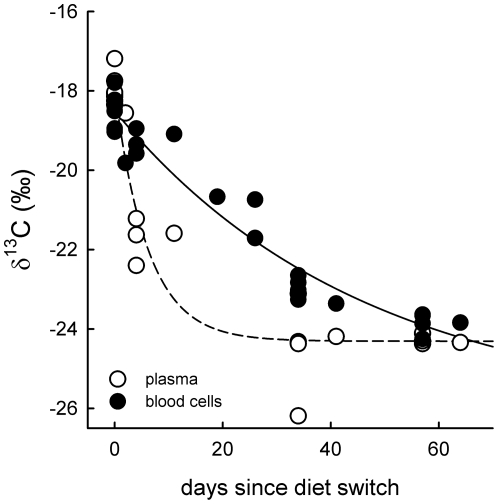
Isotopic discrimination and turn-over are fundamental to the application of stable isotope ecology in animals. However, detailed information for specific tissues and species are widely lacking, notably for herbivorous species. We provide details on tissue-specific carbon and nitrogen discrimination and turn-over times from food to blood, feathers, claws, egg tissues and offspring down feathers in four species of herbivorous waterbirds. Source-to-tissue discrimination factors for carbon (δ¹³C) and nitrogen stable isotope ratios (δ¹⁵N) showed little variation across species but varied between tissues. Apparent discrimination factors ranged between -0.5 to 2.5‰ for δ¹³C and 2.8 to 5.2‰ for δ¹⁵N, and were more similar between blood components than between keratinous tissues or egg tissue. Comparing these results with published data from other species we found no effect of foraging guild on discrimination factors for carbon but a significant foraging-guild effect for nitrogen discrimination factors.Turn-over of δ¹³C in tissues was most rapid in blood plasma, with a half-life of 4.3 d, whereas δ¹³C in blood cells had a half-life of approximately 32 d. Turn-over times for albumen and yolk in laying females were similar to those of blood plasma, at 3.2 and 6.0 d respectively. Within yolk, we found decreasing half-life times of δ¹³C from inner yolk (13.3 d) to outer yolk (3.1 d), related to the temporal pattern of tissue formation.We found similarities in tissue-specific turn-over times across all avian species studied to date. Yet, while generalities regarding discrimination factors and tissue turn-over times can be made, a large amount of variation remains unexplained.
同位素分馏和周转率是稳定同位素生态学在动物中应用的基础。然而,具体组织和物种的详细信息广泛缺乏,尤其是对于食草物种。我们提供了四种食草水鸟的血液、羽毛、爪、卵组织和后代羽绒中食物到血液、羽毛、爪、卵组织和后代羽绒中碳和氮的组织特异性分馏和周转率的详细信息。碳(δ¹³C)和氮稳定同位素比(δ¹⁵N)的源-组织分馏因子在物种间变化不大,但在组织间存在差异。δ¹³C 的表观分馏因子范围为-0.5 至 2.5‰,δ¹⁵N 的表观分馏因子范围为 2.8 至 5.2‰,血液成分之间的差异比角质组织或卵组织之间的差异更为相似。将这些结果与其他物种的已发表数据进行比较,我们发现觅食群体对碳的分馏因子没有影响,但对氮的分馏因子有显著的觅食群体效应。组织中 δ¹³C 的周转率在血液血浆中最快,半衰期为 4.3 天,而血液细胞中的 δ¹³C 半衰期约为 32 天。产卵雌鸟中白蛋白和卵黄的周转率与血浆相似,分别为 3.2 和 6.0 天。在卵黄中,我们发现从内卵黄(13.3 天)到外卵黄(3.1 天)的 δ¹³C 半衰期逐渐缩短,与组织形成的时间模式有关。我们发现,迄今为止研究的所有鸟类物种的组织特异性周转率都存在相似性。然而,虽然可以对分馏因子和组织周转率做出一般性的概括,但仍有大量的变异尚待解释。