Kasamatsu H, Nehorayan A
Proc Natl Acad Sci U S A. 1979 Jun;76(6):2808-12. doi: 10.1073/pnas.76.6.2808.
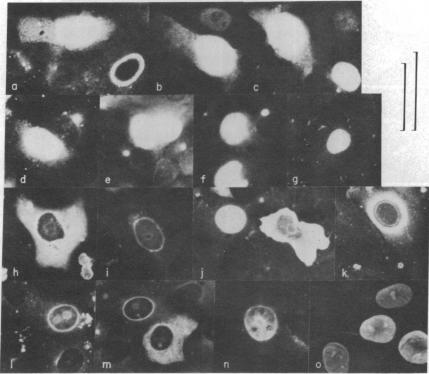
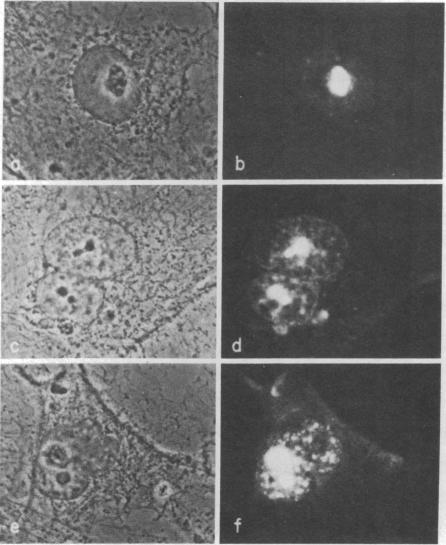
In order to understand the functions of simian virus 40 genes, permissive cells (TC7) were infected with mutants temperature sensitive in the complementation groups A, B, C, BC, and D at permissive and nonpermissive temperatures. Cells were examined for the localization of viral polypeptide antigens by immunofluorescent staining with monospecific antibodies. The results are as follows: (i) The appearance of Vp1 antigen in cells infected by tsB, C, or BC mutants was not affected appreciably by the mutations. (ii) The appearance of Vp3 antigen was affected by the mutations in B, C, or BC. Vp3 antigen is confined to the nuclei in cells infected by wild-type virus. With mutant virus infection, Vp3 antigen is found in the cytoplasm, perinuclear region, and nucleoli. (iii) The tsD mutants and the tsA mutants did not express either Vp1 or Vp3 antigens at the nonpermissive temperature. (iv) Nucleoli seem to play an essential role in the biosynthesis and assembly of viral polypeptides. Thus, mutations in any one of complementation groups B, C, or BC, which are within the structural gene for Vp1, cause an alteration of intracellular distribution of another late gene product, Vp3. These results suggest that the amino acid sequences of Vp1 polypeptide play a role(s) in the transport of viral antigens across internal membranes or in virus assembly processes or in both.
为了了解猴病毒40基因的功能,用在互补组A、B、C、BC和D中对温度敏感的突变体在允许温度和非允许温度下感染允许细胞(TC7)。通过用单特异性抗体进行免疫荧光染色来检查细胞中病毒多肽抗原的定位。结果如下:(i)tsB、C或BC突变体感染的细胞中Vp1抗原的出现未受到突变的明显影响。(ii)Vp3抗原的出现受到B、C或BC突变的影响。Vp3抗原局限于野生型病毒感染的细胞的细胞核中。在突变病毒感染的情况下,Vp3抗原存在于细胞质、核周区域和核仁中。(iii)tsD突变体和tsA突变体在非允许温度下不表达Vp1或Vp3抗原。(iv)核仁似乎在病毒多肽的生物合成和组装中起重要作用。因此,位于Vp1结构基因内的互补组B、C或BC中任何一个的突变都会导致另一种晚期基因产物Vp3的细胞内分布发生改变。这些结果表明,Vp1多肽的氨基酸序列在病毒抗原跨内膜的转运或病毒组装过程中或两者中都发挥作用。