KEMRI-Wellcome Trust Collaborative Research Programme, Centre for Geographic Medicine Research - Coast, PO Box 230, Kilifi 80108, Kenya.
Nat Commun. 2012 Feb 14;3:674. doi: 10.1038/ncomms1672.
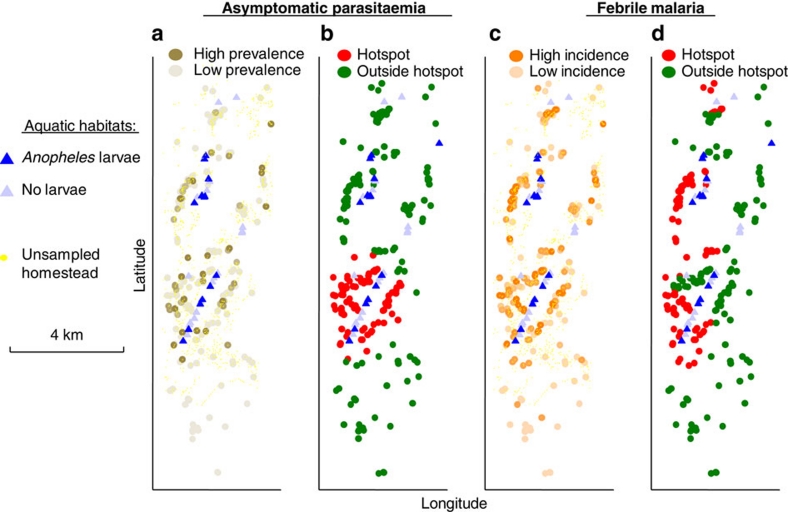
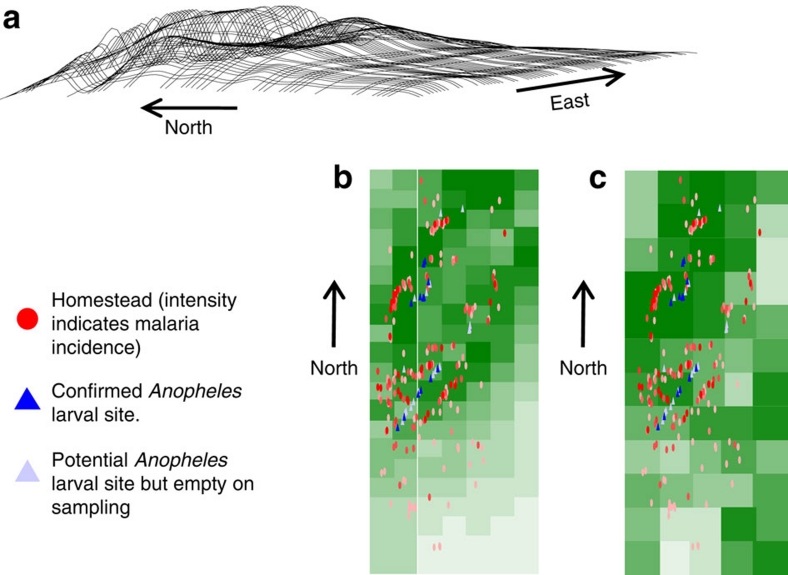
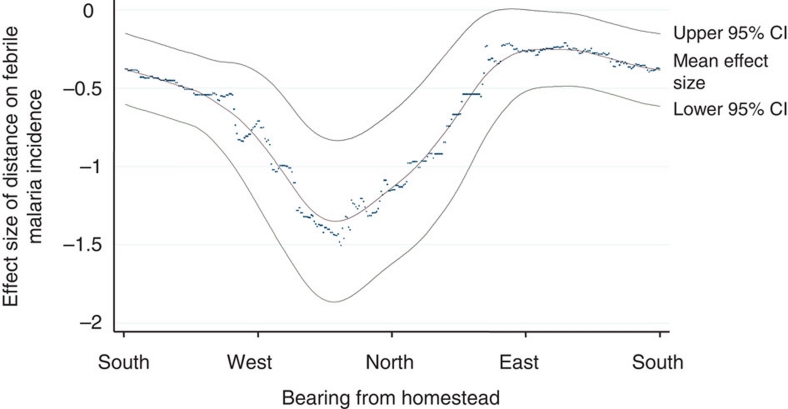
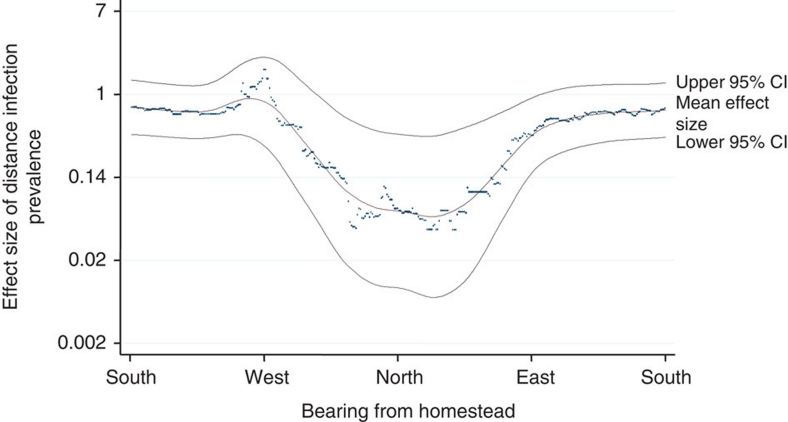
Studies of the fine-scale spatial epidemiology of malaria consistently identify malaria hotspots, comprising clusters of homesteads at high transmission intensity. These hotspots sustain transmission, and may be targeted by malaria-control programmes. Here we describe the spatial relationship between the location of Anopheles larval sites and human malaria infection in a cohort study of 642 children, aged 1-10-years-old. Our data suggest that proximity to larval sites predict human malaria infection, when homesteads are upwind of larval sites, but not when homesteads are downwind of larval sites. We conclude that following oviposition, female Anophelines fly upwind in search for human hosts and, thus, malaria transmission may be disrupted by targeting vector larval sites in close proximity, and downwind to malaria hotspots.
疟疾精细尺度空间流行病学研究一致确定了疟疾热点,包括高传播强度的家庭聚居地集群。这些热点维持着疟疾的传播,可能成为疟疾控制项目的目标。在这里,我们描述了 642 名 1-10 岁儿童队列研究中,疟蚊幼虫孳生地位置与人类疟疾感染之间的空间关系。我们的数据表明,当住家位于幼虫孳生地的上风处时,靠近幼虫孳生地可以预测人类疟疾感染,但当住家位于幼虫孳生地的下风处时则不能。我们的结论是,在产卵之后,雌性疟蚊会顺风飞行寻找人类宿主,因此,通过在疟疾热点的上风处和下风处的临近位置上靶向媒介幼虫孳生地,可能会破坏疟疾的传播。