Cavassini Ana Claudia Molina, Lima Silvana Andréa Molina, Calderon Iracema Mattos Paranhos, Rudge Marilza Vieira Cunha
Faculdade de Medicina de Botucatu, Universidade Estadual Paulista, Botucatu, São Paulo, Brazil.
Sao Paulo Med J. 2012;130(1):17-26. doi: 10.1590/s1516-31802012000100004.
Pregnancies complicated by diabetes are associated with increased numbers of maternal and neonatal complications. Hospital costs increase according to the type of care provided. This study aimed to estimate the cost-benefit relationship and social profitability ratio of hospitalization, compared with outpatient care, for pregnant women with diabetes or mild hyperglycemia.
This was a prospective observational quantitative study conducted at a university hospital. It included all pregnant women with pregestational or gestational diabetes, or mild hyperglycemia, who did not develop clinical intercurrences during pregnancy and who delivered at the Botucatu Medical School Hospital (Hospital das Clínicas, Faculdade de Medicina de Botucatu, HC-FMB) of Universidade Estadual de São Paulo (Unesp).
Thirty pregnant women treated with diet were followed as outpatients, and twenty treated with diet plus insulin were managed through frequent short hospitalizations. Direct costs (personnel, materials and tests) and indirect costs (general expenses) were ascertained from data in the patients' records and the hospital's absorption costing system. The cost-benefit was then calculated.
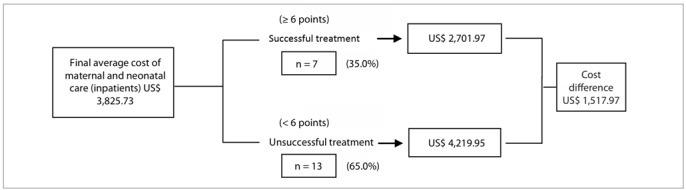
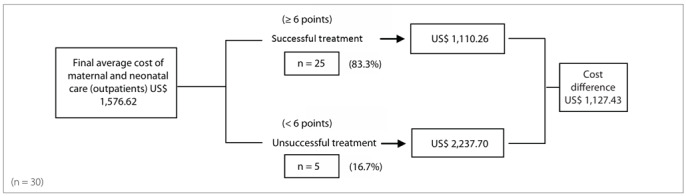
Successful treatment of pregnant women with diabetes avoided expenditure of US$ 1,517.97 and US$ 1,127.43 for patients treated with inpatient and outpatient care, respectively. The cost-benefit of inpatient care was US$ 143,719.16, and outpatient care, US$ 253,267.22, with social profitability of 1.87 and 5.35, respectively.
Decision-tree analysis confirmed that successful treatment avoided costs at the hospital. Cost-benefit analysis showed that outpatient management was economically more advantageous than hospitalization. The social profitability of both treatments was greater than one, thus demonstrating that both types of care for diabetic pregnant women had positive benefits.
糖尿病合并妊娠与孕产妇及新生儿并发症数量增加相关。医院成本会根据所提供的护理类型而增加。本研究旨在评估糖尿病或轻度高血糖孕妇住院治疗与门诊治疗相比的成本效益关系及社会收益率。
这是一项在大学医院进行的前瞻性观察性定量研究。研究对象包括所有患有孕前或孕期糖尿病或轻度高血糖、孕期未发生临床并发疾病且在圣保罗州立大学博图卡图医学院医院(博图卡图临床医院,HC - FMB)分娩的孕妇。
30名接受饮食治疗的孕妇作为门诊患者进行随访,20名接受饮食加胰岛素治疗的孕妇通过频繁短期住院进行管理。直接成本(人员、材料和检查)和间接成本(一般费用)从患者病历数据和医院吸收成本核算系统中确定。然后计算成本效益。
糖尿病孕妇的成功治疗分别为住院治疗和门诊治疗的患者避免了1517.97美元和1127.43美元的支出。住院治疗的成本效益为143719.16美元,门诊治疗为253267.22美元,社会收益率分别为1.87和5.35。
决策树分析证实成功治疗可避免医院成本。成本效益分析表明门诊管理在经济上比住院治疗更具优势。两种治疗的社会收益率均大于1,因此表明这两种糖尿病孕妇护理方式都有积极效益。