School of Psychology and Institute of Neuroscience, Trinity College Dublin Dublin, Ireland.
Front Integr Neurosci. 2012 Feb 1;6:4. doi: 10.3389/fnint.2012.00004. eCollection 2011 Dec 7.
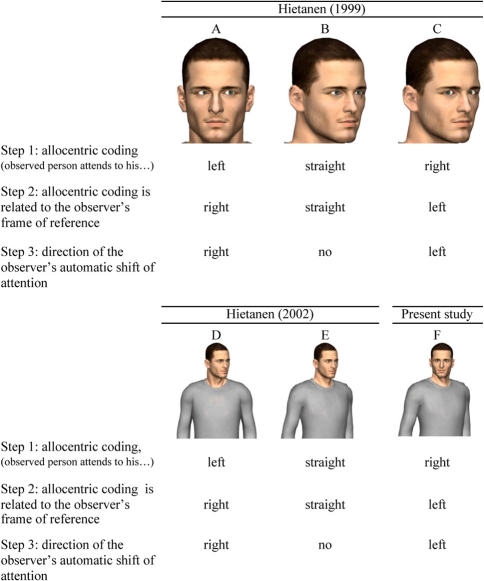
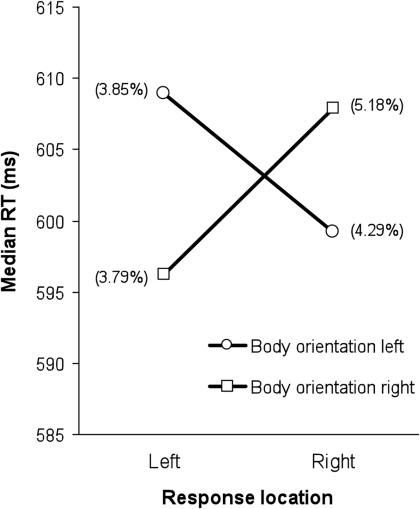
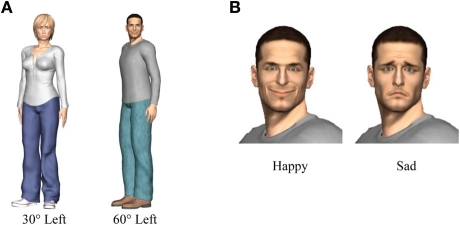
The role of body orientation in the orienting and allocation of social attention was examined using an adapted Simon paradigm. Participants categorized the facial expression of forward facing, computer-generated human figures by pressing one of two response keys, each located left or right of the observers' body midline, while the orientation of the stimulus figure's body (trunk, arms, and legs), which was the task-irrelevant feature of interest, was manipulated (oriented toward the left or right visual hemifield) with respect to the spatial location of the required response. We found that when the orientation of the body was compatible with the required response location, responses were slower relative to when body orientation was incompatible with the response location. In line with a model put forward by Hietanen (1999), this reverse compatibility effect suggests that body orientation is automatically processed into a directional spatial code, but that this code is based on an integration of head and body orientation within an allocentric-based frame of reference. Moreover, we argue that this code may be derived from the motion information implied in the image of a figure when head and body orientation are incongruent. Our results have implications for understanding the nature of the information that affects the allocation of attention for social orienting.
采用改良版的西蒙范式,考察了身体朝向在定向和分配社会注意力中的作用。参与者通过按下两个响应键之一对正脸、计算机生成的人体面部表情进行分类,这两个响应键分别位于观察者身体中线的左侧或右侧,而刺激人物身体的朝向(躯干、手臂和腿部)是感兴趣的任务不相关特征,相对于所需响应的空间位置进行操纵(朝向左侧或右侧视野)。我们发现,当身体的朝向与所需的响应位置相匹配时,响应速度会相对较慢,而当身体的朝向与响应位置不匹配时。与 Hietanen(1999)提出的模型一致,这种反向兼容性效应表明,身体朝向会自动被处理成一个方向性的空间代码,但该代码是基于头和身体朝向在以客体为中心的参照系中的整合。此外,我们认为,当头和身体朝向不一致时,该代码可能源自人物图像中所暗示的运动信息。我们的研究结果对于理解影响社会定向注意力分配的信息的本质具有重要意义。