Cohen Kadosh Roi, Bien Nina, Sack Alexander T
Department of Experimental Psychology, University of Oxford Oxford, UK.
Front Hum Neurosci. 2012 Feb 1;6:2. doi: 10.3389/fnhum.2012.00002. eCollection 2012.
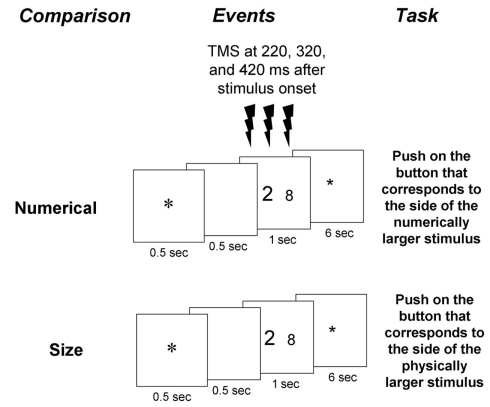
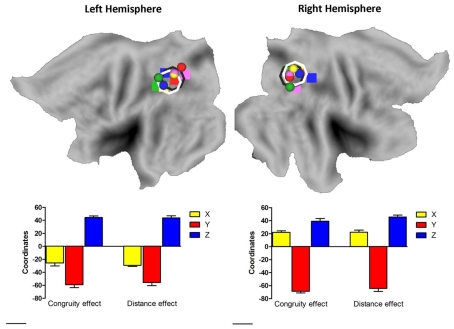
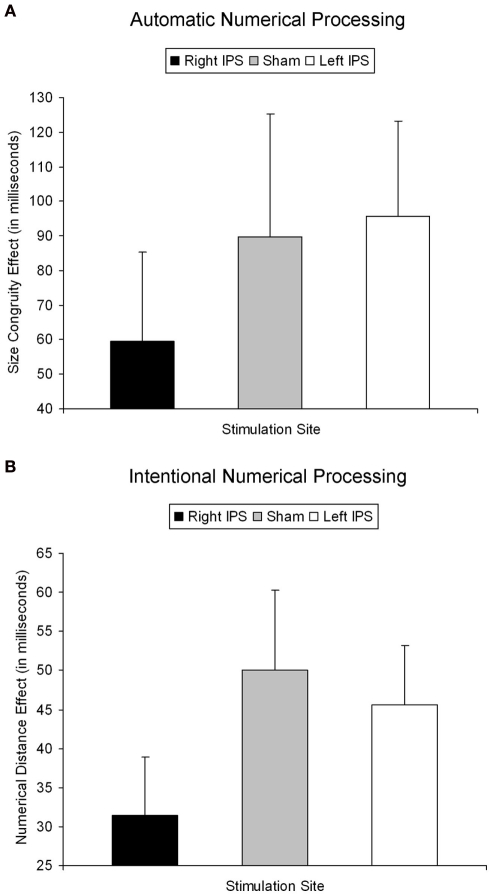
Practice and training usually lead to performance increase in a given task. In addition, a shift from intentional toward more automatic processing mechanisms is often observed. It is currently debated whether automatic and intentional processing is subserved by the same or by different mechanism(s), and whether the same or different regions in the brain are recruited. Previous correlational evidence provided by behavioral, neuroimaging, modeling, and neuropsychological studies addressing this question yielded conflicting results. Here we used transcranial magnetic stimulation (TMS) to compare the causal influence of disrupting either left or right parietal cortex during automatic and intentional numerical processing, as reflected by the size congruity effect and the numerical distance effect, respectively. We found a functional hemispheric asymmetry within parietal cortex with only the TMS-induced right parietal disruption impairing both automatic and intentional numerical processing. In contrast, disrupting the left parietal lobe with TMS, or applying sham stimulation, did not affect performance during automatic or intentional numerical processing. The current results provide causal evidence for the functional relevance of right, but not left, parietal cortex for intentional, and automatic numerical processing, implying that at least within the parietal cortices, automatic, and intentional numerical processing rely on the same underlying hemispheric lateralization.
练习和训练通常会使特定任务的表现得到提升。此外,常可观察到从有意加工机制向更自动化加工机制的转变。目前,关于自动加工和有意加工是由相同机制还是不同机制支持,以及大脑中是否募集相同或不同区域,仍存在争议。此前行为学、神经影像学、建模和神经心理学研究针对此问题提供的相关证据得出了相互矛盾的结果。在此,我们使用经颅磁刺激(TMS)分别通过大小一致性效应和数字距离效应,比较在自动和有意数字加工过程中干扰左或右顶叶皮层的因果影响。我们发现顶叶皮层内存在功能半球不对称性,仅经颅磁刺激诱发的右顶叶干扰会损害自动和有意数字加工。相比之下,经颅磁刺激干扰左顶叶或施加伪刺激,在自动或有意数字加工过程中均不影响表现。当前结果为右顶叶皮层而非左顶叶皮层对有意和自动数字加工的功能相关性提供了因果证据,这意味着至少在顶叶皮层内,自动和有意数字加工依赖于相同的潜在半球侧化。