EMPRES Wildlife Unit, Emergency Centre for Transboundary Animal Diseases, Animal Production and Health Division, Food and Agriculture Organization of the United Nations, Rome, Italy.
PLoS One. 2012;7(2):e30636. doi: 10.1371/journal.pone.0030636. Epub 2012 Feb 7.
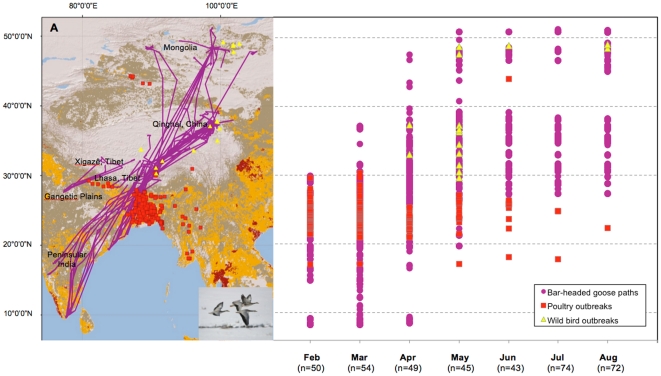
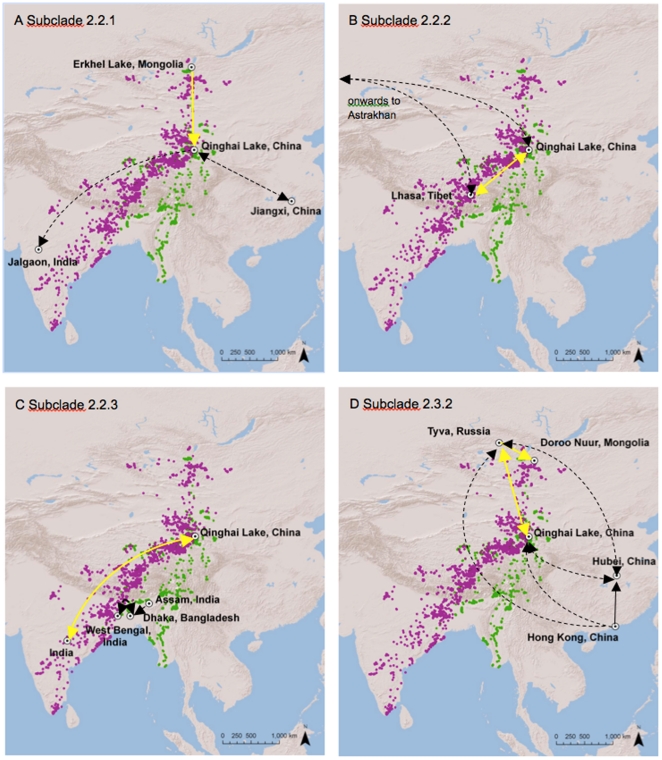
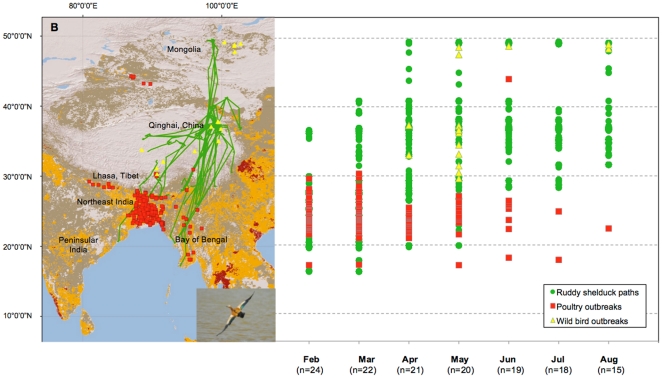
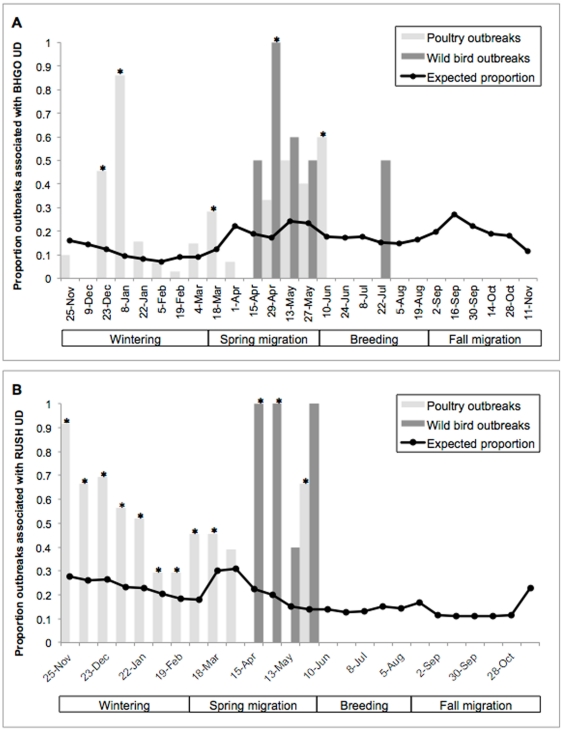
A unique pattern of highly pathogenic avian influenza (HPAI) H5N1 outbreaks has emerged along the Central Asia Flyway, where infection of wild birds has been reported with steady frequency since 2005. We assessed the potential for two hosts of HPAI H5N1, the bar-headed goose (Anser indicus) and ruddy shelduck (Tadorna tadorna), to act as agents for virus dispersal along this 'thoroughfare'. We used an eco-virological approach to compare the migration of 141 birds marked with GPS satellite transmitters during 2005-2010 with: 1) the spatio-temporal patterns of poultry and wild bird outbreaks of HPAI H5N1, and 2) the trajectory of the virus in the outbreak region based on phylogeographic mapping. We found that biweekly utilization distributions (UDs) for 19.2% of bar-headed geese and 46.2% of ruddy shelduck were significantly associated with outbreaks. Ruddy shelduck showed highest correlation with poultry outbreaks owing to their wintering distribution in South Asia, where there is considerable opportunity for HPAI H5N1 spillover from poultry. Both species showed correlation with wild bird outbreaks during the spring migration, suggesting they may be involved in the northward movement of the virus. However, phylogeographic mapping of HPAI H5N1 clades 2.2 and 2.3 did not support dissemination of the virus in a northern direction along the migration corridor. In particular, two subclades (2.2.1 and 2.3.2) moved in a strictly southern direction in contrast to our spatio-temporal analysis of bird migration. Our attempt to reconcile the disciplines of wild bird ecology and HPAI H5N1 virology highlights prospects offered by both approaches as well as their limitations.
沿中亚候鸟迁徙路线出现了一种独特的高致病性禽流感(HPAI)H5N1 暴发模式,自 2005 年以来,该路线的野生鸟类持续受到感染。我们评估了两种 HPAI H5N1 的宿主,即斑头雁(Anser indicus)和赤颈鸭(Tadorna tadorna),在这条“通道”上充当病毒传播媒介的潜力。我们采用生态病毒学方法,比较了 2005 年至 2010 年间用 GPS 卫星发射机标记的 141 只鸟类的迁徙情况:1)与 HPAI H5N1 家禽和野生鸟类暴发的时空模式;2)基于系统地理学绘图的病毒在暴发地区的轨迹。我们发现,19.2%的斑头雁和 46.2%的赤颈鸭的两周利用分布(UD)与暴发有显著关联。由于赤颈鸭在南亚越冬,而南亚是 HPAI H5N1 从家禽溢出的机会相当大,因此它们与家禽暴发的相关性最高。这两个物种在春季迁徙期间与野生鸟类暴发相关,这表明它们可能参与了病毒的北移。然而,HPAI H5N1 谱系 2.2 和 2.3 的系统地理学绘图并不支持病毒沿着迁徙走廊向北传播。特别是,两个亚谱系(2.2.1 和 2.3.2)呈严格的向南移动,与我们对鸟类迁徙的时空分析相反。我们试图协调野生鸟类生态学和 HPAI H5N1 病毒学的学科,突出了这两种方法的前景及其局限性。