Department of Psychology, Center for Collaborative Neuroscience, Rutgers University, Piscataway, New Jersey, United States of America.
PLoS One. 2012;7(2):e31375. doi: 10.1371/journal.pone.0031375. Epub 2012 Feb 10.
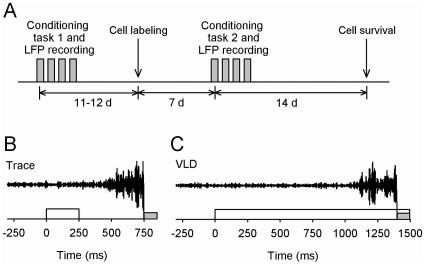
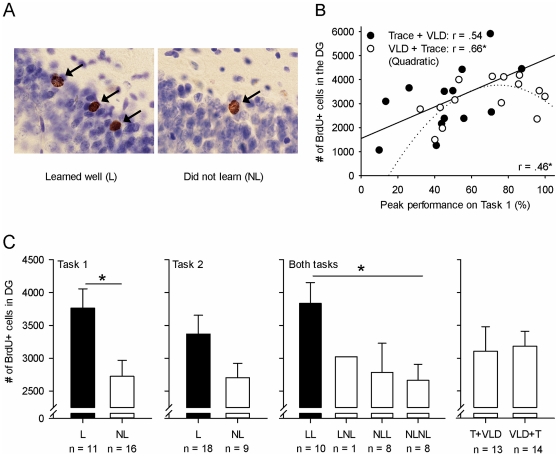
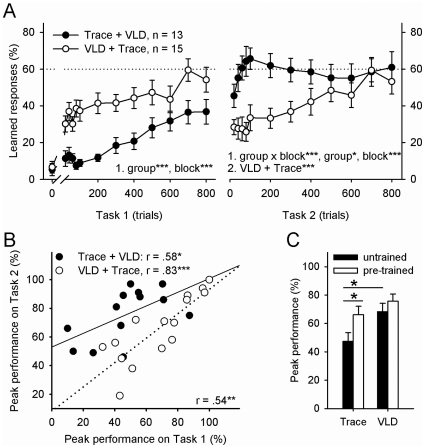
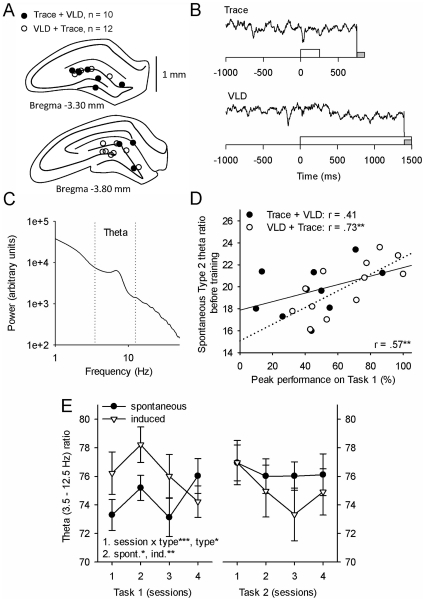
Animals in the natural world continuously encounter learning experiences of varying degrees of novelty. New neurons in the hippocampus are especially responsive to learning associations between novel events and more cells survive if a novel and challenging task is learned. One might wonder whether new neurons would be rescued from death upon each new learning experience or whether there is an internal control system that limits the number of cells that are retained as a function of learning. In this experiment, it was hypothesized that learning a task that was similar in content to one already learned previously would not increase cell survival. We further hypothesized that in situations in which the cells are rescued hippocampal theta oscillations (3-12 Hz) would be involved and perhaps necessary for increasing cell survival. Both hypotheses were disproved. Adult male Sprague-Dawley rats were trained on two similar hippocampus-dependent tasks, trace and very-long delay eyeblink conditioning, while recording hippocampal local-field potentials. Cells that were generated after training on the first task were labeled with bromodeoxyuridine and quantified after training on both tasks had ceased. Spontaneous theta activity predicted performance on the first task and the conditioned stimulus induced a theta-band response early in learning the first task. As expected, performance on the first task correlated with performance on the second task. However, theta activity did not increase during training on the second task, even though more cells were present in animals that had learned. Therefore, as long as learning occurs, relatively small changes in the environment are sufficient to increase the number of surviving neurons in the adult hippocampus and they can do so in the absence of an increase in theta activity. In conclusion, these data argue against an upper limit on the number of neurons that can be rescued from death by learning.
自然界中的动物不断遇到不同程度新颖性的学习体验。海马体中的新神经元对新颖事件与更多细胞的学习关联特别敏感,如果学习到新颖而具有挑战性的任务,这些细胞就会存活下来。人们可能会想,新神经元是否会在每次新的学习体验中免于死亡,或者是否存在一种内部控制系统,根据学习的情况限制保留的细胞数量。在这个实验中,我们假设学习内容与之前已经学习过的任务相似的任务不会增加细胞存活率。我们进一步假设,在细胞被挽救的情况下,海马体θ 振荡(3-12 Hz)将参与其中,并且可能是增加细胞存活率所必需的。这两个假设都被证明是错误的。成年雄性 Sprague-Dawley 大鼠在两个类似的海马体依赖性任务(痕迹和超长延迟眨眼条件反射)上接受训练,同时记录海马体局部场电位。在第一个任务训练后产生的细胞用溴脱氧尿苷标记,并在两个任务的训练结束后进行量化。训练后自发θ 活动预测了第一个任务的表现,而条件刺激在第一个任务的早期学习中引起了θ 频段的反应。正如预期的那样,第一个任务的表现与第二个任务的表现相关。然而,即使在已经学习过的动物中,第二个任务的训练过程中并没有增加 θ 活动。因此,只要学习发生,环境的相对较小变化足以增加成年海马体中存活神经元的数量,而且它们可以在没有 θ 活动增加的情况下做到这一点。总之,这些数据表明,学习可以挽救的神经元数量没有上限。