ENVIRON International Corporation, Amherst, Massachusetts, United States of America.
PLoS One. 2012;7(2):e31521. doi: 10.1371/journal.pone.0031521. Epub 2012 Feb 14.
Osteoarthritis of the hip (OA) is a common degenerative disorder of the joint cartilage that presents a major public health problem worldwide. While intrinsic risk factors (e.g, body mass and morphology) have been identified, external risk factors are not well understood. In this systematic review, the evidence for workload as a risk factor for hip OA is summarized and used to derive recommendations for prevention and further research.
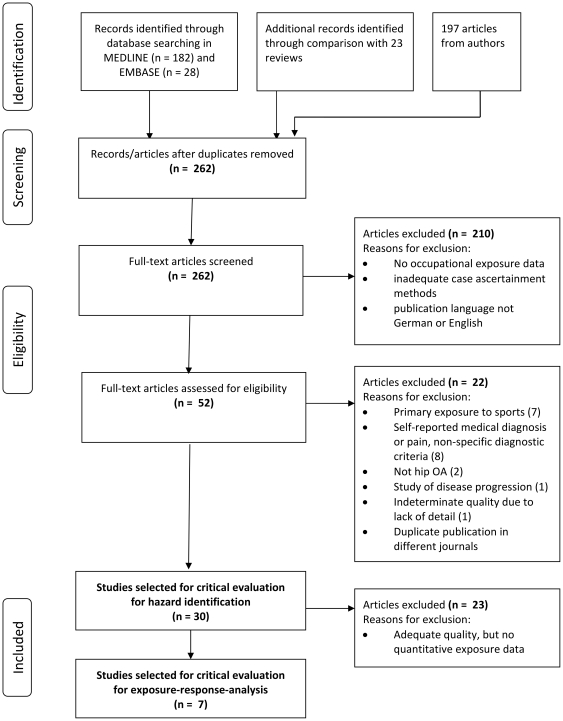
Epidemiological studies on workload or occupation and osteoarthritis of the hip were identified through database and bibliography searches. Using pre-defined quality criteria, 30 studies were selected for critical evaluation; six of these provided quantitative exposure data.
Study results were too heterogeneous to develop pooled risk estimates by specific work activities. The weight of evidence favors a graded association between long-term exposure to heavy lifting and risk of hip OA. Long-term exposure to standing at work might also increase the risk of hip OA.
It is not possible to estimate a quantitative dose-response relationship between workload and hip OA using existing data, but there is enough evidence available to identify job-related heavy lifting and standing as hazards, and thus to begin developing recommendations for preventing hip OA by limiting the amount and duration of these activities. Future research to identify specific risk factors for work-related hip OA should focus on implementing rigorous study methods with quantitative exposure measures and objective diagnostic criteria.
髋关节骨关节炎(OA)是一种常见的关节软骨退行性疾病,是全球范围内的一个主要公共卫生问题。虽然已经确定了内在的危险因素(例如,体重和形态),但对外在危险因素还了解甚少。在这项系统综述中,总结了工作负荷作为髋关节 OA 危险因素的证据,并用于为预防和进一步研究提供建议。
通过数据库和文献检索,确定了关于工作量或职业与髋关节骨关节炎的流行病学研究。使用预先定义的质量标准,选择了 30 项研究进行批判性评估;其中有 6 项提供了定量的暴露数据。
研究结果差异太大,无法根据特定的工作活动来制定汇总风险估计值。证据表明,长期接触重负荷与髋关节 OA 风险之间存在分级关联。长期站立工作也可能增加髋关节 OA 的风险。
使用现有数据无法估计工作负荷与髋关节 OA 之间的定量剂量-反应关系,但现有证据足以确定与工作相关的重负荷和站立是危险因素,从而开始制定建议,通过限制这些活动的数量和持续时间来预防髋关节 OA。未来研究应侧重于采用具有定量暴露测量和客观诊断标准的严格研究方法,以确定与工作相关的髋关节 OA 的具体危险因素。