Centre for Environmental and Climate Research, Lund University, Lund, Sweden.
PLoS One. 2012;7(2):e31599. doi: 10.1371/journal.pone.0031599. Epub 2012 Feb 15.
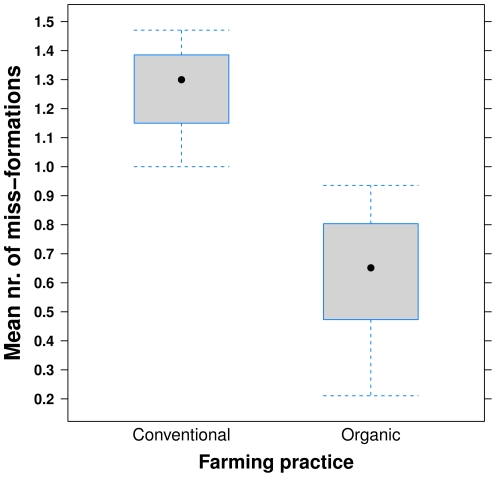
Pollination of insect pollinated crops has been found to be correlated to pollinator abundance and diversity. Since organic farming has the potential to mitigate negative effects of agricultural intensification on biodiversity, it may also benefit crop pollination, but direct evidence of this is scant. We evaluated the effect of organic farming on pollination of strawberry plants focusing on (1) if pollination success was higher on organic farms compared to conventional farms, and (2) if there was a time lag from conversion to organic farming until an effect was manifested. We found that pollination success and the proportion of fully pollinated berries were higher on organic compared to conventional farms and this difference was already evident 2-4 years after conversion to organic farming. Our results suggest that conversion to organic farming may rapidly increase pollination success and hence benefit the ecosystem service of crop pollination regarding both yield quantity and quality.
授粉昆虫授粉作物已被发现与传粉者丰度和多样性相关。由于有机农业有可能减轻农业集约化对生物多样性的负面影响,它也可能有利于作物授粉,但直接证据很少。我们评估了有机农业对草莓植物授粉的影响,重点关注(1)与传统农场相比,有机农场的授粉成功率是否更高,以及(2)从转换到有机农业到表现出效果之间是否存在时间滞后。我们发现,与传统农场相比,有机农场的授粉成功率和完全授粉浆果的比例更高,这种差异在转换为有机农业后 2-4 年内就已经显现。我们的结果表明,转换为有机农业可能会迅速提高授粉成功率,从而有益于作物授粉的生态系统服务,无论是在产量数量还是质量方面。