Hirosaki University, Graduate School of Health Sciences, 66-1 Hon-cho, Hirosaki, Aomori 036-8564, Japan.
Sci Rep. 2011;1:87. doi: 10.1038/srep00087. Epub 2011 Sep 7.
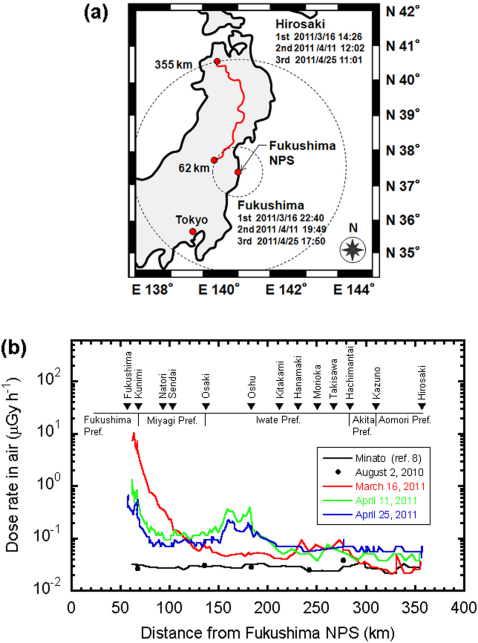
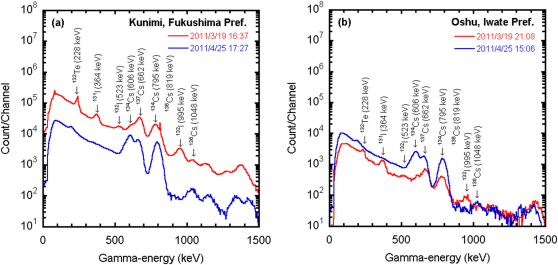
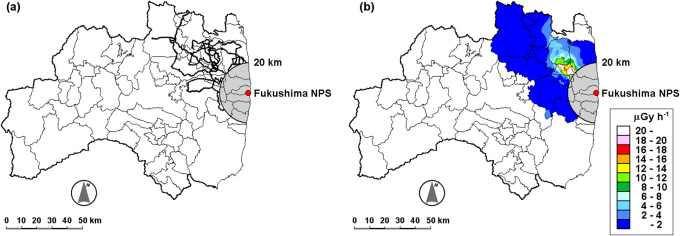
A car-borne survey for dose rate in air was carried out in March and April 2011 along an expressway passing northwest of the Fukushima Dai-ichi Nuclear Power Station which released radionuclides starting after the Great East Japan Earthquake on March 11, 2011, and in an area closer to the Fukushima NPS which is known to have been strongly affected. Dose rates along the expressway, i.e. relatively far from the power station were higher after than before March 11, in some places by several orders of magnitude, implying that there were some additional releases from Fukushima NPS. The maximum dose rate in air within the high level contamination area was 36 μGy h⁻¹, and the estimated maximum cumulative external dose for evacuees who came from Namie Town to evacuation sites (e.g. Fukushima, Koriyama and Nihonmatsu Cities) was 68 mSv. The evacuation is justified from the viewpoint of radiation protection.
2011 年 3 月至 4 月,沿著 2011 年 3 月 11 日日本东海岸大地震后开始释放放射性核素的福岛第一核电站西北方向的一条高速公路,以及靠近已知受强烈影响的福岛核电厂的区域,进行了车载空气剂量率调查。沿著高速公路,即离电站相对较远的地方,3 月 11 日之后的剂量率比之前高,在某些地方高出几个数量级,这表明福岛核电厂有一些额外的放射性物质释放。高污染区空气的最大剂量率为 36μGy h⁻¹,从浪江町撤离到撤离点(如福岛、郡山和二本松市)的撤离人员估计最大累计外照射剂量为 68mSv。从辐射防护的角度来看,撤离是合理的。