Sci Rep. 2012;2:239. doi: 10.1038/srep00239. Epub 2012 Jan 30.
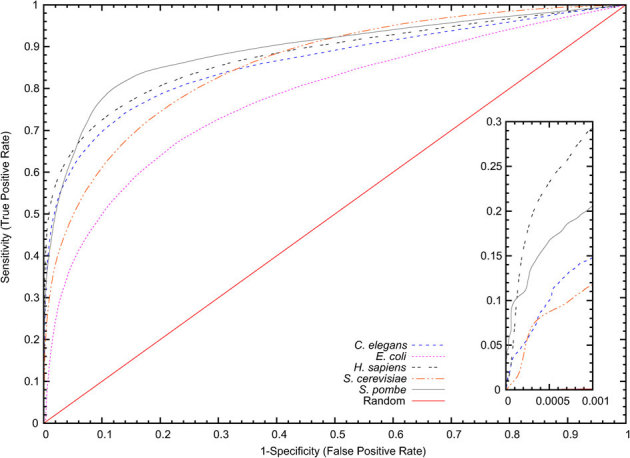
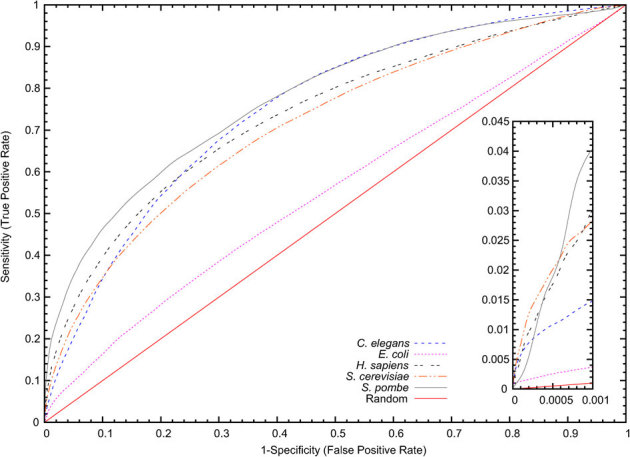
A goal of the post-genomics era has been to elucidate a detailed global map of protein-protein interactions (PPIs) within a cell. Here, we show that the presence of co-occurring short polypeptide sequences between interacting protein partners appears to be conserved across different organisms. We present an algorithm to automatically generate PPI prediction method parameters for various organisms and illustrate that global PPIs can be predicted from previously reported PPIs within the same or a different organism using protein primary sequences. The PPI prediction code is further accelerated through the use of parallel multi-core programming, which improves its usability for large scale or proteome-wide PPI prediction. We predict and analyze hundreds of novel human PPIs, experimentally confirm protein functions and importantly predict the first genome-wide PPI maps for S. pombe (∼9,000 PPIs) and C. elegans (∼37,500 PPIs).
后基因组时代的目标之一是阐明细胞内蛋白质-蛋白质相互作用(PPIs)的详细全球图谱。在这里,我们表明,在不同的生物体中,相互作用的蛋白质伴侣之间存在共现的短多肽序列似乎是保守的。我们提出了一种算法,可以自动为不同的生物体生成 PPI 预测方法参数,并说明可以使用蛋白质一级序列从同一或不同生物体中先前报道的 PPI 来预测全局 PPIs。通过使用并行多核编程进一步加速 PPI 预测代码,提高了其在大规模或全蛋白质组 PPI 预测中的可用性。我们预测和分析了数百种新型人类 PPI,实验验证了蛋白质功能,并重要的是预测了 S. pombe(约 9000 个 PPI)和 C. elegans(约 37500 个 PPI)的第一个全基因组 PPI 图谱。