Aix-Marseille-Université, Unité de Recherche sur les Maladies Infectieuses et Tropicales Émergentes (URMITE), CNRS-IRD-INSERM UMR 6236, Méditerranée Infection, Faculté de Médecine et de Pharmacie, Marseille, France.
PLoS One. 2012;7(2):e31676. doi: 10.1371/journal.pone.0031676. Epub 2012 Feb 16.
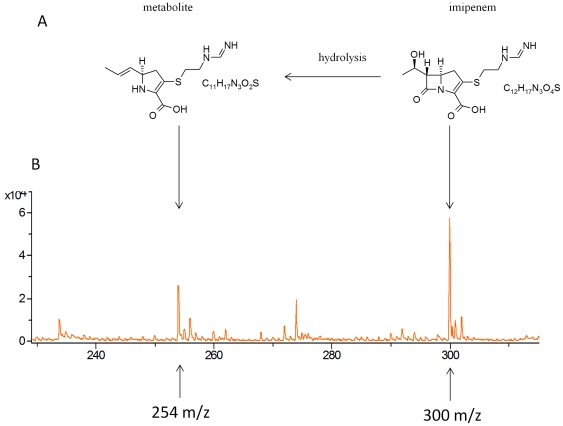
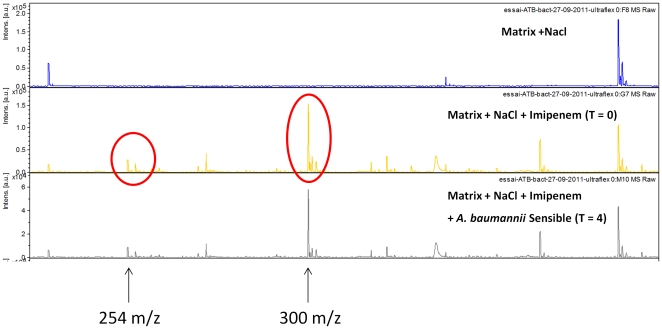
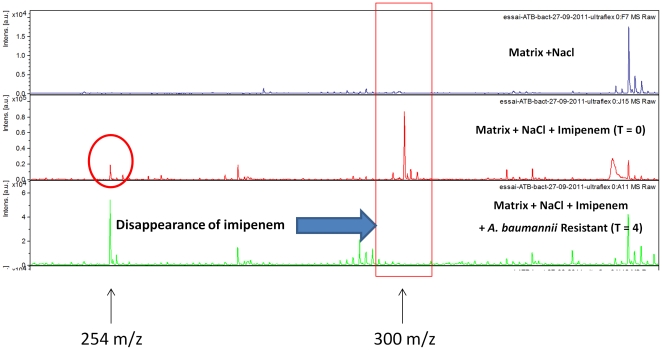
Rapid detection of carbapenem-resistant Acinetobacter baumannii strains is critical and will benefit patient care by optimizing antibiotic therapies and preventing outbreaks. Herein we describe the development and successful application of a mass spectrometry profile generated by matrix-assisted laser desorption ionization-time of flight (MALDI-TOF) that utilized the imipenem antibiotic for the detection of carbapenem resistance in a large series of A. baumannii clinical isolates from France and Algeria. A total of 106 A. baumannii strains including 63 well-characterized carbapenemase-producing and 43 non-carbapenemase-producing strains, as well as 43 control strains (7 carbapenem-resistant and 36 carbapenem-sensitive strains) were studied. After an incubation of bacteria with imipenem for up to 4 h, the mixture was centrifuged and the supernatant analyzed by MALDI-TOF MS. The presence and absence of peaks representing imipenem and its natural metabolite was analyzed. The result was interpreted as positive for carbapenemase production if the specific peak for imipenem at 300.0 m/z disappeared during the incubation time and if the peak of the natural metabolite at 254.0 m/z increased as measured by the area under the curves leading to a ratio between the peak for imipenem and its metabolite being <0.5. This assay, which was applied to the large series of A. baumannii clinical isolates, showed a sensitivity of 100.0% and a specificity of 100.0%. Our study is the first to demonstrate that this quick and simple assay can be used as a routine tool as a point-of-care method for the identification of A. baumannii carbapenemase-producers in an effort to prevent outbreaks and the spread of uncontrollable superbugs.
快速检测碳青霉烯类耐药鲍曼不动杆菌菌株至关重要,通过优化抗生素治疗和预防暴发,可以使患者受益。在此,我们描述了一种基质辅助激光解吸电离飞行时间(MALDI-TOF)质谱谱图的开发和成功应用,该谱图利用亚胺培南抗生素检测来自法国和阿尔及利亚的大量鲍曼不动杆菌临床分离株中的碳青霉烯类耐药性。共研究了 106 株鲍曼不动杆菌菌株,包括 63 株特征明确的产碳青霉烯酶株和 43 株非产碳青霉烯酶株,以及 43 株对照菌株(7 株耐碳青霉烯株和 36 株碳青霉烯敏感株)。将细菌与亚胺培南孵育长达 4 小时后,将混合物离心,并用 MALDI-TOF MS 分析上清液。分析有无代表亚胺培南及其天然代谢物的峰。如果在孵育过程中 300.0 m/z 处代表亚胺培南的特异性峰消失,并且通过曲线下面积测量,天然代谢物的峰增加到 254.0 m/z,导致峰之间的比值亚胺培南与其代谢物<0.5,则结果解释为产碳青霉烯酶。该检测方法应用于大量鲍曼不动杆菌临床分离株,显示出 100.0%的敏感性和 100.0%的特异性。我们的研究首次证明,这种快速简单的检测方法可作为一种常规工具,作为床边即时检测方法,用于鉴定鲍曼不动杆菌产碳青霉烯酶,以预防暴发和不可控超级细菌的传播。