Division of Pediatric Blood and Marrow Transplant, University of Minnesota, Minneapolis, Minnesota, United States of America.
PLoS One. 2012;7(2):e32218. doi: 10.1371/journal.pone.0032218. Epub 2012 Feb 16.
X-linked adrenoleukodystrophy (ALD) is a metabolic, peroxisomal disease that results from a mutation in the ABCD1 gene. The most severe course of ALD progression is the cerebral inflammatory and demyelinating form of the disease, cALD. To date there is very little information on the cytokine mediators in the cerebral spinal fluid (CSF) of these boys.
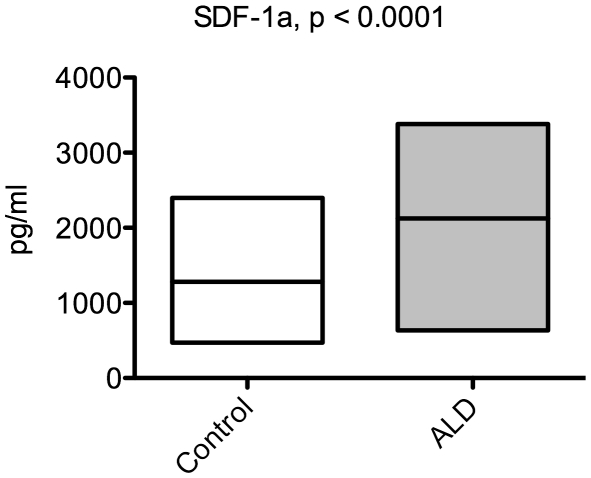
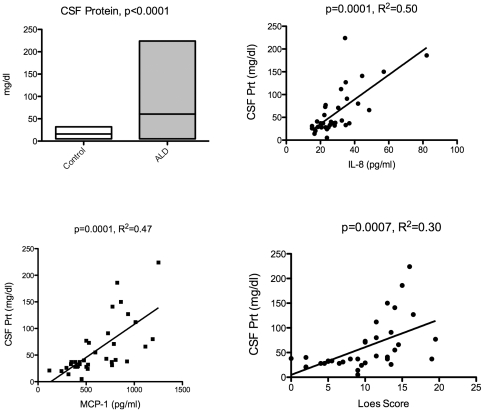
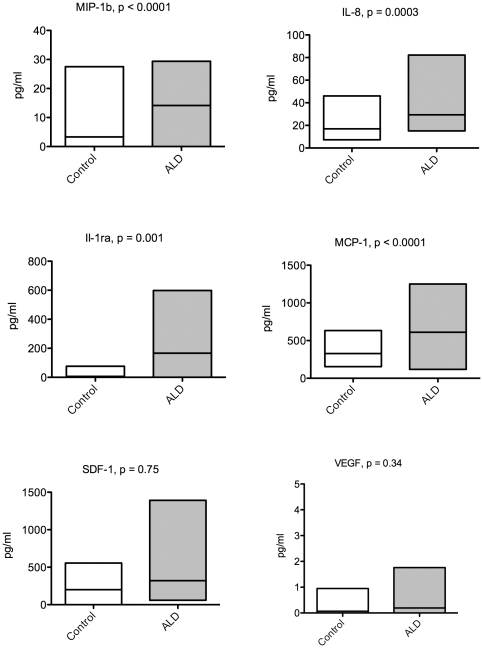
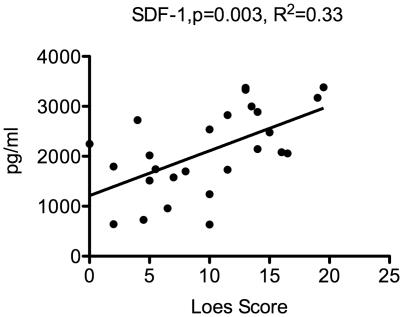
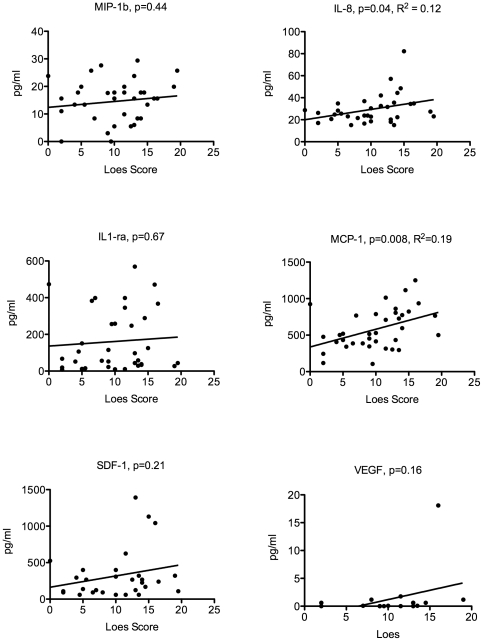
METHODOLOGY/PRINCIPAL FINDINGS: Measurement of 23 different cytokines was performed on CSF and serum of boys with cerebral ALD and patients without ALD. Significant elevations in CSF IL-8 (29.3±2.2 vs 12.8±1.1 pg/ml, p = 0.0001), IL-1ra (166±30 vs 8.6±6.5 pg/ml, p = 0.005), MCP-1 (610±47 vs 328±34 pg/ml, p = 0.002), and MIP-1b (14.2±1.3 vs 2.0±1.4 pg/ml, p<0.0001) were found in boys with cALD versus the control group. The only serum cytokine showing an elevation in the ALD group was SDF-1 (2124±155 vs 1175±125 pg/ml, p = 0.0001). The CSF cytokines of IL-8 and MCP-1b correlated with the Loes MRI severity score (p = 0.04 and p = 0.008 respectively), as well as the serum SDF-1 level (p = 0.002). Finally, CSF total protein was also significantly elevated in boys with cALD and correlated with both IL-8, MCP-1b (p = 0.0001 for both), as well as Loes MRI severity score (p = 0.0007).
CONCLUSIONS/SIGNIFICANCE: IL-8, IL-1ra, MCP-1, MIP-1b and CSF total protein were significantly elevated in patients with cALD; IL-8, MCP-1b, and CSF total protein levels correlated with disease severity determined by MRI. This is the largest report of CSF cytokine levels in cALD to date, and identification of these key cytokines will provide further insight into disease progression and perhaps lead to improved targeted therapies.
X 连锁肾上腺脑白质营养不良(ALD)是一种代谢性、过氧化物酶体疾病,由 ABCD1 基因突变引起。ALD 进展最严重的形式是脑炎性和脱髓鞘形式的疾病,即 cALD。迄今为止,关于这些男孩脑脊液(CSF)中细胞因子介质的信息非常有限。
方法/主要发现:对患有脑 ALD 和无 ALD 疾病的男孩的 CSF 和血清进行了 23 种不同细胞因子的测量。在患有 cALD 的男孩的 CSF 中发现白细胞介素-8(IL-8)(29.3±2.2 vs 12.8±1.1 pg/ml,p=0.0001)、白细胞介素-1 受体拮抗剂(IL-1ra)(166±30 vs 8.6±6.5 pg/ml,p=0.005)、单核细胞趋化蛋白-1(MCP-1)(610±47 vs 328±34 pg/ml,p=0.002)和巨噬细胞炎性蛋白-1b(MIP-1b)(14.2±1.3 vs 2.0±1.4 pg/ml,p<0.0001)显著升高。在 ALD 组中唯一升高的血清细胞因子是基质细胞衍生因子-1(SDF-1)(2124±155 vs 1175±125 pg/ml,p=0.0001)。CSF 细胞因子白细胞介素-8 和 MCP-1b 与 Loes MRI 严重程度评分相关(p=0.04 和 p=0.008),以及血清 SDF-1 水平(p=0.002)。最后,cALD 男孩的 CSF 总蛋白也显著升高,与白细胞介素-8、MCP-1b(均为 p=0.0001)以及 Loes MRI 严重程度评分相关(p=0.0007)。
结论/意义:cALD 患者的白细胞介素-8、白细胞介素-1ra、单核细胞趋化蛋白-1、巨噬细胞炎性蛋白-1b 和 CSF 总蛋白显著升高;白细胞介素-8、MCP-1b 和 CSF 总蛋白水平与 MRI 确定的疾病严重程度相关。这是迄今为止关于 cALD 脑脊液细胞因子水平的最大报告,鉴定这些关键细胞因子将进一步深入了解疾病进展,并可能导致改进的靶向治疗。