Faculty of Biotechnology, University of Wroclaw, Przybyszewskiego 63/77, Wroclaw 51-148, Poland.
BMC Microbiol. 2012 Feb 23;12:24. doi: 10.1186/1471-2180-12-24.
Pseudofactin II is a recently identified biosurfactant secreted by Pseudomonas fluorescens BD5, the strain obtained from freshwater from the Arctic Archipelago of Svalbard. Pseudofactin II is a novel compound identified as cyclic lipopeptide with a palmitic acid connected to the terminal amino group of eighth amino acid in peptide moiety. The C-terminal carboxylic group of the last amino acid forms a lactone with the hydroxyl of Thr3. Adhesion is the first stage of biofilm formation and the best moment for the action of antiadhesive and anti-biofilm compounds. Adsorption of biosurfactants to a surface e.g. glass, polystyrene, silicone modifies its hydrophobicity, interfering with the microbial adhesion and desorption processes. In this study the role and applications of pseudofactin II as a antiadhesive compound has been investigated from medicinal and therapeutic perspectives.
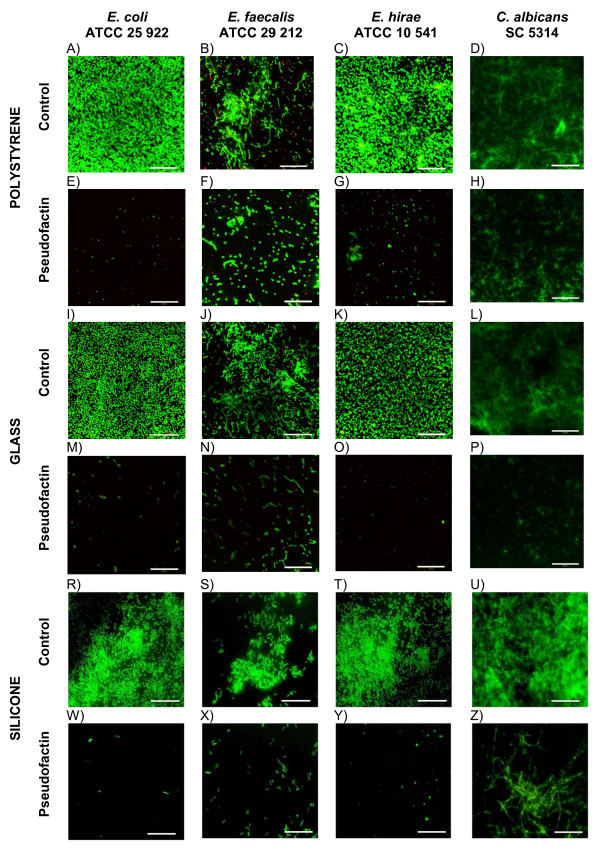
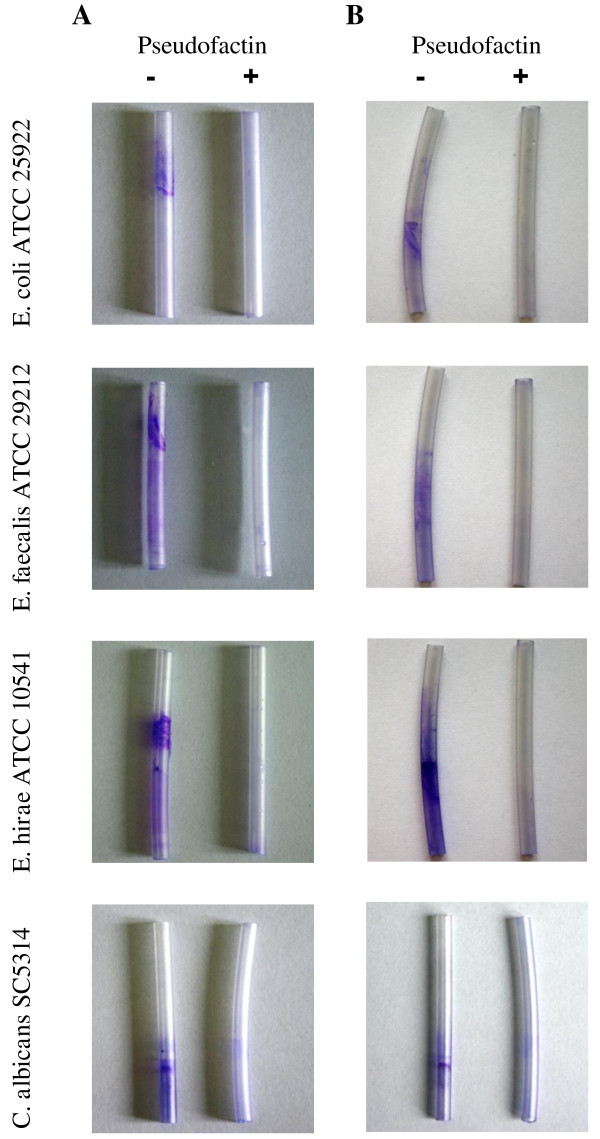
Pseudofactin II lowered the adhesion to three types of surfaces (glass, polystyrene and silicone) of bacterial strains of five species: Escherichia coli, Enterococcus faecalis, Enterococcus hirae, Staphylococcus epidermidis, Proteus mirabilis and two Candida albicans strains. Pretreatment of a polystyrene surface with 0.5 mg/ml pseudofactin II inhibited bacterial adhesion by 36-90% and that of C. albicans by 92-99%. The same concentration of pseudofactin II dislodged 26-70% of preexisting biofilms grown on previously untreated surfaces. Pseudofactin II also caused a marked inhibition of the initial adhesion of E. faecalis, E. coli, E. hirae and C. albicans strains to silicone urethral catheters. The highest concentration tested (0.5 mg/ml) caused a total growth inhibition of S. epidermidis, partial (18-37%) inhibition of other bacteria and 8-9% inhibition of C. albicans growth.
Pseudofactin II showed antiadhesive activity against several pathogenic microorganisms which are potential biofilm formers on catheters, implants and internal prostheses. Up to 99% prevention could be achieved by 0.5 mg/ml pseudofactin II. In addition, pseudofactin II dispersed preformed biofilms. Pseudofactin II can be used as a disinfectant or surface coating agent against microbial colonization of different surfaces, e.g. implants or urethral catheters.
假丝菌素 II 是一种最近从斯瓦尔巴群岛北极群岛的淡水分离到的荧光假单胞菌 BD5 菌株分泌的生物表面活性剂。假丝菌素 II 是一种新型化合物,被鉴定为环状脂肽,其棕榈酸连接在肽部分第八个氨基酸的末端氨基上。最后一个氨基酸的 C-末端羧酸与 Thr3 的羟基形成内酯。粘附是生物膜形成的第一阶段,也是抗粘附和抗生物膜化合物作用的最佳时机。生物表面活性剂吸附到玻璃、聚苯乙烯、硅酮等表面会改变其疏水性,干扰微生物的粘附和解吸过程。在这项研究中,从医学和治疗的角度研究了假丝菌素 II 作为一种抗粘附化合物的作用和应用。
假丝菌素 II 降低了五种细菌菌株(大肠杆菌、粪肠球菌、海氏肠球菌、表皮葡萄球菌、奇异变形杆菌和两种白色念珠菌)对三种表面(玻璃、聚苯乙烯和硅酮)的粘附。用 0.5mg/ml 的假丝菌素 II 预处理聚苯乙烯表面可抑制 36-90%的细菌粘附和 92-99%的白色念珠菌粘附。相同浓度的假丝菌素 II 可去除 26-70%的未处理表面上已生长的生物膜。假丝菌素 II 还显著抑制了粪肠球菌、大肠杆菌、海氏肠球菌和白色念珠菌菌株最初对硅胶尿道导管的粘附。测试的最高浓度(0.5mg/ml)完全抑制了表皮葡萄球菌的生长,部分(18-37%)抑制了其他细菌的生长,8-9%抑制了白色念珠菌的生长。
假丝菌素 II 对几种有潜在生物膜形成能力的病原体具有抗粘附活性,这些病原体可能在导管、植入物和内部假体上形成生物膜。用 0.5mg/ml 的假丝菌素 II 可达到 99%的预防效果。此外,假丝菌素 II 还可分散已形成的生物膜。假丝菌素 II 可作为消毒剂或表面涂层剂,防止不同表面(如植入物或尿道导管)的微生物定植。