Department of Ophthalmology, Groote Schuur Hospital, Cape Town, South Africa.
PLoS One. 2012;7(2):e30718. doi: 10.1371/journal.pone.0030718. Epub 2012 Feb 20.
To estimate the prevalence and causes of blindness and visual impairment in Cape Town, South Africa and to explore socio-economic and demographic predictors of vision loss in this setting.
A cross sectional population-based survey was conducted in Cape Town. Eighty-two clusters were selected using probability proportionate to size sampling. Within each cluster 35 or 40 people aged 50 years and above were selected using compact segment sampling. Visual acuity of participants was assessed and eyes with a visual acuity less than 6/18 were examined by an ophthalmologist to determine the cause of vision loss. Demographic data (age, gender and education) were collected and a socio-economic status (SES) index was created using principal components analysis.
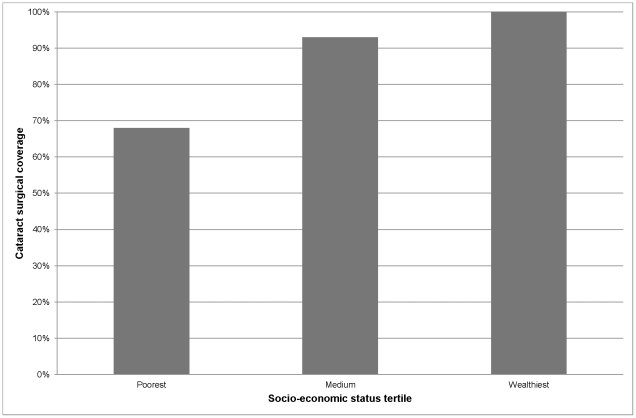
Out of 3100 eligible people, 2750 (89%) were examined. The sample prevalence of bilateral blindness (presenting visual acuity <3/60) was 1.4% (95% CI 0.9-1.8). Posterior segment diseases accounted for 65% of blindness and cataract was responsible for 27%. The prevalence of vision loss was highest among people over 80 years (odds ratio (OR) 6.9 95% CI 4.6-10.6), those in the poorest SES group (OR 3.9 95% CI 2.2-6.7) and people with no formal education (OR 5.4 95% CI 1.7-16.6). Cataract surgical coverage was 68% in the poorest SES tertile (68%) compared to 93% in the medium and 100% in the highest tertile.
The prevalence of blindness among people ≥50 years in Cape Town was lower than expected and the contribution of posterior segment diseases higher than previously reported in South Africa and Sub Saharan Africa. There were clear socio-economic disparities in prevalence of vision loss and cataract surgical coverage in this setting which need to be addressed in blindness prevention programs.
估计南非开普敦的盲症和视力障碍的流行率和原因,并探讨在这种环境下视力丧失的社会经济和人口统计学预测因素。
在开普敦进行了一项横断面基于人群的调查。使用概率比例大小抽样选择了 82 个聚类。在每个聚类中,使用紧凑段抽样选择 35 或 40 名 50 岁及以上的人。评估参与者的视力,并由眼科医生检查视力低于 6/18 的眼睛,以确定视力丧失的原因。收集人口统计学数据(年龄、性别和教育程度),并使用主成分分析创建社会经济地位(SES)指数。
在 3100 名符合条件的人中,有 2750 人(89%)接受了检查。双侧失明(表现视力<3/60)的样本患病率为 1.4%(95%CI 0.9-1.8)。后段疾病占失明的 65%,白内障占 27%。80 岁以上人群的视力丧失患病率最高(优势比(OR)6.9,95%CI 4.6-10.6),社会经济地位最低组(OR 3.9,95%CI 2.2-6.7)和没有正规教育的人(OR 5.4,95%CI 1.7-16.6)。最贫穷 SES 三分位组的白内障手术覆盖率为 68%(68%),而中等和最高三分位组分别为 93%和 100%。
开普敦≥50 岁人群的盲症患病率低于预期,后段疾病的患病率高于南非和撒哈拉以南非洲此前的报告。在这种情况下,视力丧失和白内障手术覆盖率存在明显的社会经济差异,需要在盲症预防计划中加以解决。