Department of Biology, McGill University, Montreal, Quebec, Canada.
PLoS One. 2012;7(2):e31785. doi: 10.1371/journal.pone.0031785. Epub 2012 Feb 20.
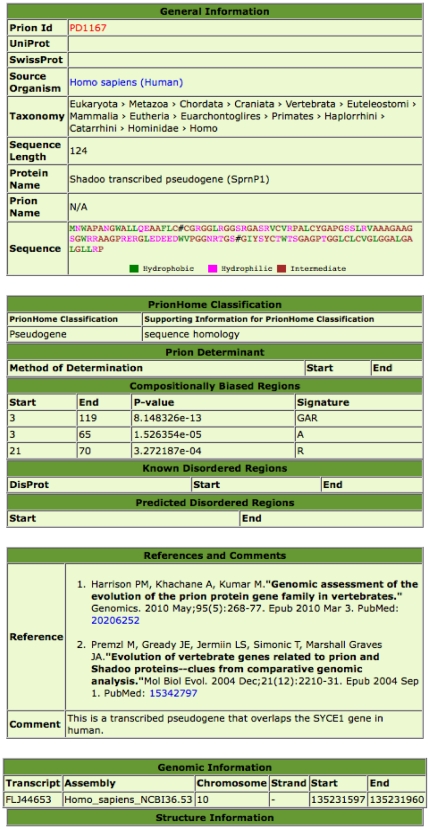
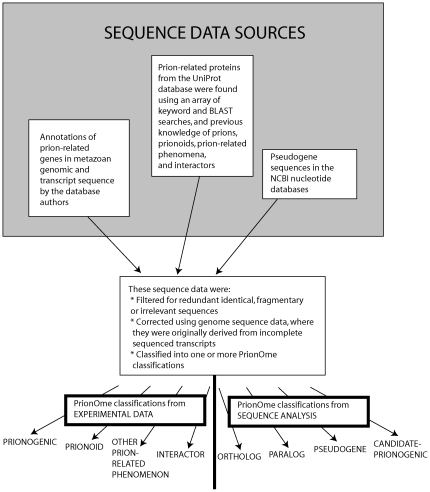
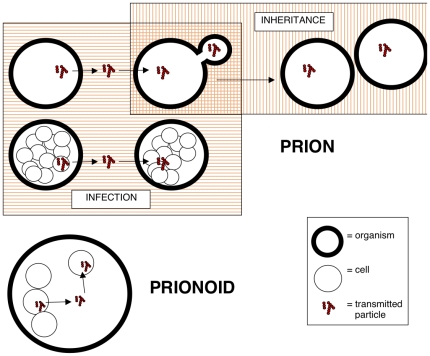
Prions are units of propagation of an altered state of a protein or proteins; prions can propagate from organism to organism, through cooption of other protein copies. Prions contain no necessary nucleic acids, and are important both as both pathogenic agents, and as a potential force in epigenetic phenomena. The original prions were derived from a misfolded form of the mammalian Prion Protein PrP. Infection by these prions causes neurodegenerative diseases. Other prions cause non-Mendelian inheritance in budding yeast, and sometimes act as diseases of yeast. We report the bioinformatic construction of the PrionHome, a database of >2000 prion-related sequences. The data was collated from various public and private resources and filtered for redundancy. The data was then processed according to a transparent classification system of prionogenic sequences (i.e., sequences that can make prions), prionoids (i.e., proteins that propagate like prions between individual cells), and other prion-related phenomena. There are eight PrionHome classifications for sequences. The first four classifications are derived from experimental observations: prionogenic sequences, prionoids, other prion-related phenomena, and prion interactors. The second four classifications are derived from sequence analysis: orthologs, paralogs, pseudogenes, and candidate-prionogenic sequences. Database entries list: supporting information for PrionHome classifications, prion-determinant areas (where relevant), and disordered and compositionally-biased regions. Also included are literature references for the PrionHome classifications, transcripts and genomic coordinates, and structural data (including comparative models made for the PrionHome from manually curated alignments). We provide database usage examples for both vertebrate and fungal prion contexts. Using the database data, we have performed a detailed analysis of the compositional biases in known budding-yeast prionogenic sequences, showing that the only abundant bias pattern is for asparagine bias with subsidiary serine bias. We anticipate that this database will be a useful experimental aid and reference resource. It is freely available at: http://libaio.biol.mcgill.ca/prion.
朊病毒是蛋白质或蛋白质的改变状态的传播单位;朊病毒可以通过其他蛋白质副本的选择从一个生物体传播到另一个生物体。朊病毒不含必要的核酸,既是致病因子,也是表观遗传现象的潜在力量。最初的朊病毒来自哺乳动物朊病毒蛋白 PrP 的错误折叠形式。这些朊病毒的感染会导致神经退行性疾病。其他朊病毒导致芽殖酵母中的非孟德尔遗传,有时也会导致酵母疾病。我们报告了 PrionHome 的生物信息学构建,这是一个包含>2000 个朊病毒相关序列的数据库。该数据是从各种公共和私人资源中收集的,并经过冗余筛选。然后,根据朊病毒生成序列(即可以产生朊病毒的序列)、朊病毒样蛋白(即在个体细胞之间像朊病毒一样传播的蛋白质)和其他朊病毒相关现象的透明分类系统对数据进行处理。序列有八个 PrionHome 分类。前四个分类是根据实验观察得出的:朊病毒生成序列、朊病毒样蛋白、其他朊病毒相关现象和朊病毒相互作用物。后四个分类是根据序列分析得出的:同源物、旁系同源物、假基因和候选朊病毒生成序列。数据库条目列出:PrionHome 分类的支持信息、朊病毒决定区域(如果相关)、无序和组成性偏向区域。还包括 PrionHome 分类的文献参考、转录本和基因组坐标以及结构数据(包括为 PrionHome 从手动整理的比对中制作的比较模型)。我们为脊椎动物和真菌朊病毒上下文提供了数据库使用示例。使用数据库数据,我们对已知芽殖酵母朊病毒生成序列中的组成性偏向进行了详细分析,结果表明唯一丰富的偏向模式是天冬酰胺偏向,其次是丝氨酸偏向。我们预计该数据库将成为有用的实验辅助工具和参考资源。它可在以下网址免费获取:http://libaio.biol.mcgill.ca/prion。