Department of Society, Human Development and Health, Harvard School of Public Health, 677 Huntington Avenue, Boston, MA 02115, USA.
Soc Sci Med. 2012 Apr;74(7):982-8. doi: 10.1016/j.socscimed.2011.12.029. Epub 2012 Feb 1.
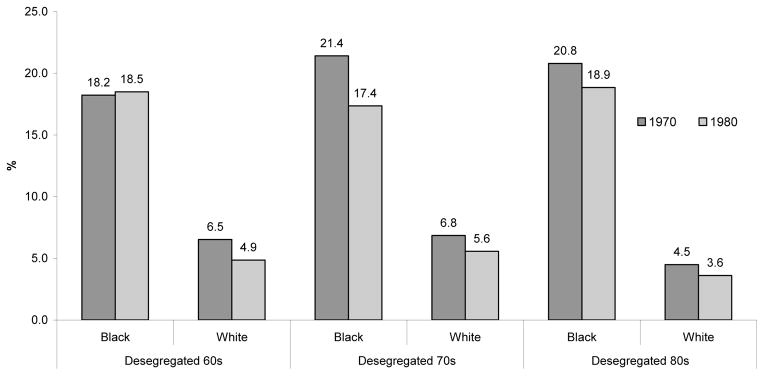
Although the socioeconomic impact of school desegregation in the U.S. has been well documented, little is known about the health consequences of this policy. The purpose of this study was to quantify the associations between school desegregation and adolescent births among black and white females. We compared the change in prevalence of adolescent births in areas that implemented school desegregation plans in the 1970s with areas that implemented school desegregation plans in other decades, using difference-in-difference methods with 1970 and 1980 Census microdata. School desegregation policy in the U.S. in the 1970s was associated with a significant reduction of 3.2 percentage points in the prevalence of births among black female adolescents between 1970 and 1980. This association was specific to black female adolescents and was not observed among white adolescents.
尽管美国学校的社会经济影响已经得到了充分的记录,但对于这项政策对健康的影响却知之甚少。本研究的目的是量化学校隔离与黑人和白人女性青少年生育之间的关联。我们使用 1970 年和 1980 年人口普查微数据的差异法,比较了 20 世纪 70 年代实施学校隔离计划地区和其他年代实施学校隔离计划地区青少年生育比例的变化。20 世纪 70 年代美国的学校隔离政策与黑人少女青少年出生率在 1970 年至 1980 年期间显著下降了 3.2 个百分点有关。这种关联仅针对黑人少女青少年,在白人青少年中没有观察到。