Centre for Genetics and Genomics, School of Biology Queens Medical Centre, University of Nottingham, Nottingham, UK.
PLoS Pathog. 2012 Feb;8(2):e1002554. doi: 10.1371/journal.ppat.1002554. Epub 2012 Feb 23.
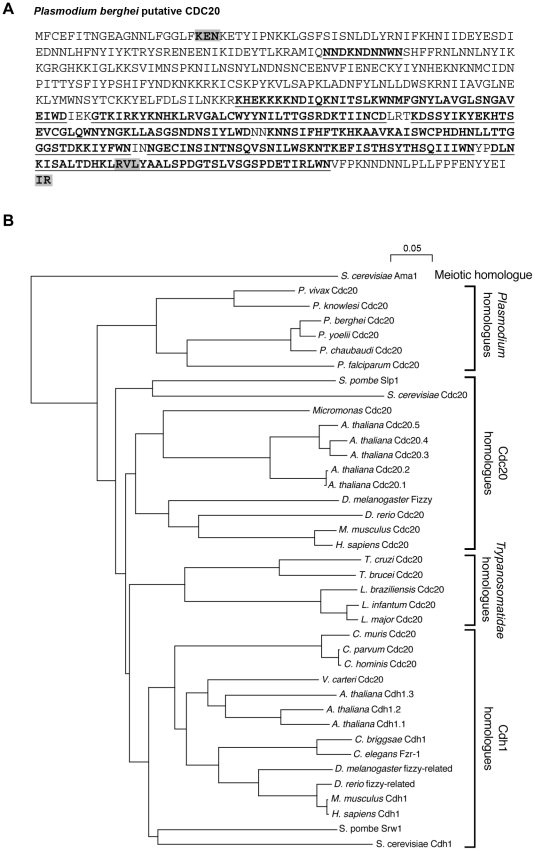
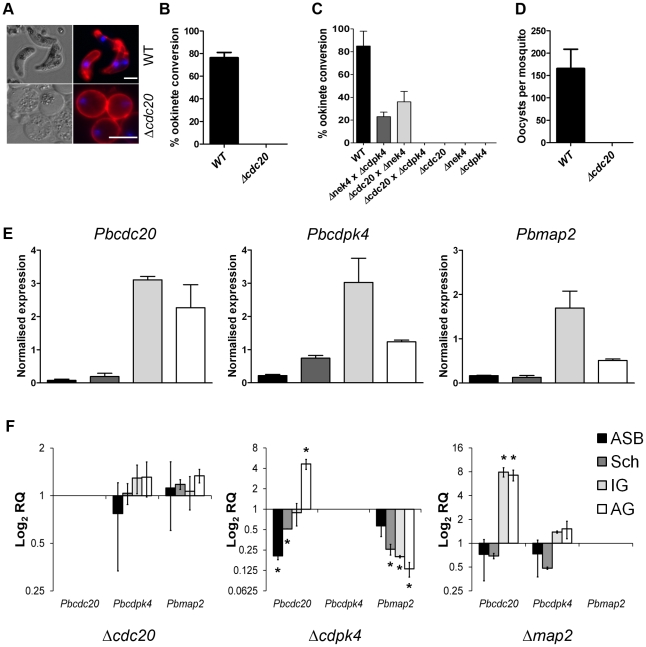
Cell-cycle progression is governed by a series of essential regulatory proteins. Two major regulators are cell-division cycle protein 20 (CDC20) and its homologue, CDC20 homologue 1 (CDH1), which activate the anaphase-promoting complex/cyclosome (APC/C) in mitosis, and facilitate degradation of mitotic APC/C substrates. The malaria parasite, Plasmodium, is a haploid organism which, during its life-cycle undergoes two stages of mitosis; one associated with asexual multiplication and the other with male gametogenesis. Cell-cycle regulation and DNA replication in Plasmodium was recently shown to be dependent on the activity of a number of protein kinases. However, the function of cell division cycle proteins that are also involved in this process, such as CDC20 and CDH1 is totally unknown. Here we examine the role of a putative CDC20/CDH1 in the rodent malaria Plasmodium berghei (Pb) using reverse genetics. Phylogenetic analysis identified a single putative Plasmodium CDC20/CDH1 homologue (termed CDC20 for simplicity) suggesting that Plasmodium APC/C has only one regulator. In our genetic approach to delete the endogenous cdc20 gene of P. berghei, we demonstrate that PbCDC20 plays a vital role in male gametogenesis, but is not essential for mitosis in the asexual blood stage. Furthermore, qRT-PCR analysis in parasite lines with deletions of two kinase genes involved in male sexual development (map2 and cdpk4), showed a significant increase in cdc20 transcription in activated gametocytes. DNA replication and ultra structural analyses of cdc20 and map2 mutants showed similar blockage of nuclear division at the nuclear spindle/kinetochore stage. CDC20 was phosphorylated in asexual and sexual stages, but the level of modification was higher in activated gametocytes and ookinetes. Changes in global protein phosphorylation patterns in the Δcdc20 mutant parasites were largely different from those observed in the Δmap2 mutant. This suggests that CDC20 and MAP2 are both likely to play independent but vital roles in male gametogenesis.
细胞周期的进展受到一系列必需的调节蛋白的控制。两个主要的调节因子是细胞分裂周期蛋白 20(CDC20)及其同源物 CDC20 同源物 1(CDH1),它们在有丝分裂中激活后期促进复合物/周期体(APC/C),并促进有丝分裂 APC/C 底物的降解。疟原虫是一种单倍体生物,在其生命周期中经历两个有丝分裂阶段;一个与无性繁殖有关,另一个与雄性配子发生有关。最近发现,疟原虫的细胞周期调控和 DNA 复制依赖于许多蛋白激酶的活性。然而,参与这一过程的细胞分裂周期蛋白,如 CDC20 和 CDH1 的功能完全未知。在这里,我们使用反向遗传学研究了一种假定的 CDC20/CDH1 在啮齿动物疟原虫 Plasmodium berghei(Pb)中的作用。系统发育分析鉴定出一个单一的假定的疟原虫 CDC20/CDH1 同源物(简称为 CDC20),表明疟原虫 APC/C 只有一个调节因子。在我们的遗传方法中,我们删除了 P. berghei 的内源性 cdc20 基因,证明 PbCDC20 在雄性配子发生中起着至关重要的作用,但在无性血阶段的有丝分裂中不是必需的。此外,在涉及雄性性发育的两个激酶基因(map2 和 cdpk4)缺失的寄生虫系中进行的 qRT-PCR 分析显示,激活的配子体中 cdc20 转录显著增加。cdc20 和 map2 突变体的 DNA 复制和超微结构分析显示,在核纺锤体/动粒阶段,核分裂出现类似的阻断。CDC20 在无性和有性阶段都被磷酸化,但在激活的配子体和卵囊体中的修饰水平更高。在Δcdc20 突变体寄生虫中,全局蛋白质磷酸化模式的变化与在Δmap2 突变体中观察到的变化有很大不同。这表明 CDC20 和 MAP2 可能在雄性配子发生中都发挥独立但至关重要的作用。