G3 (Bethesda). 2012 Jan;2(1):43-58. doi: 10.1534/g3.111.001552. Epub 2012 Jan 1.
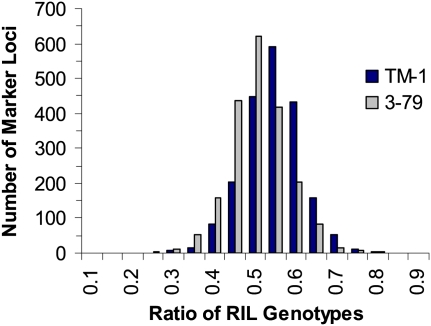
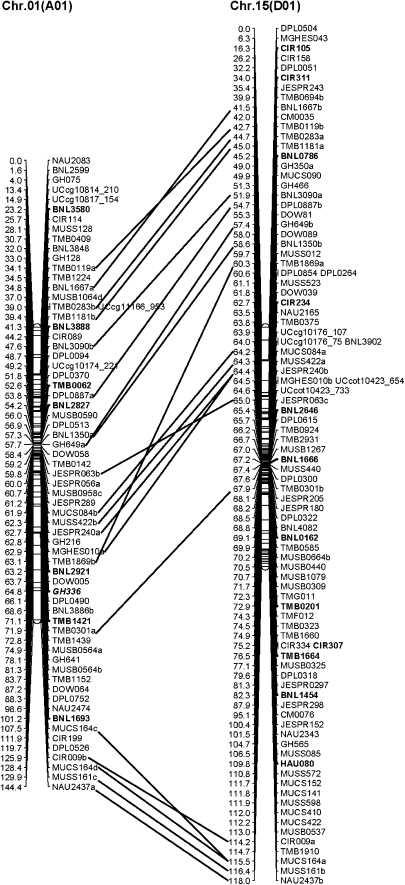
Genetic linkage maps play fundamental roles in understanding genome structure, explaining genome formation events during evolution, and discovering the genetic bases of important traits. A high-density cotton (Gossypium spp.) genetic map was developed using representative sets of simple sequence repeat (SSR) and the first public set of single nucleotide polymorphism (SNP) markers to genotype 186 recombinant inbred lines (RILs) derived from an interspecific cross between Gossypium hirsutum L. (TM-1) and G. barbadense L. (3-79). The genetic map comprised 2072 loci (1825 SSRs and 247 SNPs) and covered 3380 centiMorgan (cM) of the cotton genome (AD) with an average marker interval of 1.63 cM. The allotetraploid cotton genome produced equivalent recombination frequencies in its two subgenomes (At and Dt). Of the 2072 loci, 1138 (54.9%) were mapped to 13 At-subgenome chromosomes, covering 1726.8 cM (51.1%), and 934 (45.1%) mapped to 13 Dt-subgenome chromosomes, covering 1653.1 cM (48.9%). The genetically smallest homeologous chromosome pair was Chr. 04 (A04) and 22 (D04), and the largest was Chr. 05 (A05) and 19 (D05). Duplicate loci between and within homeologous chromosomes were identified that facilitate investigations of chromosome translocations. The map augments evidence of reciprocal rearrangement between ancestral forms of Chr. 02 and 03 versus segmental homeologs 14 and 17 as centromeric regions show homeologous between Chr. 02 (A02) and 17 (D02), as well as between Chr. 03 (A03) and 14 (D03). This research represents an important foundation for studies on polyploid cottons, including germplasm characterization, gene discovery, and genome sequence assembly.
遗传连锁图谱在理解基因组结构、解释进化过程中基因组形成事件以及发现重要性状的遗传基础方面发挥着重要作用。本研究利用代表简单序列重复(SSR)和第一批公共单核苷酸多态性(SNP)标记的集合,对来自陆地棉(Gossypium hirsutum L.,TM-1)和长果种棉(G. barbadense L.,3-79)种间杂交的 186 个重组自交系(RILs)进行基因型分析,构建了一个高密度的棉花(Gossypium spp.)遗传图谱。该图谱包含 2072 个标记(1825 个 SSR 和 247 个 SNP),覆盖棉花基因组(AD)的 3380 厘摩(cM),标记间平均距离为 1.63 cM。该异源四倍体棉花基因组在其两个亚基因组(At 和 Dt)中产生了相当的重组频率。在 2072 个标记中,有 1138 个(54.9%)定位到 13 个 At 亚基因组染色体上,覆盖 1726.8 cM(51.1%),934 个(45.1%)定位到 13 个 Dt 亚基因组染色体上,覆盖 1653.1 cM(48.9%)。遗传上最小的同源染色体对是 Chr.04(A04)和 22(D04),最大的是 Chr.05(A05)和 19(D05)。在同源染色体之间和内部鉴定出重复的标记,这有助于研究染色体易位。该图谱增加了证据表明 Chr.02 和 03 与 14 和 17 之间的祖先形式之间存在相互倒位,因为 Chr.02(A02)和 17(D02)之间以及 Chr.03(A03)和 14(D03)之间显示出同源性。这项研究为多倍体棉花的研究提供了重要基础,包括种质资源鉴定、基因发现和基因组序列组装。