G3 (Bethesda). 2012 Feb;2(2):279-86. doi: 10.1534/g3.111.001115. Epub 2012 Feb 1.
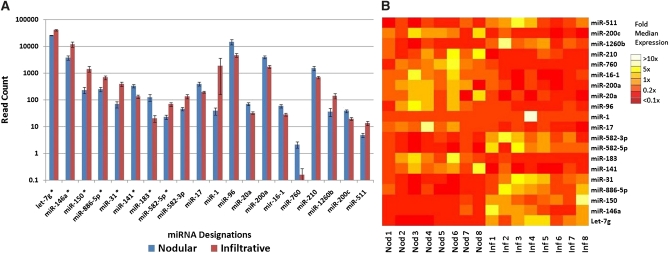
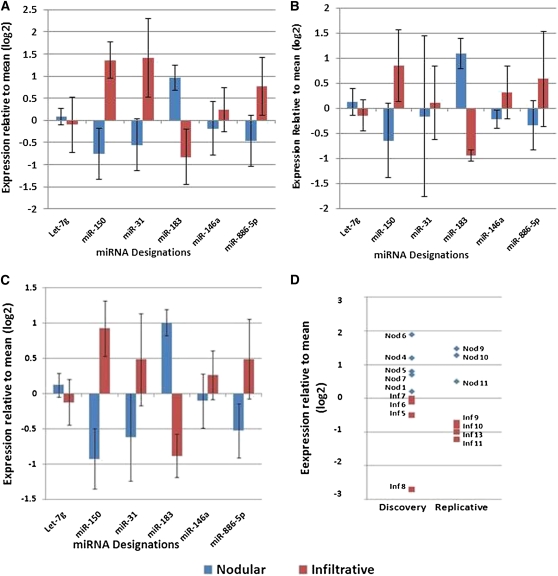
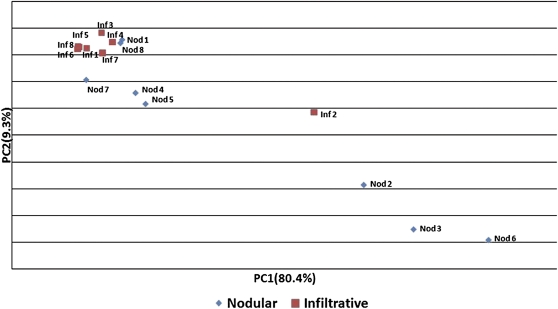
Basal cell carcinomas (BCCs) are the most common cancers in the United States. The histologic appearance distinguishes several subtypes, each of which can have a different biologic behavior. In this study, global miRNA expression was quantified by high-throughput sequencing in nodular BCCs, a subtype that is slow growing, and infiltrative BCCs, aggressive tumors that extend through the dermis and invade structures such as cutaneous nerves. Principal components analysis correctly classified seven of eight infiltrative tumors on the basis of miRNA expression. The remaining tumor, on pathology review, contained a mixture of nodular and infiltrative elements. Nodular tumors did not cluster tightly, likely reflecting broader histopathologic diversity in this class, but trended toward forming a group separate from infiltrative BCCs. Quantitative polymerase chain reaction assays were developed for six of the miRNAs that showed significant differences between the BCC subtypes, and five of these six were validated in a replication set of four infiltrative and three nodular tumors. The expression level of miR-183, a miRNA that inhibits invasion and metastasis in several types of malignancies, was consistently lower in infiltrative than nodular tumors and could be one element underlying the difference in invasiveness. These results represent the first miRNA profiling study in BCCs and demonstrate that miRNA gene expression may be involved in tumor pathogenesis and particularly in determining the aggressiveness of these malignancies.
基底细胞癌(BCC)是美国最常见的癌症。组织学表现可区分出几种亚型,每种亚型的生物学行为可能不同。在这项研究中,通过高通量测序对结节性 BCC(生长缓慢的一种亚型)和侵袭性 BCC(通过真皮扩散并侵犯皮肤神经等结构的侵袭性肿瘤)进行了全局 miRNA 表达定量。基于 miRNA 表达,主成分分析正确地对八种侵袭性肿瘤中的七种进行了分类。其余的肿瘤在病理检查中包含了结节性和侵袭性成分的混合物。结节性肿瘤没有紧密聚集,可能反映了该类别的更广泛的组织病理学多样性,但倾向于形成一个与侵袭性 BCC 分开的组。针对在 BCC 亚型之间表现出显著差异的六个 miRNA 开发了定量聚合酶链反应(qPCR)检测,其中五个在侵袭性和三个结节性肿瘤的复制组中得到了验证。miR-183 是一种在多种恶性肿瘤中抑制侵袭和转移的 miRNA,其在侵袭性肿瘤中的表达水平始终低于结节性肿瘤,这可能是侵袭性差异的一个因素。这些结果代表了 BCC 中首次 miRNA 分析研究,并表明 miRNA 基因表达可能参与肿瘤发病机制,特别是决定这些恶性肿瘤的侵袭性。