Silva Manuel T
Institute for Molecular and Cell Biology, University of Porto Porto, Portugal.
Front Microbiol. 2012 Feb 29;3:71. doi: 10.3389/fmicb.2012.00071. eCollection 2012.
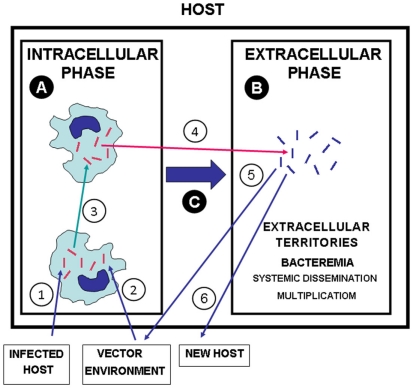
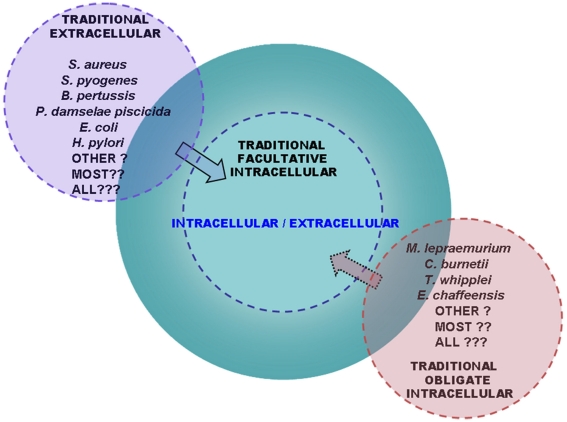
An ample understanding of the complex interactions between host and pathogen will improve our ability to develop new prophylactic and therapeutic measures against infection. Precise classification of infectious agents in regards to their infective lifestyles in the host and corresponding pathogenic implications are required because clear concepts are essential to plan fruitful research. Classically, pathogenic bacteria are classified as extracellular, facultative intracellular, and obligate intracellular. In my opinion, this classification is inadequate because, as concluded from data here discussed, it is based on inconsistencies and hyper-valorizes the capacity of the infectious agent replicate in vitro in cell-free media. For a microbial pathogen, what matters is whether intra- or extracellularity is in the context of the in vivo life and in association with pathogenicity. When living as a pathogen in association with its host, what is relevant in microbiological terms is not the ability to grow in artificial cell-free bacteriological media or in environmental niches but whether the intracellular infectious agent, besides the phase of intracellular growth which is behind its label, also is able to live extracellularly in the natural settings of the extracellular territories of their hosts. To eliminate the inconsistencies associated with the classical labeling of bacterial pathogens, I propose that bacterial pathogens be labeled exclusive extracellular, dual intracellular/extracellular and exclusive intracellular based on their infective lifestyle in the host, not in the ability to grow in artificial bacteriological media.
充分了解宿主与病原体之间的复杂相互作用,将提高我们开发针对感染的新预防和治疗措施的能力。需要根据感染因子在宿主体内的感染生活方式及其相应的致病影响对感染因子进行精确分类,因为清晰的概念对于规划卓有成效的研究至关重要。传统上,病原菌被分类为胞外菌、兼性胞内菌和专性胞内菌。在我看来,这种分类并不充分,因为从这里讨论的数据得出的结论是,它基于不一致性,并且过度强调了感染因子在无细胞培养基中体外复制的能力。对于微生物病原体而言,重要的是胞内或胞外状态是否处于体内生活环境中以及与致病性相关。当作为病原体与宿主共生时,从微生物学角度来看,相关的不是在人工无细胞细菌培养基或环境生态位中生长的能力,而是细胞内感染因子除了其标签所暗示的细胞内生长阶段外,是否还能够在其宿主细胞外区域的自然环境中在细胞外生存。为了消除与细菌病原体经典标签相关的不一致性,我建议根据细菌病原体在宿主体内的感染生活方式,而不是在人工细菌培养基中生长的能力,将其标记为专性胞外菌、胞内/胞外兼性菌和专性胞内菌。