Department of Infectious Diseases Epidemiology, Imperial College, London, United Kingdom.
PLoS One. 2012;7(3):e32324. doi: 10.1371/journal.pone.0032324. Epub 2012 Mar 1.
To design HIV prevention programmes, it is critical to understand the temporal and geographic aspects of the local epidemic and to address the key behaviours that drive HIV transmission. Two methods have been developed to appraise HIV epidemics and guide prevention strategies. The numerical proxy method classifies epidemics based on current HIV prevalence thresholds. The Modes of Transmission (MOT) model estimates the distribution of incidence over one year among risk-groups. Both methods focus on the current state of an epidemic and provide short-term metrics which may not capture the epidemiologic drivers. Through a detailed analysis of country and sub-national data, we explore the limitations of the two traditional methods and propose an alternative approach.
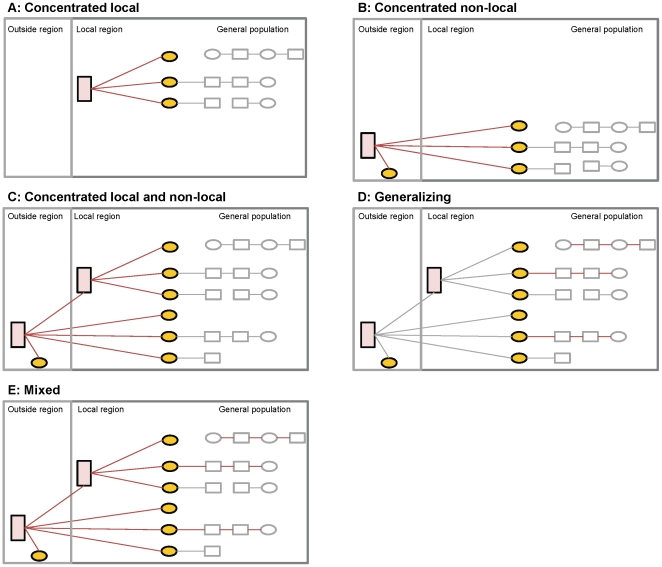
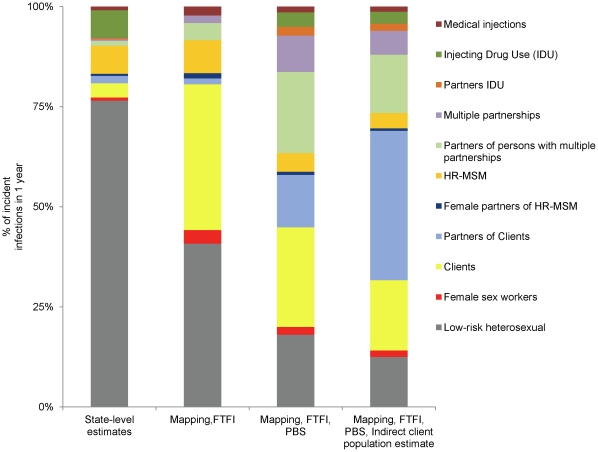
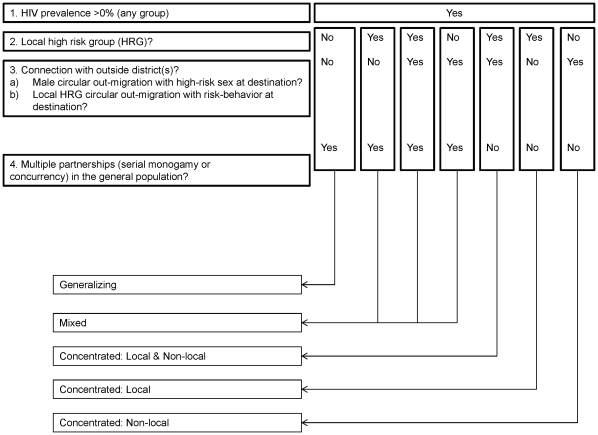
We compared outputs of the traditional methods in five countries for which results were published, and applied the numeric and MOT model to India and six districts within India. We discovered three limitations of the current methods for epidemic appraisal: (1) their results failed to identify the key behaviours that drive the epidemic; (2) they were difficult to apply to local epidemics with heterogeneity across district-level administrative units; and (3) the MOT model was highly sensitive to input parameters, many of which required extraction from non-regional sources. We developed an alternative decision-tree framework for HIV epidemic appraisals, based on a qualitative understanding of epidemiologic drivers, and demonstrated its applicability in India. The alternative framework offered a logical algorithm to characterize epidemics; it required minimal but key data.
Traditional appraisals that utilize the distribution of prevalent and incident HIV infections in the short-term could misguide prevention priorities and potentially impede efforts to halt the trajectory of the HIV epidemic. An approach that characterizes local transmission dynamics provides a potentially more effective tool with which policy makers can design intervention programmes.
为设计艾滋病预防方案,了解当地疫情的时间和空间方面以及驱动艾滋病传播的关键行为至关重要。已经开发出两种方法来评估艾滋病疫情并指导预防策略。数值代理方法根据当前艾滋病流行率阈值对疫情进行分类。传播方式(MOT)模型估计了在一年中风险群体中发病率的分布。这两种方法都侧重于疫情的当前状况,并提供了可能无法捕获流行病学驱动因素的短期指标。通过对国家和次国家数据的详细分析,我们探讨了两种传统方法的局限性,并提出了一种替代方法。
我们比较了五种发布结果的国家的传统方法的输出,并将数值和 MOT 模型应用于印度和印度的六个地区。我们发现了当前疫情评估方法的三个局限性:(1)它们的结果未能确定驱动疫情的关键行为;(2)它们难以应用于具有地区行政单位之间异质性的当地疫情;(3)MOT 模型对输入参数非常敏感,其中许多参数需要从非区域来源提取。我们基于对流行病学驱动因素的定性理解,开发了一种用于艾滋病疫情评估的替代决策树框架,并在印度证明了其适用性。替代框架提供了一种逻辑算法来描述疫情;它只需要最少但关键的数据。
利用短期流行和新发艾滋病感染分布的传统评估方法可能会误导预防重点,并可能阻碍阻止艾滋病疫情发展轨迹的努力。一种描述当地传播动态的方法提供了一个更有效的工具,决策者可以用它来设计干预计划。