Duan Fengxia, Xie Mingxing, Wang Xinfang, Li Yuman, He Lin, Jiang Lan, Fu Qian
Department of Medical Ultrasound, Union Hospital, Tongji Medical College, Huazhong University of Science and Technology, Wuhan, People's Republic of China.
Cardiovasc Ultrasound. 2012 Mar 7;10:8. doi: 10.1186/1476-7120-10-8.
Non-ischemic dilated cardiomyopathy (DCM) is the most common cardiomyopathy worldwide, with significant mortality. Correct evaluation of the patient's myocardial function has important clinical significance in the diagnosis, therapeutic effect assessment and prognosis in non-ischemic DCM patients. This study evaluated the feasibility of three-dimensional speckle tracking imaging (3D-STE) for assessment of the left ventricular myocardial strain in patients with non-ischemic dilated cardiomyopathy (DCM).
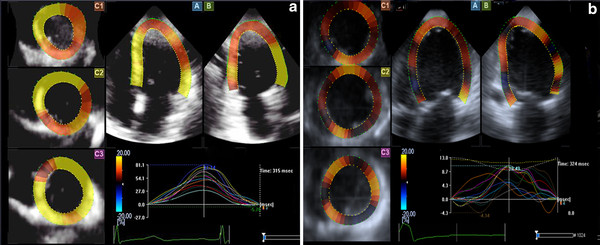
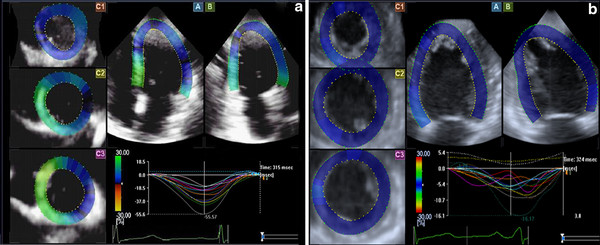
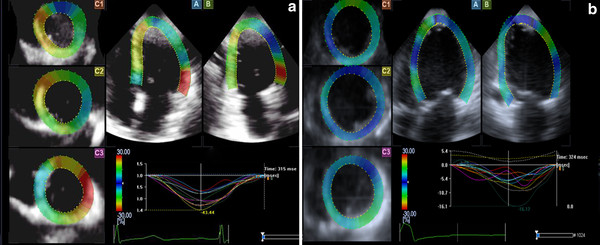
Apical full-volume images were acquired from 65 patients with non-ischemic DCM (DCM group) and 59 age-matched normal controls (NC group), respectively. The following parameters were measured by 3D-STE: the peak systolic radial strain (RS), circumferential strain (CS), longitudinal strain (LS) of each segment. Then all the parameters were compared between the two groups.
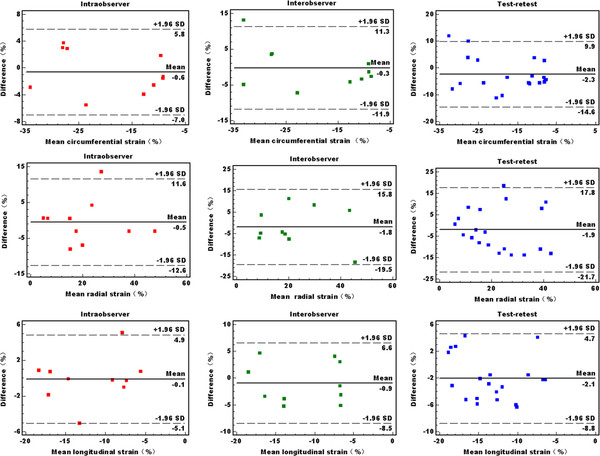
The peak systolic strain in different planes had certain regularities in normal groups, radial strain (RS) was the largest in the mid region, the smallest in the apical region, while circumferential strain (CS) and longitudinal strain (LS) increased from the basal to the apical region. In contrast, the regularity could not be applied to the DCM group. RS, CS, LS were significantly decreased in DCM group as compared with NC group (P < 0.001 for all). The interobserver, intraobserver and test-retest reliability were acceptable.
3D-STE is a reliable tool for evaluation of left ventricular myocardial strain in patients with non-ischemic DCM, with huge advantage in clinical application.
非缺血性扩张型心肌病(DCM)是全球最常见的心肌病,死亡率较高。准确评估患者的心肌功能对非缺血性DCM患者的诊断、疗效评估及预后具有重要临床意义。本研究评估三维斑点追踪成像(3D-STE)用于评估非缺血性扩张型心肌病(DCM)患者左心室心肌应变的可行性。
分别采集65例非缺血性DCM患者(DCM组)和59例年龄匹配的正常对照者(NC组)的心尖全容积图像。采用3D-STE测量以下参数:各节段的收缩期峰值径向应变(RS)、圆周应变(CS)、纵向应变(LS)。然后比较两组间所有参数。
正常组不同平面的收缩期峰值应变有一定规律,径向应变(RS)在中间区域最大,在心尖区域最小,而圆周应变(CS)和纵向应变(LS)从心底到心尖区域逐渐增加。相比之下,该规律不适用于DCM组。与NC组相比,DCM组的RS、CS、LS显著降低(均P<0.001)。观察者间、观察者内及重测可靠性均可接受。
3D-STE是评估非缺血性DCM患者左心室心肌应变的可靠工具,在临床应用中具有巨大优势。