Brain Behav. 2011 Nov;1(2):142-52. doi: 10.1002/brb3.19.
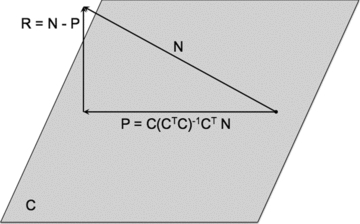
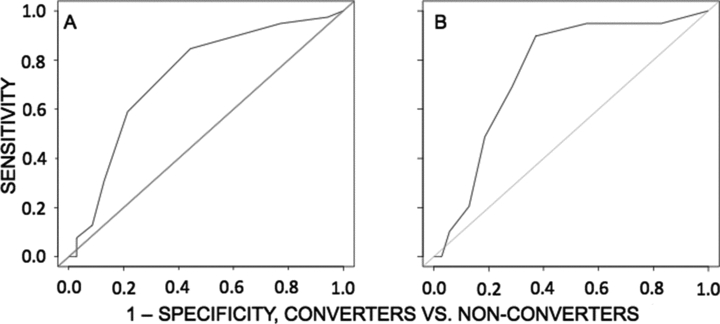
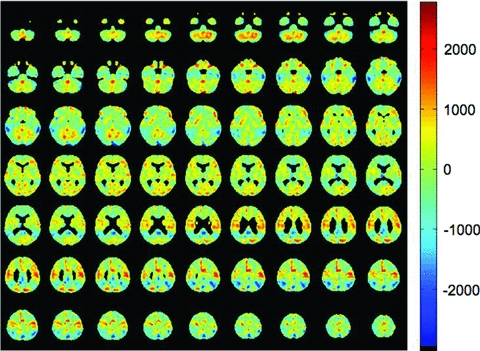
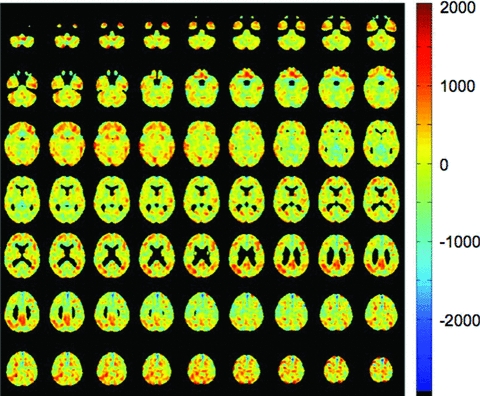
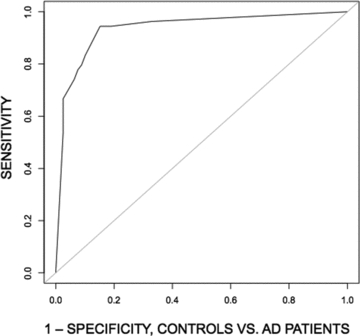
Alzheimer disease (AD) is an increasingly prevalent neurodegenerative condition and a looming socioeconomic threat. A biomarker for the disease could make the process of diagnosis easier and more accurate, and accelerate drug discovery. The current work describes a method for scoring brain images that is inspired by fundamental principles from information retrieval (IR), a branch of computer science that includes the development of Internet search engines. For this research, a dataset of 254 baseline 18-F fluorodeoxyglucose positron emission tomography (FDG-PET) scans was obtained from the Alzheimer's Disease Neuroimaging Initiative (ADNI). For a given contrast, a subset of scans (nine of every 10) was used to compute a residual vector that typified the difference, at each voxel, between the two groups being contrasted. Scans that were not used for computing the residual vector (the remaining one of 10 scans) were then compared to the residual vector using a cosine similarity metric. This process was repeated sequentially, each time generating cosine similarity scores on 10% of the FDG-PET scans for each contrast. Statistical analysis revealed that the scores were significant predictors of functional decline as measured by the Functional Activities Questionnaire (FAQ). When logistic regression models that incorporated these scores were evaluated with leave-one-out cross-validation, cognitively normal controls were discerned from AD with sensitivity and specificity of 94.4% and 84.8%, respectively. Patients who converted from mild cognitive impairment (MCI) to AD were discerned from MCI nonconverters with sensitivity and specificity of 89.7% and 62.9%, respectively, when FAQ scores were brought into the model. Residual vectors are easy to compute and provide a simple method for scoring the similarity between an FDG-PET scan and sets of examples from a given diagnostic group. The method is readily generalizable to any imaging modality. Further interdisciplinary work between IR and clinical neuroscience is warranted.
阿尔茨海默病(AD)是一种日益普遍的神经退行性疾病,也是一个迫在眉睫的社会经济威胁。疾病的生物标志物可以使诊断过程更容易、更准确,并加速药物发现。目前的工作描述了一种基于信息检索(IR)基本原理的脑图像评分方法,IR 是计算机科学的一个分支,包括互联网搜索引擎的开发。在这项研究中,从阿尔茨海默病神经影像学倡议(ADNI)获得了 254 例基线 18-F 氟脱氧葡萄糖正电子发射断层扫描(FDG-PET)扫描的数据集。对于给定的对比,使用扫描的子集(每 10 个中的 9 个)来计算残差向量,该向量典型地表示对比的两组之间每个体素的差异。然后,使用余弦相似性度量将未用于计算残差向量的扫描(剩余的 10 个扫描中的一个)与残差向量进行比较。这个过程依次重复,每次为每个对比生成 10%的 FDG-PET 扫描的余弦相似得分。统计分析表明,这些分数是功能活动问卷(FAQ)测量的功能下降的显著预测因子。当使用留一交叉验证评估包含这些分数的逻辑回归模型时,认知正常对照者与 AD 之间的灵敏度和特异性分别为 94.4%和 84.8%。当将 FAQ 分数纳入模型时,从轻度认知障碍(MCI)转化为 AD 的患者与 MCI 非转化者之间的灵敏度和特异性分别为 89.7%和 62.9%。残差向量易于计算,并为 FDG-PET 扫描与给定诊断组的示例集之间的相似性提供了一种简单的评分方法。该方法易于推广到任何成像模式。IR 和临床神经科学之间需要进一步的跨学科工作。