Public Health, Epidemiology and Biostatistics, University of Birmingham, Birmingham, UK.
Diabetes Care. 2012 May;35(5):1158-64. doi: 10.2337/dc11-1714. Epub 2012 Mar 7.
Optimal vitamin D levels are associated with reduced cardiovascular and all-cause mortality. We investigated whether optimal 25-hydroxyvitamin D (25[OH]D) is protective in individuals with the metabolic syndrome.
The Ludwigshafen Risk and Cardiovascular Health (LURIC) study is a cohort study of subjects referred for coronary angiography between 1997 and 2000, from which 1,801 with the metabolic syndrome were investigated. Mortality was tracked for a median of 7.7 years. Multivariable survival analysis was used to estimate the association between 25(OH)D levels and mortality.
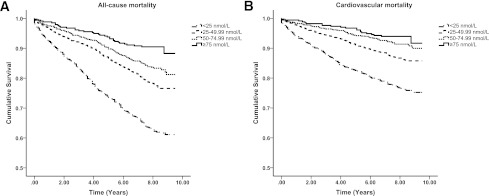
Most subjects (92%) had suboptimal levels of 25(OH)D (<75 nmol/L), with 22.2% being severely deficient (<25 nmol/L). During follow-up, 462 deaths were recorded, 267 (57.8%) of which were cardiovascular in origin. After full adjustment, including the metabolic syndrome components, those with optimal 25(OH)D levels showed a substantial reduction in all-cause (hazard ratio [HR] 0.25 [95% CI 0.13-0.46]) and cardiovascular disease mortality (0.33 [0.16-0.66]) compared with those with severe vitamin D deficiency. For specific cardiovascular disease mortality, there was a strong reduction for sudden death (0.15 [0.04-0.63]) and congestive heart failure (0.24 [0.06-1.04]), but not for myocardial infarction. The reduction in mortality was dose-dependent for each of these causes.
Optimal 25(OH)D levels substantially lowered all-cause and cardiovascular disease mortality in subjects with the metabolic syndrome. These observations call for interventional studies that test whether vitamin D supplementation provides a useful adjunct in reducing mortality in these subjects.
最佳维生素 D 水平与降低心血管疾病和全因死亡率相关。我们研究了代谢综合征患者中,最佳 25-羟维生素 D(25[OH]D)是否具有保护作用。
路德维希港风险与心血管健康(LURIC)研究是一项于 1997 年至 2000 年期间进行的冠状动脉造影患者的队列研究,其中有 1801 名代谢综合征患者被纳入研究。中位随访 7.7 年,用于评估 25(OH)D 水平与死亡率之间的关系。
大多数患者(92%)25(OH)D 水平不理想(<75 nmol/L),22.2%严重缺乏(<25 nmol/L)。随访期间,有 462 例死亡记录,其中 267 例(57.8%)为心血管源性。经过充分调整,包括代谢综合征的组成部分,与严重维生素 D 缺乏的患者相比,最佳 25(OH)D 水平的患者全因死亡率(风险比[HR]0.25[95%可信区间 0.13-0.46])和心血管疾病死亡率(0.33[0.16-0.66])显著降低。对于特定的心血管疾病死亡率,猝死风险降低幅度较大(0.15[0.04-0.63])和充血性心力衰竭(0.24[0.06-1.04]),但心肌梗死则没有。这些原因的死亡率降低与剂量呈依赖性。
代谢综合征患者的最佳 25(OH)D 水平显著降低全因和心血管疾病死亡率。这些观察结果呼吁进行干预性研究,以测试维生素 D 补充是否能为降低这些患者的死亡率提供有用的辅助手段。