Department of Biological Sciences, University of Southern California, Los Angeles CA, USA.
Front Neuroinform. 2012 Feb 28;6:2. doi: 10.3389/fninf.2012.00002. eCollection 2012.
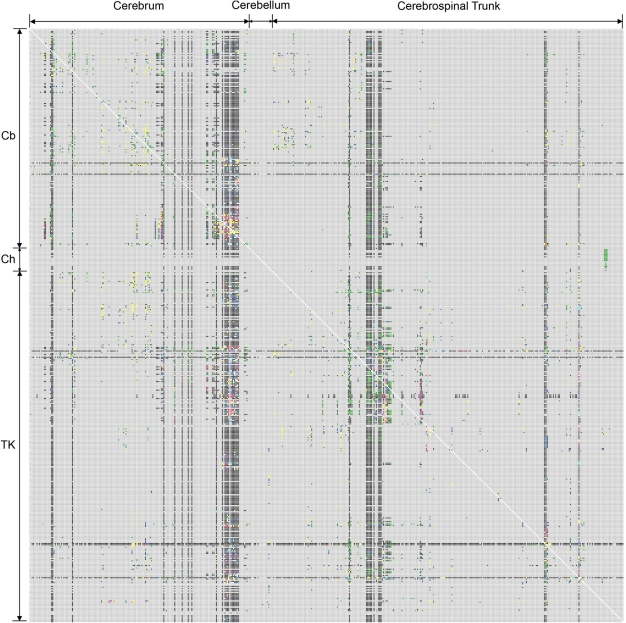
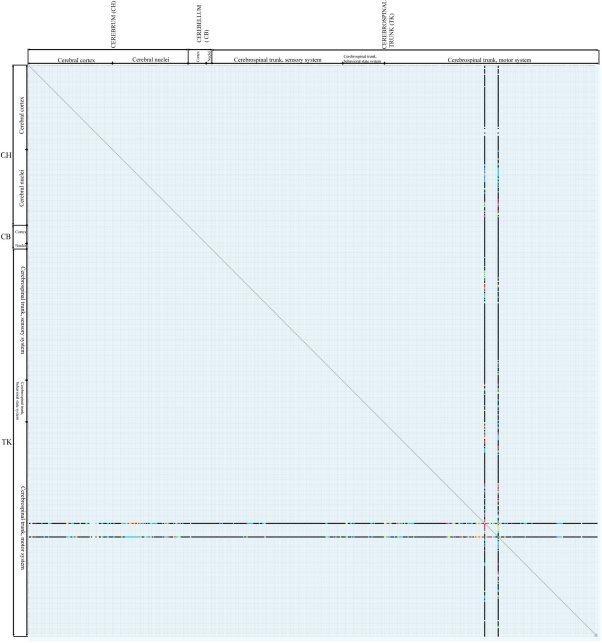
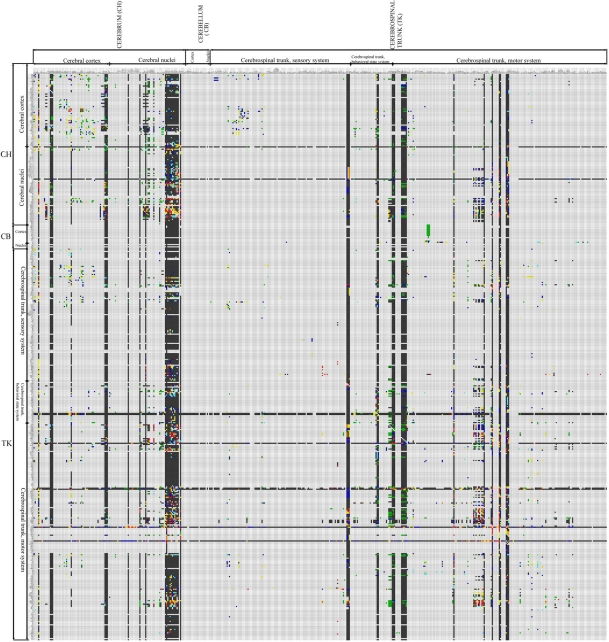
Many different independently published neuroanatomical parcellation schemes (brain maps, nomenclatures, or atlases) can exist for a particular species, although one scheme (a standard scheme) is typically chosen for mapping neuroanatomical data in a particular study. This is problematic for building connection matrices (connectomes) because the terms used to name structures in different parcellation schemes differ widely and interrelationships are seldom defined. Therefore, data sets cannot be compared across studies that have been mapped on different neuroanatomical atlases without a reliable translation method. Because resliceable 3D brain models for relating systematically and topographically different parcellation schemes are still in the first phases of development, it is necessary to rely on qualitative comparisons between regions and tracts that are either inserted directly by neuroanatomists or trained annotators, or are extracted or inferred by collators from the available literature. To address these challenges, we developed a publicly available neuroinformatics system, the Brain Architecture Knowledge Management System (BAMS; http://brancusi.usc.edu/bkms). The structure and functionality of BAMS is briefly reviewed here, as an exemplar for constructing interrelated connectomes at different levels of the mammalian central nervous system organization. Next, the latest version of BAMS rat macroconnectome is presented because it is significantly more populated with the number of inserted connectivity reports exceeding a benchmark value (50,000), and because it is based on a different classification scheme. Finally, we discuss a general methodology and strategy for producing global connection matrices, starting with rigorous mapping of data, then inserting and annotating it, and ending with online generation of large-scale connection matrices.
许多不同的独立发表的神经解剖分区方案(脑图谱、命名法或图谱)可以存在于特定物种中,尽管通常为特定研究中的神经解剖数据选择一个方案(标准方案)。这对于构建连接矩阵(连接组)来说是有问题的,因为不同分区方案中用于命名结构的术语差异很大,并且很少定义相互关系。因此,如果没有可靠的翻译方法,就无法在基于不同神经解剖图谱进行映射的研究之间比较数据集。由于可重新切片的 3D 大脑模型用于系统地和地形上不同的分区方案仍处于开发的第一阶段,因此有必要依赖神经解剖学家或受过训练的注释者直接插入的区域和束之间的定性比较,或者由协作者从现有文献中提取或推断。为了解决这些挑战,我们开发了一个公共可用的神经信息学系统,即大脑架构知识管理系统(BAMS;http://brancusi.usc.edu/bkms)。这里简要回顾了 BAMS 的结构和功能,作为在哺乳动物中枢神经系统组织的不同层次上构建相互关联的连接组的范例。接下来,介绍了最新版本的 BAMS 大鼠宏观连接组,因为它具有更多的插入连接报告数量(超过基准值 50,000),并且因为它基于不同的分类方案。最后,我们讨论了一种生成全局连接矩阵的通用方法和策略,从严格的数据映射开始,然后插入和注释它,最后在线生成大规模连接矩阵。