Rensselaer Polytechnic Institute, Computer Science Department, Troy, New York, United States of America.
PLoS One. 2012;7(3):e32906. doi: 10.1371/journal.pone.0032906. Epub 2012 Mar 5.
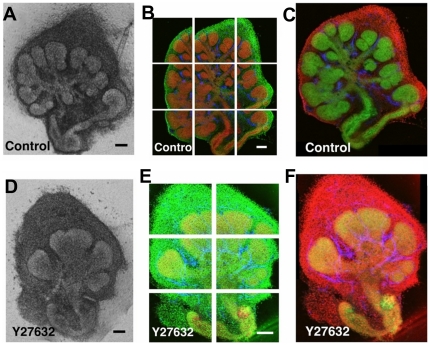
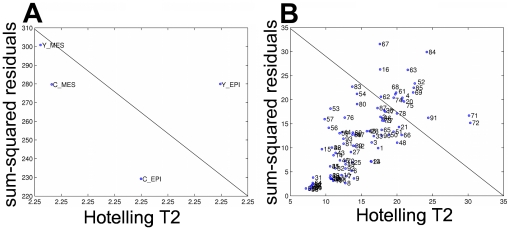
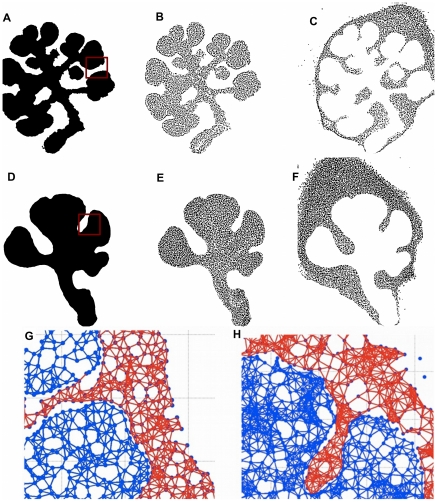
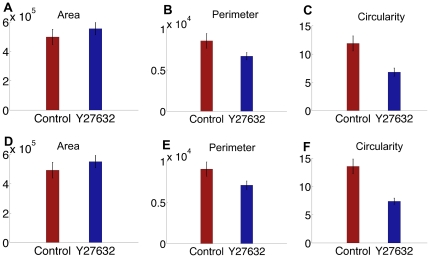
Pattern formation in developing tissues involves dynamic spatio-temporal changes in cellular organization and subsequent evolution of functional adult structures. Branching morphogenesis is a developmental mechanism by which patterns are generated in many developing organs, which is controlled by underlying molecular pathways. Understanding the relationship between molecular signaling, cellular behavior and resulting morphological change requires quantification and categorization of the cellular behavior. In this study, tissue-level and cellular changes in developing salivary gland in response to disruption of ROCK-mediated signaling by are modeled by building cell-graphs to compute mathematical features capturing structural properties at multiple scales. These features were used to generate multiscale cell-graph signatures of untreated and ROCK signaling disrupted salivary gland organ explants. From confocal images of mouse submandibular salivary gland organ explants in which epithelial and mesenchymal nuclei were marked, a multiscale feature set capturing global structural properties, local structural properties, spectral, and morphological properties of the tissues was derived. Six feature selection algorithms and multiway modeling of the data was performed to identify distinct subsets of cell graph features that can uniquely classify and differentiate between different cell populations. Multiscale cell-graph analysis was most effective in classification of the tissue state. Cellular and tissue organization, as defined by a multiscale subset of cell-graph features, are both quantitatively distinct in epithelial and mesenchymal cell types both in the presence and absence of ROCK inhibitors. Whereas tensor analysis demonstrate that epithelial tissue was affected the most by inhibition of ROCK signaling, significant multiscale changes in mesenchymal tissue organization were identified with this analysis that were not identified in previous biological studies. We here show how to define and calculate a multiscale feature set as an effective computational approach to identify and quantify changes at multiple biological scales and to distinguish between different states in developing tissues.
发育组织中的模式形成涉及细胞组织的动态时空变化,以及随后功能成人结构的演变。分支形态发生是一种发育机制,通过该机制,许多发育器官中产生了模式,该机制受潜在的分子途径控制。理解分子信号、细胞行为和导致形态变化之间的关系需要对细胞行为进行定量和分类。在这项研究中,通过构建细胞图来模拟发育中的唾液腺对 ROCK 介导的信号中断的组织水平和细胞变化,以计算捕获多个尺度结构特性的数学特征。这些特征用于生成未处理和 ROCK 信号中断的唾液腺器官外植体的多尺度细胞图特征。从小鼠下颌下唾液腺器官外植体的共聚焦图像中,对上皮和间充质核进行标记,得出了一个多尺度特征集,该特征集捕获了组织的全局结构特性、局部结构特性、光谱和形态特性。对数据进行了六种特征选择算法和多向建模,以识别可以唯一分类和区分不同细胞群体的独特细胞图特征子集。多尺度细胞图分析在组织状态的分类中最有效。细胞和组织组织,如由细胞图特征的多尺度子集定义的,在存在和不存在 ROCK 抑制剂的情况下,在上皮和间充质细胞类型中都是数量不同的。尽管张量分析表明 ROCK 信号抑制最能影响上皮组织,但通过该分析确定了间充质组织组织的显著多尺度变化,而以前的生物学研究并未确定这些变化。我们在这里展示了如何定义和计算多尺度特征集,作为一种有效的计算方法,可以识别和量化多个生物学尺度上的变化,并区分发育组织中的不同状态。