Department of Microbiology, Oregon State University, Corvallis, 97331, USA.
BMC Microbiol. 2012 Mar 9;12:30. doi: 10.1186/1471-2180-12-30.
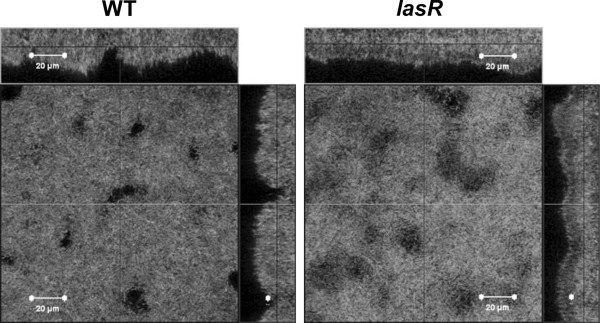
Acyl-homoserine lactone (acyl-HSL) and alkyl quinolone (AQ) based quorum-sensing (QS) systems are important for Pseudomonas aeruginosa virulence and biofilm formation. The effect of QS on biofilm formation is influenced by various genetic and environmental factors. Here, we used a colony biofilm assay to study the effect of the central acyl-HSL QS regulator, LasR, on biofilm formation and structure in the representative clinical P. aeruginosa isolate ZK2870.
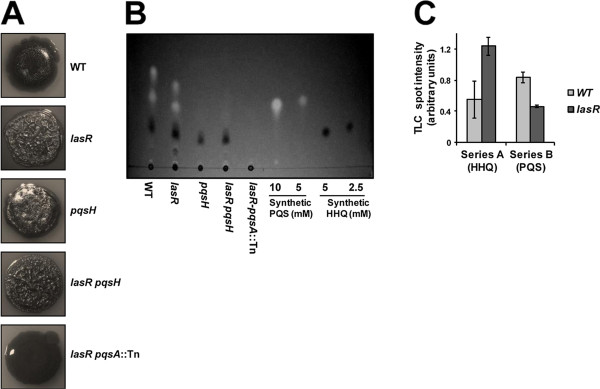
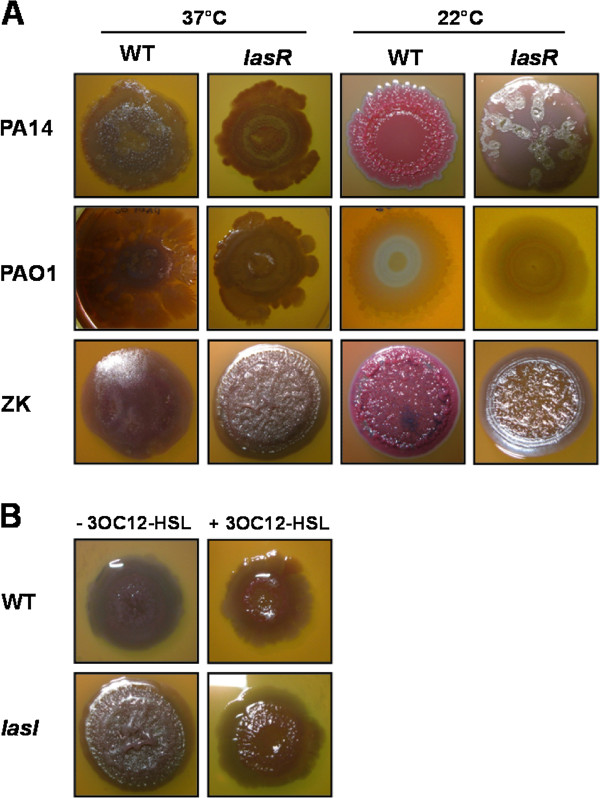
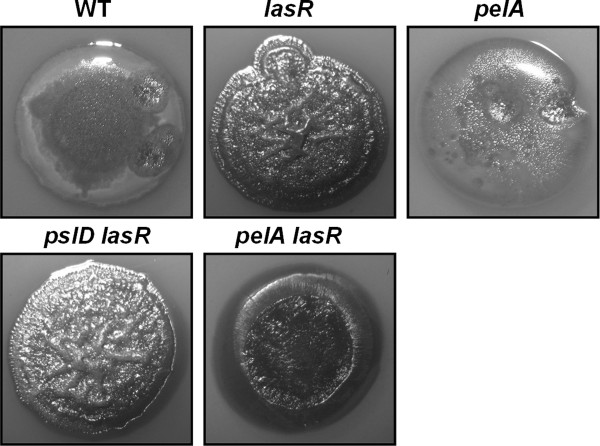
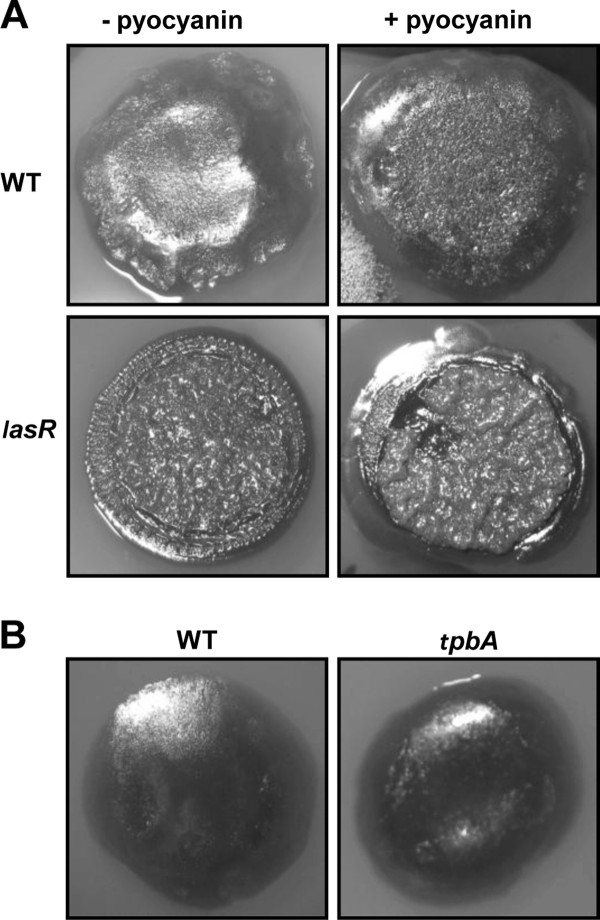
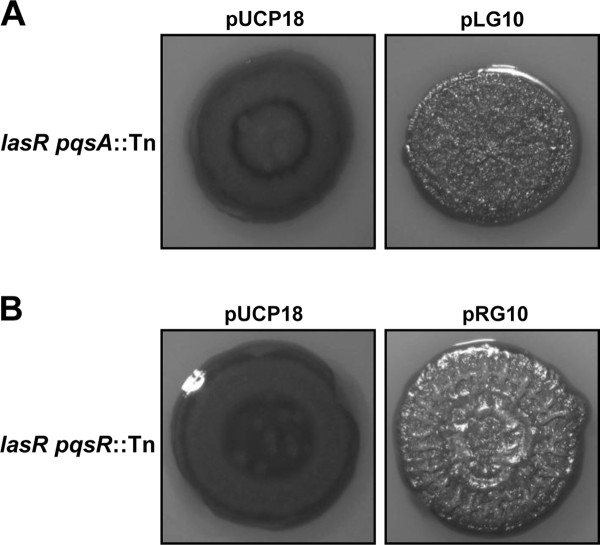
A lasR mutant exhibited wrinkled colony morphology at 37°C in contrast to the smooth colony morphology of the wild-type. Mutational analysis indicated that wrinkling of the lasR mutant is dependent on pel, encoding a biofilm matrix exopolysaccharide. Suppressor mutagenesis and complementation analysis implicated the AQ signaling pathway as the link between las QS and colony morphology. In this pathway, genes pqsA-D are involved in the synthesis of 4-hydroxyalkyl quinolines ("Series A congeners"), which are converted to 3,4-dihydroxyalkyl quinolines ("Series B congeners", including the well-characterized Pseudomonas Quinolone Signal, PQS) by the product of the LasR-dependent pqsH gene. Measurement of AQ in the wild-type, the lasR pqsA::Tn suppressor mutant as well as the defined lasR, pqsH, and lasR pqsH mutants showed a correlation between 4-hydroxyalkyl quinoline levels and the degree of colony wrinkling. Most importantly, the lasR pqsH double mutant displayed wrinkly morphology without producing any 3,4-dihydroxyalkyl quinolines. Constitutive expression of pqsA-D genes in a lasR pqsR::Tnmutant showed that colony wrinkling does not require the AQ receptor PqsR.
Taken together, these results indicate that the las QS system represses Pel and modulates colony morphology through a 4-hydroxyalkyl quinoline in a PqsR-independent manner, ascribing a novel function to an AQ other than PQS in P. aeruginosa.
酰基高丝氨酸内酯(acyl-HSL)和烷基喹诺酮(AQ)为基础的群体感应(QS)系统对铜绿假单胞菌的毒力和生物膜形成至关重要。QS 对生物膜形成的影响受到各种遗传和环境因素的影响。在这里,我们使用菌落生物膜测定法来研究代表性临床铜绿假单胞菌分离株 ZK2870 中中央酰基-HSL QS 调节剂 LasR 对生物膜形成和结构的影响。
LasR 突变体在 37°C 时表现出皱缩的菌落形态,而野生型则表现出光滑的菌落形态。突变分析表明,LasR 突变体的皱缩依赖于 pel,该基因编码生物膜基质胞外多糖。抑制性诱变和互补分析表明,AQ 信号通路是 Las QS 与菌落形态之间的联系。在这个途径中,基因 pqsA-D 参与了 4-羟烷基喹啉(“A 系列同系物”)的合成,这些化合物通过 LasR 依赖性 pqsH 基因的产物转化为 3,4-二羟烷基喹啉(“B 系列同系物”,包括著名的假单胞菌喹诺酮信号 PQS)。在野生型、LasR pqsA::Tn 抑制突变体以及定义明确的 LasR、pqsH 和 LasR pqsH 突变体中测量 AQ 时,发现 4-羟烷基喹啉水平与菌落皱缩程度之间存在相关性。最重要的是,LasR pqsH 双突变体在不产生任何 3,4-二羟烷基喹啉的情况下表现出皱缩形态。LasR pqsR::Tn 突变体中 pqsA-D 基因的组成型表达表明,菌落皱缩不需要 AQ 受体 PqsR。
总之,这些结果表明,Las QS 系统通过一种 PqsR 独立的方式抑制 Pel 并调节菌落形态,这归因于铜绿假单胞菌中 AQ 除 PQS 以外的新功能。