Chinese Center for Disease Control and Prevention, Beijing, China.
PLoS One. 2012;7(3):e32976. doi: 10.1371/journal.pone.0032976. Epub 2012 Mar 7.
Tuberculosis (TB), caused by Mycobacterium tuberculosis complex (MTBC), is one of the major causes of death in the world today. Although China has the second largest global case rate of tuberculosis, a systematic study of TB prevalence in China has not been completed. From 2006 to 2007, the base line surveillance of tuberculosis was carried out by Ministry of Health, and more than 4000 representative strains were selected from 31 provinces in China.
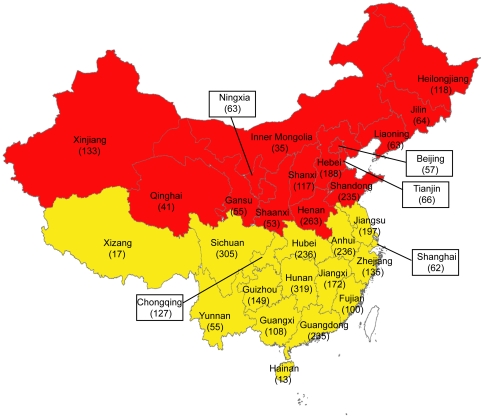
METHODOLOGY/PRINCIPAL FINDINGS: The aim of the present research was to survey the genotypes of representative Mycobacterium tuberculosis (M. tuberculosis) strains from China using spacer oligonucleotide typing (spoligotyping), and to analyze the relationship between genotype and drug resistance for the first time. A total of 4017 clinical isolates were collected from 2007 to 2008 throughout China. Among those M. tuberculosis isolates, 2500 (62.2%) isolates were Beijing genotypes. The percentage of Beijing genotypes in northern China was higher than in southern China (76.5% vs. 53.2%). Additionally, the frequencies of rifampin-resistant, ofloxacin-resistant and multidrug-resistant isolates were significantly higher in Beijing genotype strains than non-Beijing strains. Furthermore, a novel genotype named "China Southern genotype (CS)" was only isolated from Fujian and Guangdong provinces. Hence, it is very practical to uncover the reason for prevalence of the CS type in southern China.
CONCLUSIONS/SIGNIFICANCE: In conclusion, Beijing family genotypes were still the predominant genotype throughout China, which exhibited a greater correlation with rifampin-resistance, ofloxacin-resistance and MDR phenotypes than other TB spoligotypes, and some regions of China showed several unique characters in the distribution of M. tuberculosis genotypes. Our research represents an important contribution for the TB control and research community, which completes broad pictures on drug resistance levels and distribution of M. tuberculosis strain types over China.
结核病(TB)是由结核分枝杆菌复合群(MTBC)引起的,是当今世界主要的死亡原因之一。尽管中国的结核病发病率在全球居第二位,但尚未完成对中国结核病流行情况的系统研究。2006-2007 年,卫生部开展了结核病基线监测工作,从全国 31 个省(自治区、直辖市)中抽取了 4000 余株代表株。
方法/主要发现:本研究旨在利用间隔寡核苷酸分型( spoligotyping)对中国代表结核分枝杆菌(M. tuberculosis)菌株进行基因型调查,并首次分析基因型与耐药性之间的关系。2007-2008 年,从全国范围内收集了 4017 株临床分离株。在这些结核分枝杆菌分离株中,2500 株(62.2%)为北京基因型。北方地区北京基因型的比例高于南方地区(76.5%比 53.2%)。此外,北京基因型菌株的利福平耐药、氧氟沙星耐药和耐多药菌株的频率明显高于非北京基因型菌株。此外,一种新的基因型命名为“中国南方基因型(CS)”,仅从福建和广东分离到。因此,揭示中国南方 CS 型流行的原因是非常有实际意义的。
总之,北京家族基因型在中国仍然是主要的基因型,与利福平耐药、氧氟沙星耐药和 MDR 表型的相关性大于其他结核 spoligotypes,中国的一些地区在结核分枝杆菌基因型的分布上表现出一些独特的特征。我们的研究为结核病控制和研究界做出了重要贡献,全面描绘了中国耐药水平和结核分枝杆菌菌株类型的分布情况。