Department of Molecular Biology, University of Medicine and Dentistry of New Jersey, Stratford, NJ 08084, USA.
Mol Biol Cell. 2012 May;23(9):1609-17. doi: 10.1091/mbc.E11-06-0536. Epub 2012 Mar 21.
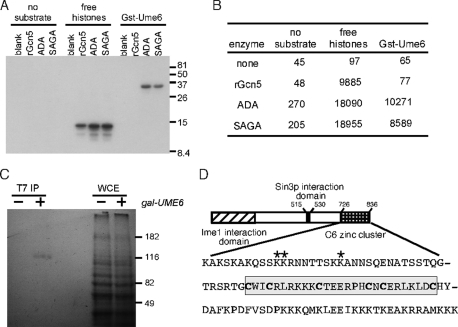
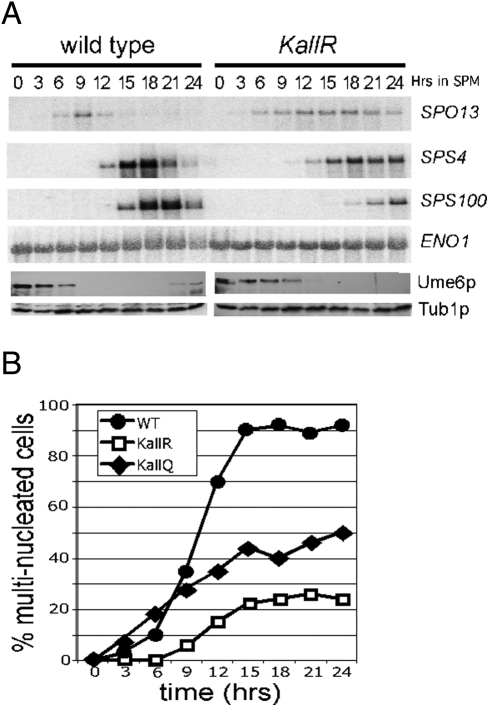
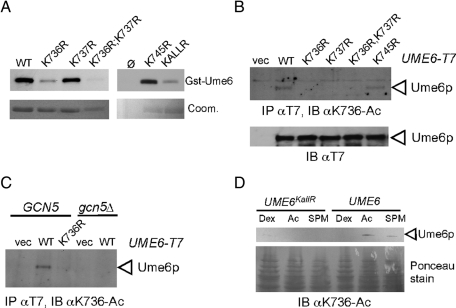
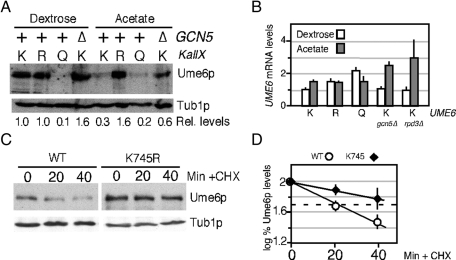
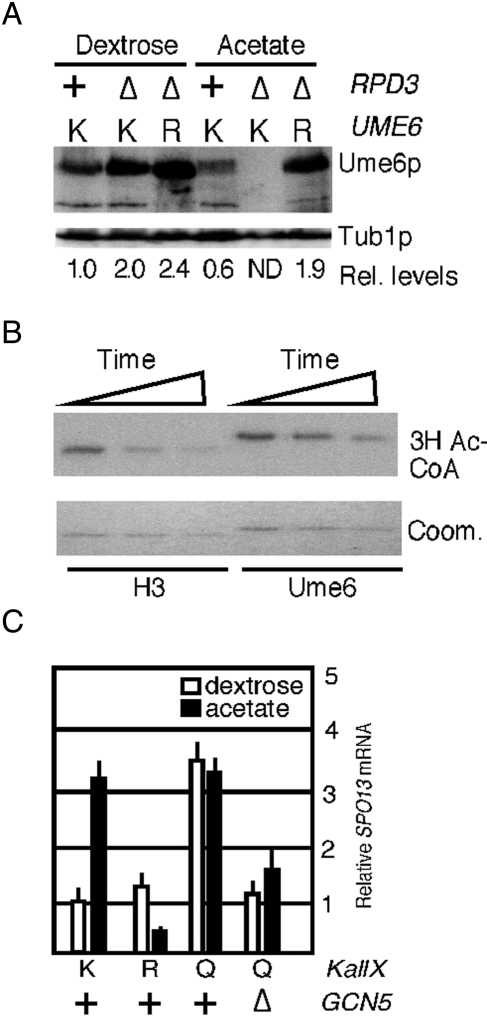
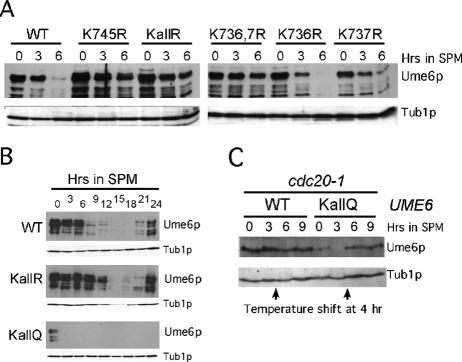
Ume6p represses early meiotic gene transcription in Saccharomyces cerevisiae by recruiting the Rpd3p histone deacetylase and chromatin-remodeling proteins. Ume6p repression is relieved in a two-step destruction process mediated by the anaphase-promoting complex/cyclosome (APC/C) ubiquitin ligase. The first step induces partial Ume6p degradation when vegetative cells shift from glucose- to acetate-based medium. Complete proteolysis happens only upon meiotic entry. Here we demonstrate that the first step in Ume6p destruction is controlled by its acetylation and deacetylation by the Gcn5p acetyltransferase and Rpd3p, respectively. Ume6p acetylation occurs in medium lacking dextrose and results in a partial destruction of the repressor. Preventing acetylation delays Ume6p meiotic destruction and retards both the transient transcription program and execution of the meiotic nuclear divisions. Conversely, mimicking acetylation induces partial destruction of Ume6p in dextrose medium and accelerates meiotic degradation by the APC/C. These studies reveal a new mechanism by which acetyltransferase activity induces gene expression through targeted destruction of a transcriptional repressor. These findings also demonstrate an important role for nonhistone acetylation in the transition between mitotic and meiotic cell division.
Ume6p 通过招募 Rpd3p 组蛋白去乙酰化酶和染色质重塑蛋白来抑制酿酒酵母中的早期减数分裂基因转录。Ume6p 的抑制作用通过后期促进复合物/环体 (APC/C) 泛素连接酶介导的两步破坏过程得到缓解。第一步在营养细胞从葡萄糖基到基于醋酸盐的培养基中转移时诱导部分 Ume6p 降解。只有在减数分裂进入时才会发生完全蛋白水解。在这里,我们证明 Ume6p 破坏的第一步受其乙酰化和去乙酰化的控制,分别由 Gcn5p 乙酰转移酶和 Rpd3p 控制。Ume6p 的乙酰化发生在缺乏葡萄糖的培养基中,导致抑制剂的部分破坏。阻止乙酰化会延迟 Ume6p 的减数破坏,并延迟瞬时转录程序和减数核分裂的执行。相反,模拟乙酰化会在葡萄糖培养基中诱导 Ume6p 的部分破坏,并通过 APC/C 加速减数降解。这些研究揭示了乙酰转移酶活性通过靶向破坏转录抑制剂来诱导基因表达的新机制。这些发现还表明,非组蛋白乙酰化在有丝分裂和减数分裂细胞分裂之间的转变中起着重要作用。