Institute of Pathology, University of Veterinary Medicine Hannover, Bünteweg 17, D-30559 Hannover, Germany.
Vet Res. 2012 Mar 22;43(1):23. doi: 10.1186/1297-9716-43-23.
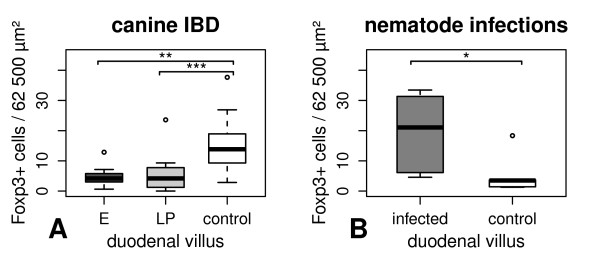
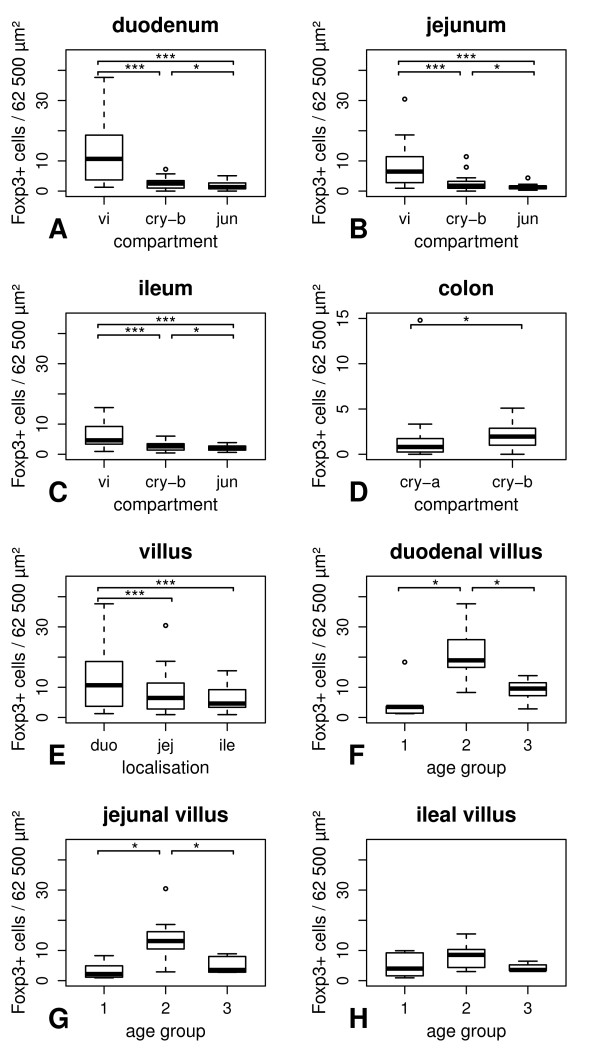
Intestinal immune regulation including development of oral tolerance is of great importance for the maintenance of intestinal homeostasis. Concerning this, regulatory T cells (Tregs) occupy a pivotal role in cell-mediated immunosuppression. Dysregulation of mucosal immunology leading to an abnormal interaction with commensal bacteria is suggested to play a key role in the pathogenesis of Inflammatory Bowel Disease (IBD) in men and dogs. The aim of this study was to characterise the expression of Foxp3 in the normal canine gut of 18 dogs (mean age: 6.03 years), in 16 dogs suffering from IBD (mean age: 5.05 years), and of 6 dogs with intestinal nematode infection (mean age: 0.87 years) using immunohistochemistry. In the duodenum, Tregs in healthy dogs declined from villi (median: 10.67/62 500 μm2) to crypts (median: 1.89/62 500 μm2). Tregs were further increased in the villi of middle-aged dogs (median: 18.92/62 500 μm2) in contrast to juvenile (median: 3.50/62 500 μm2) and old (median: 9.56/62 500 μm2) individuals. Compared to healthy controls, animals suffering from IBD revealed reduced numbers of Tregs in duodenal villi (median: 4.13/62 500 μm2). Dogs with intestinal nematode infection displayed increased numbers of Tregs (median: 21.06/62 500 μm2) compared to healthy animals.Age-related changes indicate a progressive establishment of oral tolerance and immunosenescence in the canine elderly. The results further suggest that a defect in Treg homeostasis may be involved in the pathogenesis of canine IBD. In contrast, increased numbers of Tregs in the duodenum may be due to nematode infection.
肠道免疫调节包括口服耐受的发展对于维持肠道内稳态非常重要。在这方面,调节性 T 细胞(Tregs)在细胞介导的免疫抑制中起着关键作用。黏膜免疫失调导致与共生细菌的异常相互作用被认为在人类和犬的炎症性肠病(IBD)发病机制中起关键作用。本研究的目的是使用免疫组织化学方法研究 18 只正常犬(平均年龄:6.03 岁)、16 只患有 IBD 的犬(平均年龄:5.05 岁)和 6 只患有肠道线虫感染的犬(平均年龄:0.87 岁)肠道中 Foxp3 的表达特征。在十二指肠中,健康犬的 Tregs 从绒毛(中位数:10.67/62500μm2)到隐窝(中位数:1.89/62500μm2)减少。与幼年(中位数:3.50/62500μm2)和老年(中位数:9.56/62500μm2)个体相比,中年犬的绒毛中 Tregs 进一步增加(中位数:18.92/62500μm2)。与健康对照组相比,患有 IBD 的动物十二指肠绒毛中的 Tregs 数量减少(中位数:4.13/62500μm2)。患有肠道线虫感染的犬与健康动物相比,Tregs 数量增加(中位数:21.06/62500μm2)。年龄相关变化表明犬老年期口服耐受和免疫衰老的逐渐建立。结果进一步表明,Treg 稳态的缺陷可能参与犬 IBD 的发病机制。相比之下,十二指肠中 Tregs 数量的增加可能是由于线虫感染。