Project Phidisa, Pretoria, South Africa.
PLoS One. 2012;7(3):e24243. doi: 10.1371/journal.pone.0024243. Epub 2012 Mar 20.
Levels of high-sensitivity C-reactive protein (hsCRP), interleukin-6 (IL-6), and D-dimer predict mortality in HIV patients on antiretroviral therapy (ART) with relatively preserved CD4+ T cell counts. We hypothesized that elevated pre-ART levels of these markers among patients with advanced HIV would be associated with an increased risk of death following the initiation of ART.
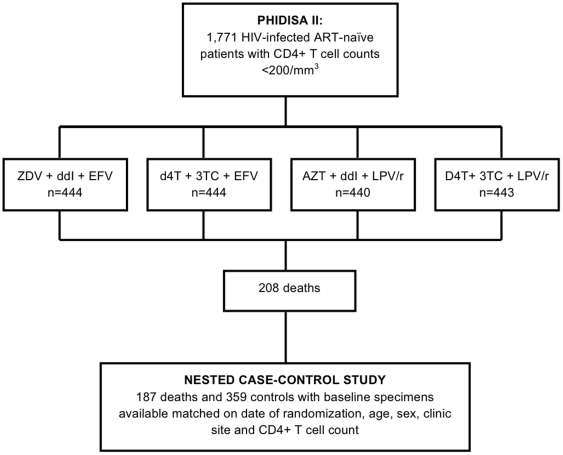
Pre-ART plasma from patients with advanced HIV in South Africa was used to measure hsCRP, IL-6 and D-dimer. Using a nested case-control study design, the biomarkers were measured for 187 deaths and two controls matched on age, sex, clinical site, follow-up time and CD4+ cell counts. Odds ratios were estimated using conditional logistic regression. In addition, for a random sample of 100 patients, biomarkers were measured at baseline and 6 months following randomization to determine whether ART altered their levels.
Median baseline biomarkers levels for cases and controls, respectively, were 11.25 vs. 3.6 mg/L for hsCRP, 1.41 vs. 0.98 mg/L for D-dimer, and 9.02 vs. 4.20 pg/mL for IL-6 (all p<0.0001). Adjusted odds ratios for the highest versus lowest quartile of baseline biomarker levels were 3.5 (95% CI: 1.9-6.7) for hsCRP, 2.6 (95%CI 1.4-4.9) for D-dimer, and 3.8 (95% CI: 1.8-7.8) for IL-6. These associations were stronger for deaths that occurred more proximal to the biomarker measurements. Levels of D-dimer and IL-6, but not hsCRP, were significantly lower at month 6 after commencing ART compared to baseline (p<0.0001).
Among patients with advanced HIV disease, elevated pre-ART levels of hsCRP, IL-6 and D-dimer are strongly associated with early mortality after commencing ART. Elevated levels of inflammatory and coagulation biomarkers may identify patients who may benefit from aggressive clinical monitoring after commencing ART. Further investigation of strategies to reduce biomarkers of inflammation and coagulation in patients with advanced HIV disease is warranted.
Parent study: ClinicalTrials.gov NCT00342355.
高水平的高敏 C 反应蛋白(hsCRP)、白细胞介素 6(IL-6)和 D-二聚体可预测接受抗逆转录病毒治疗(ART)且 CD4+T 细胞计数相对稳定的 HIV 患者的死亡率。我们假设,在 HIV 晚期患者中,这些标志物的 ART 前水平升高与 ART 开始后死亡风险增加有关。
使用来自南非 HIV 晚期患者的 ART 前血浆来测量 hsCRP、IL-6 和 D-二聚体。使用巢式病例对照研究设计,对 187 例死亡病例和 2 例年龄、性别、临床地点、随访时间和 CD4+细胞计数相匹配的对照病例进行了生物标志物检测。采用条件逻辑回归估计比值比。此外,对随机选择的 100 例患者进行了基线和随机分组后 6 个月的生物标志物检测,以确定 ART 是否改变了它们的水平。
病例和对照患者的中位基线生物标志物水平分别为 11.25mg/L 比 3.6mg/L(hsCRP)、1.41mg/L 比 0.98mg/L(D-二聚体)和 9.02pg/mL 比 4.20pg/mL(IL-6)(均<0.0001)。hsCRP、D-二聚体和 IL-6 最高与最低四分位基线生物标志物水平的调整比值比分别为 3.5(95%CI:1.9-6.7)、2.6(95%CI:1.4-4.9)和 3.8(95%CI:1.8-7.8)。这些关联在更接近生物标志物测量的死亡事件中更强。与基线相比,开始 ART 后 6 个月 D-二聚体和 IL-6 的水平(均<0.0001)显著降低,但 hsCRP 水平无显著变化。
在 HIV 晚期疾病患者中,ART 前 hsCRP、IL-6 和 D-二聚体水平升高与 ART 开始后早期死亡率密切相关。炎症和凝血生物标志物水平升高可能提示开始 ART 后需要进行积极的临床监测。进一步研究降低晚期 HIV 疾病患者炎症和凝血生物标志物的策略是有必要的。
母体研究:ClinicalTrials.gov NCT00342355。