State Key Laboratory of Genetic Resources and Evolution, Kunming Institute of Zoology, the Chinese Academy of Sciences, Kunming, China.
PLoS One. 2012;7(3):e34013. doi: 10.1371/journal.pone.0034013. Epub 2012 Mar 20.
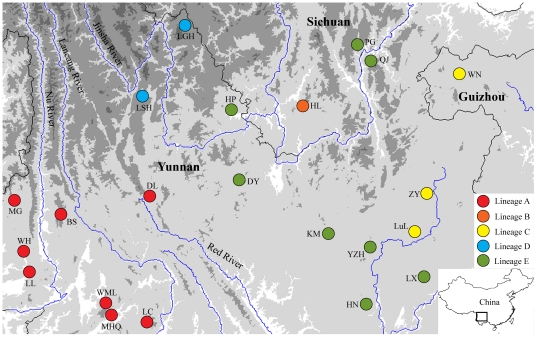
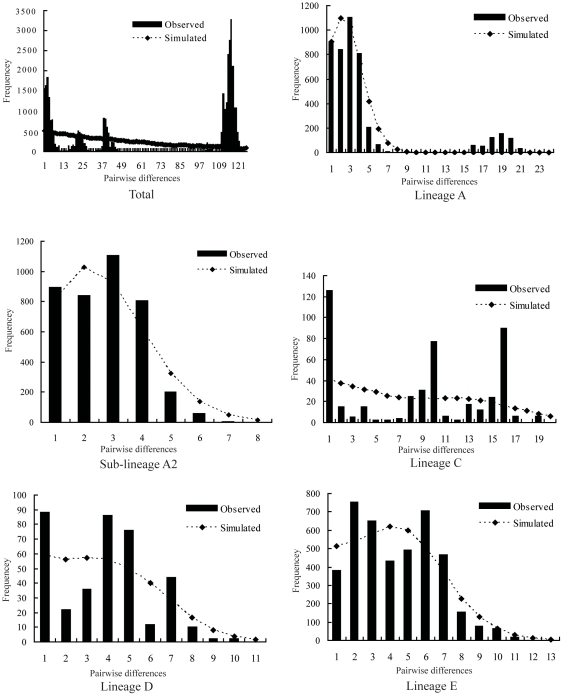
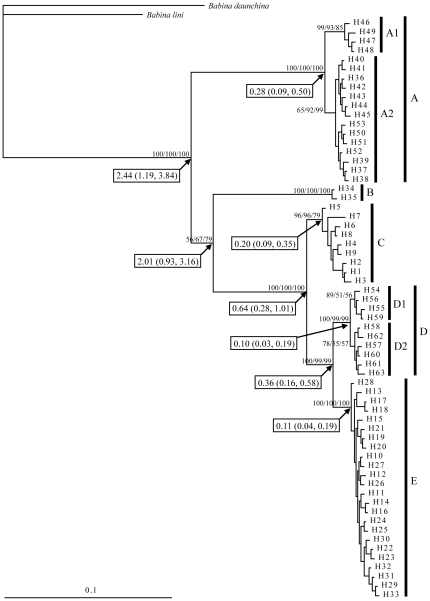
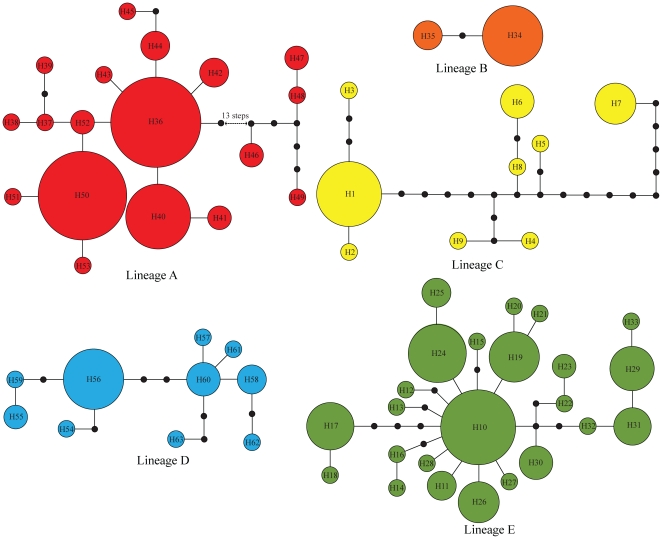
Factors that determine genetic structure of species in southwestern China remain largely unknown. In this study, sequences of two mitochondrial genes (COI and cyt b) were determined to investigate the phylogeography and demography of Babina pleuraden, a pond frog endemic to southwestern China. A total of 262 individuals from 22 populations across the entire range of the species were collected. Our results indicate that B. pleuraden comprises five well-supported mitochondrial lineages roughly corresponding to five geographical areas. The phylogeographic structure of B. pleuraden has been shaped primarily by the unique regional responses of the Yunnan Plateau to the rapid uplift of the Qinghai-Tibetan Plateau occurred c. 2.5 Mya (B phrase of Qingzang Movement) and climatic oscillation during middle Pleistocene (c. 0.64-0.36 Mya), rather than by the paleo-drainage systems. The present wide distribution of the species has resulted from recent population expansion (c. 0.053-0.025 Mya) from multiple refugia prior to the Last Glacial Maximum, corresponding to the scenario of "refugia within refugia".
在中国西南部,决定物种遗传结构的因素在很大程度上尚不清楚。在这项研究中,我们测定了两个线粒体基因(COI 和 cyt b)的序列,以调查中国西南部特有物种巴氏小雨蛙的系统地理学和种群动态。我们从该物种的整个分布范围内的 22 个种群中采集了 262 个个体。研究结果表明,巴氏小雨蛙由五个支持度较高的线粒体谱系组成,大致对应于五个地理区域。巴氏小雨蛙的系统地理学结构主要是由云南高原对约 250 万年前(青藏运动 B 幕)青藏高原快速抬升和中更新世气候振荡(约 0.64-0.36 百万年前)的独特区域响应所塑造的,而不是由古水系造成的。该物种目前的广泛分布是由于末次冰盛期之前从多个避难所发生的近期种群扩张(约 0.053-0.025 百万年前)造成的,这与“避难所内的避难所”情景相对应。