Sci Rep. 2012;2:334. doi: 10.1038/srep00334. Epub 2012 Mar 26.
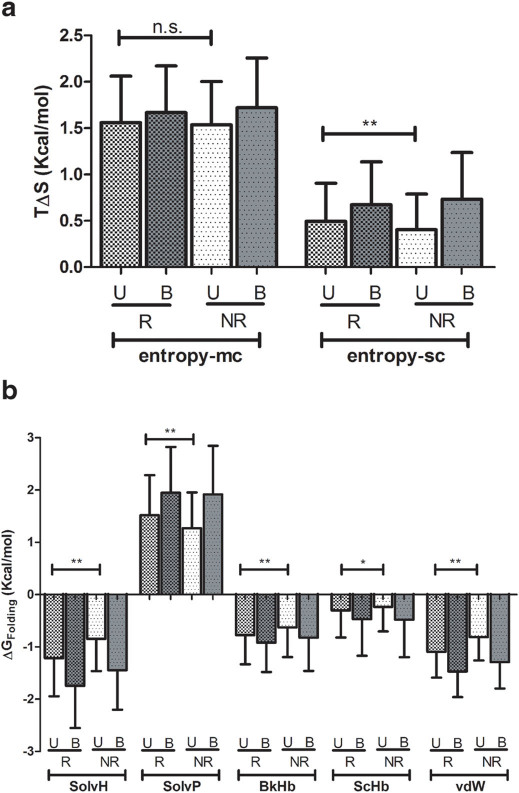
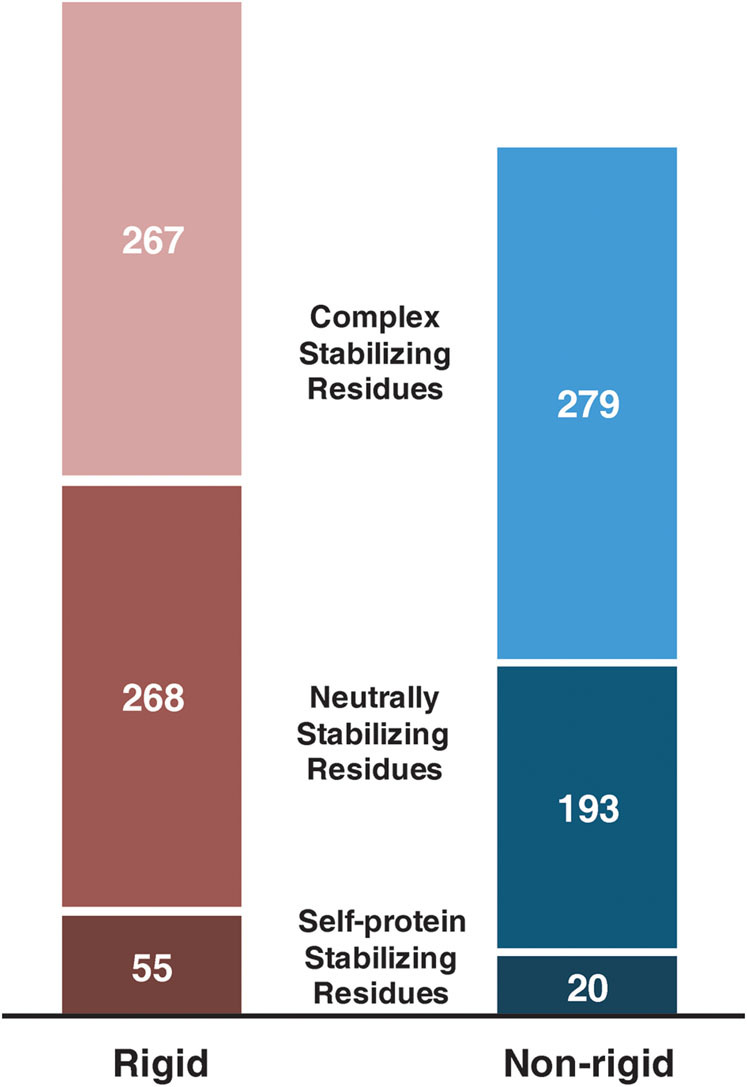
Transient protein-protein interactions play crucial roles in all facets of cellular physiology. Here, using an analysis on known 3-D structures of transient protein-protein complexes, their corresponding uncomplexed forms and energy calculations we seek to understand the roles of protein-protein interfacial residues in the unbound forms. We show that there are conformationally near invariant and evolutionarily conserved interfacial residues which are rigid and they account for ∼65% of the core interface. Interestingly, some of these residues contribute significantly to the stabilization of the interface structure in the uncomplexed form. Such residues have strong energetic basis to perform dual roles of stabilizing the structure of the uncomplexed form as well as the complex once formed while they maintain their rigid nature throughout. This feature is evolutionarily well conserved at both the structural and sequence levels. We believe this analysis has general bearing in the prediction of interfaces and understanding molecular recognition.
瞬时蛋白质-蛋白质相互作用在细胞生理学的各个方面都起着至关重要的作用。在这里,我们使用已知的瞬时蛋白质-蛋白质复合物的三维结构、它们相应的未复合物形式和能量计算来试图理解蛋白质-蛋白质界面残基在未结合形式中的作用。我们表明,存在构象上近不变和进化上保守的界面残基,它们是刚性的,占核心界面的约 65%。有趣的是,这些残基中的一些在未复合物形式中对界面结构的稳定有重要贡献。这些残基具有很强的能量基础,可以在复合物形成之前和之后稳定未复合物的结构,同时保持其刚性。这种特性在结构和序列水平上都得到了很好的进化保守。我们相信,这种分析对界面的预测和分子识别的理解具有普遍意义。