Department of Psychiatry, University of Michigan, Ann Arbor, MI 48105, USA.
Personal Disord. 2012 Jul;3(3):209-27. doi: 10.1037/a0025084. Epub 2011 Aug 29.
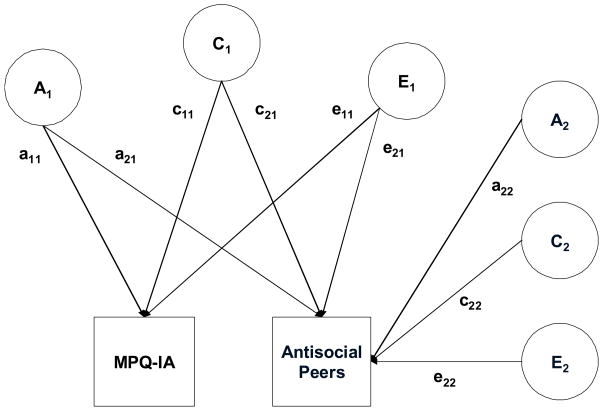
Theorists have speculated that primary psychopathy (or Factor 1 affective-interpersonal features) is prominently heritable whereas secondary psychopathy (or Factor 2 social deviance) is more environmentally determined. We tested this differential heritability hypothesis using a large adolescent twin sample. Trait-based proxies of primary and secondary psychopathic tendencies were assessed using Multidimensional Personality Questionnaire (MPQ) estimates of Fearless Dominance and Impulsive Antisociality, respectively. The environmental contexts of family, school, peers, and stressful life events were assessed using multiple raters and methods. Consistent with prior research, MPQ Impulsive Antisociality was robustly associated with each environmental risk factor, and these associations were significantly greater than those for MPQ Fearless Dominance. However, MPQ Fearless Dominance and Impulsive Antisociality exhibited similar heritability, and genetic effects mediated the associations between MPQ Impulsive Antisociality and the environmental measures. Results were largely consistent across male and female twins. We conclude that gene-environment correlations rather than main effects of genes and environments account for the differential environmental correlates of primary and secondary psychopathy.
理论家推测,原发性精神病态(或因子 1 情感-人际特征)主要具有遗传性,而继发性精神病态(或因子 2 社会偏差)更多地由环境决定。我们使用一个大型青少年双胞胎样本检验了这种差异遗传性假设。使用多维人格问卷(MPQ)对无畏支配和冲动反社会的估计,分别评估了原发性和继发性精神病态倾向的基于特质的代表。使用多个评估者和方法评估了家庭、学校、同伴和压力生活事件的环境背景。与先前的研究一致,MPQ 冲动反社会性与每个环境风险因素都有很强的关联,而且这些关联明显大于 MPQ 无畏支配的关联。然而,MPQ 无畏支配和冲动反社会性表现出相似的遗传性,并且遗传效应介导了 MPQ 冲动反社会性与环境测量之间的关联。结果在男性和女性双胞胎中基本一致。我们的结论是,基因-环境相关性而不是基因和环境的主要效应解释了原发性和继发性精神病态的不同环境相关性。