Department of Diabetes and Endocrinology, Centre Hospitalier Sud Francilien, Corbeil-Essonnes, France.
Diabetes Care. 2012 May;35(5):965-71. doi: 10.2337/dc11-2021. Epub 2012 Mar 28.
The benefits of real-time continuous glucose monitoring (CGM) have been demonstrated in patients with type 1 diabetes. Our aim was to compare the effect of two modes of use of CGM, patient led or physician driven, for 1 year in subjects with poorly controlled type 1 diabetes.
Patients with type 1 diabetes aged 8-60 years with HbA(1c) ≥ 8% were randomly assigned to three groups (1:1:1). Outcomes for glucose control were assessed at 1 year for two modes of CGM (group 1: patient led; group 2: physician driven) versus conventional self-monitoring of blood glucose (group 3: control).
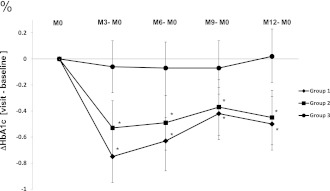
A total of 257 subjects with type 1 diabetes underwent screening. Of these, 197 were randomized, with 178 patients completing the study (age: 36 ± 14 years; HbA(1c): 8.9 ± 0.9%). HbA(1c) improved similarly in both CGM groups and was reduced compared with the control group (group 1 vs. group 3: -0.52%, P = 0.0006; group 2 vs. group 3: -0.47%, P = 0.0008; groups 1 + 2 vs. group 3: -0.50%, P < 0.0001). The incidence of hypoglycemia was similar in the three groups. Patient SF-36 questionnaire physical health score improved in both experimental CGM groups (P = 0.004). Sensor consumption was 34% lower in group 2 than in group 1 (median [Q1-Q3] consumption: group 1: 3.42/month [2.20-3.91] vs. group 2: 2.25/month [1.27-2.99], P = 0.001).
Both patient-led and physician-driven CGM provide similar long-term improvement in glucose control in patients with poorly controlled type 1 diabetes, but the physician-driven CGM mode used fewer sensors.
实时连续血糖监测(CGM)已在 1 型糖尿病患者中显示出益处。我们的目的是比较 CGM 两种使用模式(患者主导或医生驱动)在血糖控制不佳的 1 型糖尿病患者中使用 1 年的效果。
年龄在 8-60 岁之间、糖化血红蛋白(HbA1c)≥8%的 1 型糖尿病患者被随机分为三组(1:1:1)。在 1 年时评估两种 CGM 模式(组 1:患者主导;组 2:医生驱动)与常规自我监测血糖(组 3:对照组)的血糖控制结果。
共有 257 例 1 型糖尿病患者接受了筛查。其中,197 例被随机分组,178 例患者完成了研究(年龄:36±14 岁;HbA1c:8.9±0.9%)。两组 CGM 患者的 HbA1c 改善情况相似,与对照组相比均有所降低(组 1 与组 3 相比:-0.52%,P=0.0006;组 2 与组 3 相比:-0.47%,P=0.0008;组 1+2 与组 3 相比:-0.50%,P<0.0001)。三组患者的低血糖发生率相似。两组实验性 CGM 患者的 SF-36 问卷身体状况评分均有所改善(P=0.004)。与组 1 相比,组 2 的传感器使用率降低了 34%(中位数[Q1-Q3]使用率:组 1:3.42 个/月[2.20-3.91];组 2:2.25 个/月[1.27-2.99],P=0.001)。
在血糖控制不佳的 1 型糖尿病患者中,患者主导和医生驱动的 CGM 均能提供相似的长期血糖控制改善,但医生驱动的 CGM 模式使用的传感器更少。