Wood Rachael, Stirling Alex, Nolan Claire, Chalmers Jim, Blair Mitch
Information Services Division, NHS National Services Scotland, Edinburgh, UK.
BMJ Open. 2012 Mar 28;2(2):e000759. doi: 10.1136/bmjopen-2011-000759. Print 2012.
Universally offered child health reviews form the backbone of the UK child health programme. The reviews assess children's health, development and well-being and facilitate access to additional support as required. The number of reviews offered per child has been reduced over recent years to allow more flexible provision of support to families in need: equitable coverage of the remaining reviews is therefore particularly important. This study assessed the coverage of universal child health reviews, with an emphasis on trends over time and inequalities in coverage by deprivation.
Assessment of the coverage of child health reviews by area-based deprivation using routinely available data. Supplementary audit of the quality of the routine data source used.
Scotland.
Two cohorts of around 40 000 children each. The cohorts were born in 1998/1999 and 2007/2008 and eligible for the previous programme of five and the current programme of two preschool reviews, respectively.
Coverage of the specified child health reviews for the whole cohorts and by deprivation.
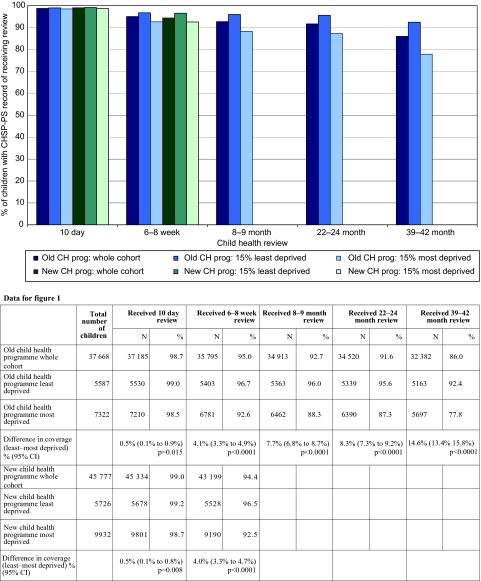
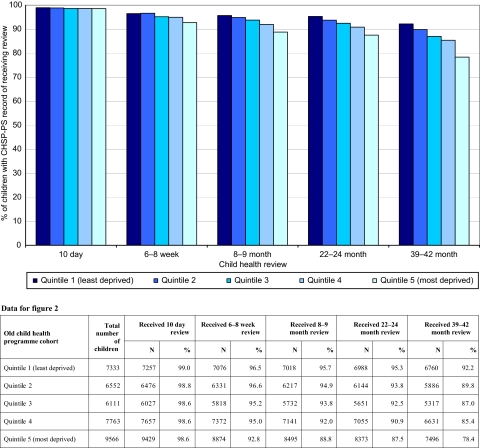
Coverage of the 10 day review is high (99%), but it progressively declines for reviews at older ages (86% for the 39-42 month review). Coverage is lower in children living in the most deprived areas for all reviews, and the discrepancy progressively increases for reviews at older ages (78% and 92% coverage for the 39-42 month review in most and least deprived groups). Coverage has been stable over time: it has not increased for the remaining reviews after reduction in the number of reviews provided.
The inverse care law continues to operate in relation to 'universal' child health reviews. Equitable uptake of reviews is important to ensure maximum likely impact on inequalities in children's outcomes.
普遍提供的儿童健康检查是英国儿童健康计划的核心。这些检查评估儿童的健康、发育和幸福状况,并根据需要促进获得额外支持。近年来,每个儿童接受的检查数量有所减少,以便更灵活地为有需要的家庭提供支持:因此,确保剩余检查的公平覆盖尤为重要。本研究评估了普遍儿童健康检查的覆盖情况,重点关注随时间的趋势以及贫困导致的覆盖不平等情况。
利用常规可得数据,按地区贫困程度评估儿童健康检查的覆盖情况。对所使用的常规数据源质量进行补充审核。
苏格兰。
两组队列,每组约40000名儿童。这些队列分别出生于1998/1999年和2007/2008年,分别符合之前的五次学前检查计划和当前的两次学前检查计划。
整个队列以及按贫困程度划分的特定儿童健康检查的覆盖情况。
出生10天检查的覆盖率很高(99%),但随着年龄增长,检查的覆盖率逐渐下降(39 - 42个月检查的覆盖率为86%)。所有检查中,生活在最贫困地区的儿童覆盖率较低,且随着年龄增长,这种差异逐渐增大(最贫困和最不贫困组在39 - 42个月检查中的覆盖率分别为78%和92%)。随着时间推移,覆盖率一直保持稳定:在提供的检查数量减少后,剩余检查的覆盖率没有增加。
在“普遍”的儿童健康检查方面,逆向关怀法则仍然适用。公平接受检查对于确保对儿童结局不平等产生最大可能影响至关重要。