Department of Psychology, University of Notre Dame, Notre Dame, Indiana, United States of America.
PLoS One. 2012;7(3):e33079. doi: 10.1371/journal.pone.0033079. Epub 2012 Mar 22.
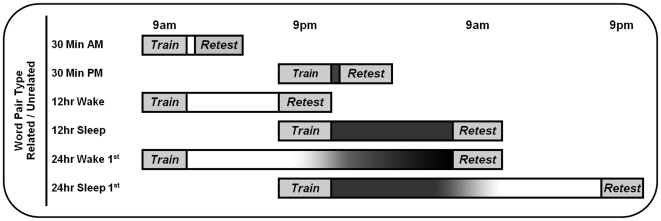
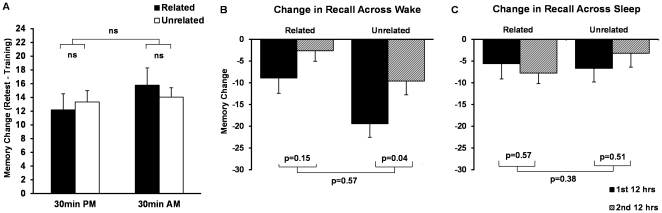
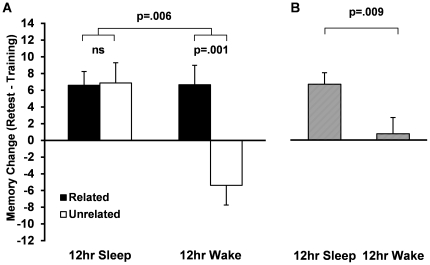
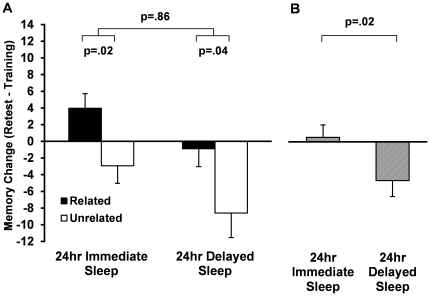
Numerous studies have examined sleep's influence on a range of hippocampus-dependent declarative memory tasks, from text learning to spatial navigation. In this study, we examined the impact of sleep, wake, and time-of-day influences on the processing of declarative information with strong semantic links (semantically related word pairs) and information requiring the formation of novel associations (unrelated word pairs). Participants encoded a set of related or unrelated word pairs at either 9 am or 9 pm, and were then tested after an interval of 30 min, 12 hr, or 24 hr. The time of day at which subjects were trained had no effect on training performance or initial memory of either word pair type. At 12 hr retest, memory overall was superior following a night of sleep compared to a day of wakefulness. However, this performance difference was a result of a pronounced deterioration in memory for unrelated word pairs across wake; there was no sleep-wake difference for related word pairs. At 24 hr retest, with all subjects having received both a full night of sleep and a full day of wakefulness, we found that memory was superior when sleep occurred shortly after learning rather than following a full day of wakefulness. Lastly, we present evidence that the rate of deterioration across wakefulness was significantly diminished when a night of sleep preceded the wake period compared to when no sleep preceded wake, suggesting that sleep served to stabilize the memories against the deleterious effects of subsequent wakefulness. Overall, our results demonstrate that 1) the impact of 12 hr of waking interference on memory retention is strongly determined by word-pair type, 2) sleep is most beneficial to memory 24 hr later if it occurs shortly after learning, and 3) sleep does in fact stabilize declarative memories, diminishing the negative impact of subsequent wakefulness.
大量研究已经考察了睡眠对一系列海马体依赖的陈述性记忆任务的影响,从文本学习到空间导航。在这项研究中,我们考察了睡眠、觉醒和时间对具有强语义联系(语义相关的词对)和需要形成新关联(不相关的词对)的陈述性信息处理的影响。参与者在上午 9 点或晚上 9 点学习一组相关或不相关的词对,然后在 30 分钟、12 小时或 24 小时后进行测试。被试接受训练的时间点对训练表现或两种词对类型的初始记忆没有影响。在 12 小时的重测中,与一天的觉醒相比,睡眠后的整体记忆更好。然而,这种表现差异是由于觉醒过程中不相关词对的记忆明显恶化所致;对于相关词对,没有睡眠-觉醒差异。在 24 小时的重测中,所有被试都接受了完整的一夜睡眠和一整天的觉醒,我们发现当睡眠发生在学习后而不是在一整天的觉醒后时,记忆效果更好。最后,我们提供的证据表明,与没有睡眠相比,当睡眠发生在觉醒之前时,觉醒过程中的记忆恶化速度显著降低,这表明睡眠有助于稳定记忆,防止随后的觉醒带来的有害影响。总的来说,我们的结果表明:1)12 小时的觉醒干扰对记忆保留的影响强烈取决于词对类型;2)如果睡眠发生在学习后不久,那么 24 小时后对记忆最有益;3)睡眠确实可以稳定陈述性记忆,降低随后觉醒的负面影响。