Prashanth N S, Marchal Bruno, Hoeree Tom, Devadasan Narayanan, Macq Jean, Kegels Guy, Criel Bart
Institute of Public Health, Bangalore, Karnataka, India.
BMJ Open. 2012 Mar 30;2(2):e000882. doi: 10.1136/bmjopen-2012-000882. Print 2012.
There has been a lot of attention on the role of human resource management interventions to improve delivery of health services in low- and middle-income countries. However, studies on this subject are few due to limited research on implementation of programmes and methodological difficulties in conducting experimental studies on human resource interventions. The authors present the protocol of an evaluation of a district-level capacity-building intervention to identify the determinants of performance of health workers in managerial positions and to understand how changes (if any) are brought about.
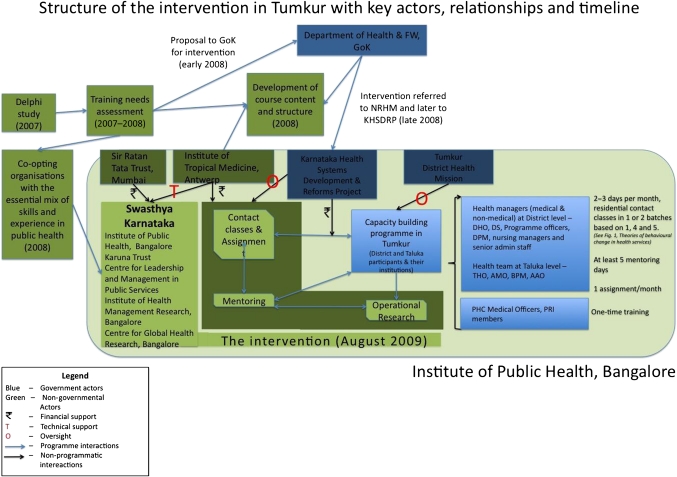
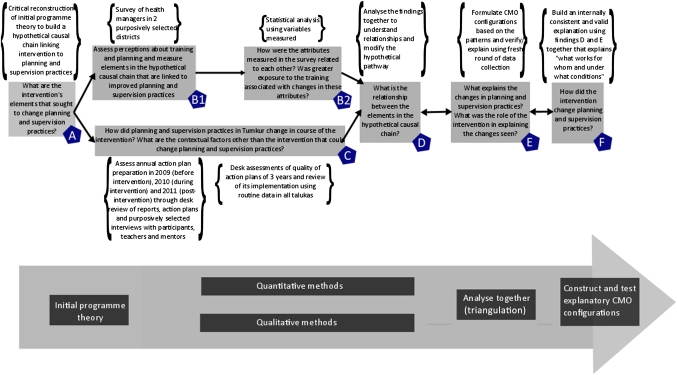
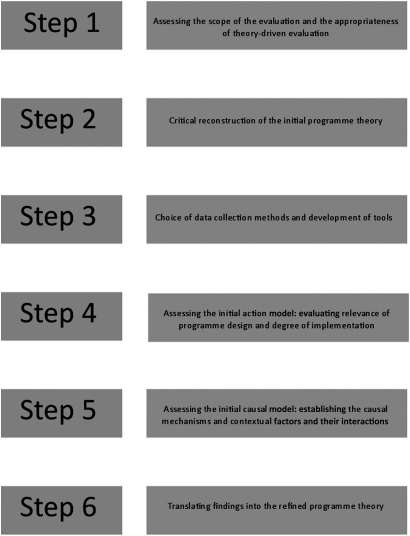
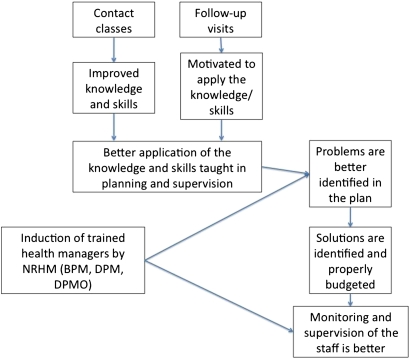
The aim of this study is to understand how capacity building works. The authors will use realist evaluation to evaluate an intervention in Karnataka, India. The intervention is a capacity-building programme that seeks to improve management capacities of health managers at district and subdistrict levels through periodic classroom-based teaching and mentoring support at the workplace. The authors conducted interviews and reviewed literature on capacity building in health to draw out the programme theory of the intervention. Based on this, the authors formulated hypothetical pathways connecting the expected outcomes of the intervention (planning and supervision) to the inputs (contact classes and mentoring). The authors prepared a questionnaire to assess elements of the programme theory-organisational culture, self-efficacy and supervision. The authors shall conduct a survey among health managers as well as collect qualitative data through interviews with participants and non-participants selected purposively based on their planning and supervision performance. The authors will construct explanations in the form of context-mechanism-outcome configurations from the results. This will be iterative and the authors will use a realist evaluation framework to refine the explanatory theories that are based on the findings to explain and validate an improved theory on 'what works for whom and under what conditions'.
The scope for applying realist evaluation to study human resource management interventions in health are discussed.
在低收入和中等收入国家,人力资源管理干预措施在改善卫生服务提供方面所起的作用备受关注。然而,由于对项目实施的研究有限以及在开展人力资源干预实验研究时存在方法上的困难,关于这一主题的研究较少。作者介绍了一项区级能力建设干预评估方案,以确定担任管理职位的卫生工作者绩效的决定因素,并了解如何带来变化(如果有变化的话)。
本研究的目的是了解能力建设如何发挥作用。作者将使用现实主义评估法对印度卡纳塔克邦的一项干预措施进行评估。该干预措施是一项能力建设项目,旨在通过定期的课堂教学和工作场所的指导支持,提高区级和分区级卫生管理人员的管理能力。作者进行了访谈,并查阅了有关卫生领域能力建设的文献,以梳理出该干预措施的项目理论。在此基础上,作者制定了将干预措施的预期结果(规划和监督)与投入(联系课程和指导)联系起来的假设路径。作者编制了一份问卷,以评估项目理论的要素——组织文化、自我效能感和监督。作者将对卫生管理人员进行调查,并通过对根据其规划和监督绩效有目的地挑选出的参与者和非参与者进行访谈来收集定性数据。作者将根据结果以背景-机制-结果配置的形式构建解释。这将是一个迭代过程,作者将使用现实主义评估框架来完善基于研究结果的解释性理论,以解释和验证关于“什么对谁有效以及在什么条件下有效”的改进理论。
讨论了应用现实主义评估法研究卫生领域人力资源管理干预措施的范围。