Friedrich-Loeffler-Institut, Wusterhausen, Germany.
PLoS One. 2012;7(3):e34212. doi: 10.1371/journal.pone.0034212. Epub 2012 Mar 28.
Different clonal types of Toxoplasma gondii are thought to be associated with distinct clinical manifestations of infections. Serotyping is a novel technique which may allow to determine the clonal type of T. gondii humans are infected with and to extend typing studies to larger populations which include infected but non-diseased individuals.
A peptide-microarray test for T. gondii serotyping was established with 54 previously published synthetic peptides, which mimic clonal type-specific epitopes. The test was applied to human sera (n = 174) collected from individuals with an acute T. gondii infection (n = 21), a latent T. gondii infection (n = 53) and from T. gondii-seropositive forest workers (n = 100).
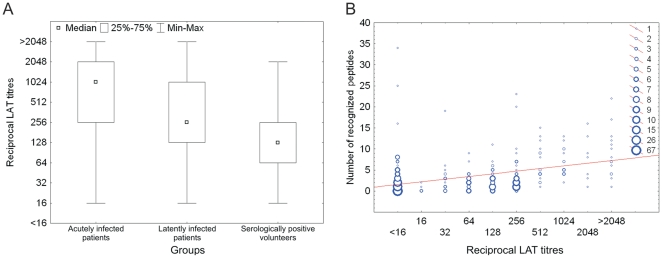
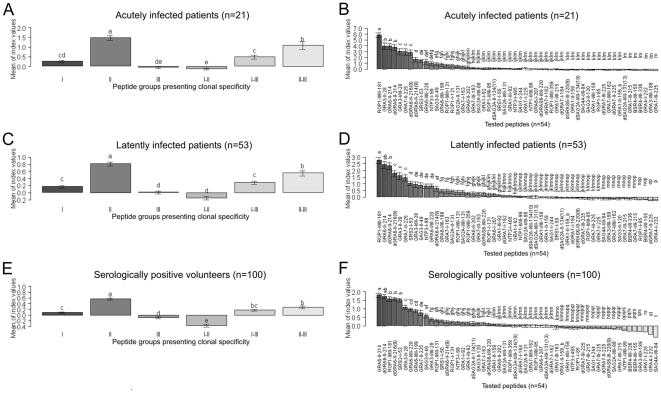
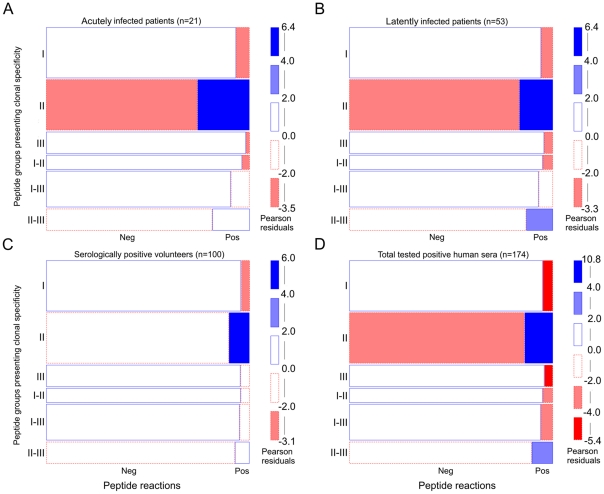
The majority (n = 124; 71%) of all T. gondii seropositive human sera showed reactions against synthetic peptides with sequences specific for clonal type II (type II peptides). Type I and type III peptides were recognized by 42% (n = 73) or 16% (n = 28) of the human sera, respectively, while type II-III, type I-III or type I-II peptides were recognized by 49% (n = 85), 36% (n = 62) or 14% (n = 25) of the sera, respectively. Highest reaction intensities were observed with synthetic peptides mimicking type II-specific epitopes. A proportion of the sera (n = 22; 13%) showed no reaction with type-specific peptides. Individuals with acute toxoplasmosis reacted with a statistically significantly higher number of peptides as compared to individuals with latent T. gondii infection or seropositive forest workers.
Type II-specific reactions were overrepresented and higher in intensity in the study population, which was in accord with genotyping studies on T. gondii oocysts previously conducted in the same area. There were also individuals with type I- or type III-specific reactions. Well-characterized reference sera and further specific peptide markers are needed to establish and to perform future serotyping approaches with higher resolution.
不同的刚地弓形虫克隆型被认为与感染的不同临床表现有关。血清分型是一种新的技术,它可以确定人类感染的刚地弓形虫的克隆型,并将分型研究扩展到包括感染但未患病的个体在内的更大人群。
建立了一种用于刚地弓形虫血清分型的肽微阵列检测方法,使用了 54 个先前发表的模拟克隆型特异性表位的合成肽。该检测方法应用于从急性刚地弓形虫感染患者(n=21)、潜伏性刚地弓形虫感染患者(n=53)和刚地弓形虫血清阳性的森林工作者(n=100)中收集的人血清(n=174)。
大多数(n=124;71%)刚地弓形虫血清阳性的人血清对与克隆型 II(II 型肽)特异性序列的合成肽有反应。I 型和 III 型肽分别被 42%(n=73)或 16%(n=28)的人血清识别,而 II-III、I-III 或 I-II 肽分别被 49%(n=85)、36%(n=62)或 14%(n=25)的血清识别。与模拟 II 型特异性表位的合成肽相比,观察到最高的反应强度。一部分血清(n=22;13%)与特异性肽无反应。与潜伏性刚地弓形虫感染或血清阳性的森林工作者相比,急性弓形体病患者与更多的肽发生统计学上显著的反应。
在研究人群中,II 型特异性反应的比例过高且强度更高,这与以前在同一地区进行的刚地弓形虫卵囊基因分型研究一致。也有个体对 I 型或 III 型特异性反应。需要具有良好特征的参考血清和进一步的特异性肽标记物来建立和进行具有更高分辨率的未来血清分型方法。