Institute of Epidemiology, Friedrich-Loeffler-Institut, Federal Research Institute for Animal Health, Greifswald - Insel Riems, Germany.
PLoS One. 2013 Nov 7;8(11):e80213. doi: 10.1371/journal.pone.0080213. eCollection 2013.
Cats are definitive hosts of Toxoplasma gondii and play an essential role in the epidemiology of this parasite. The study aims at clarifying whether cats are able to develop specific antibodies against different clonal types of T. gondii and to determine by serotyping the T. gondii clonal types prevailing in cats as intermediate hosts in Germany.
To establish a peptide-microarray serotyping test, we identified 24 suitable peptides using serological T. gondii positive (n=21) and negative cat sera (n=52). To determine the clonal type-specific antibody response of cats in Germany, 86 field sera from T. gondii seropositive naturally infected cats were tested. In addition, we analyzed the antibody response in cats experimentally infected with non-canonical T. gondii types (n=7).
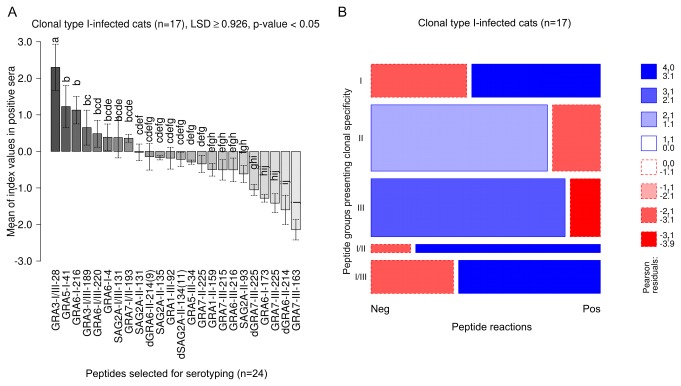
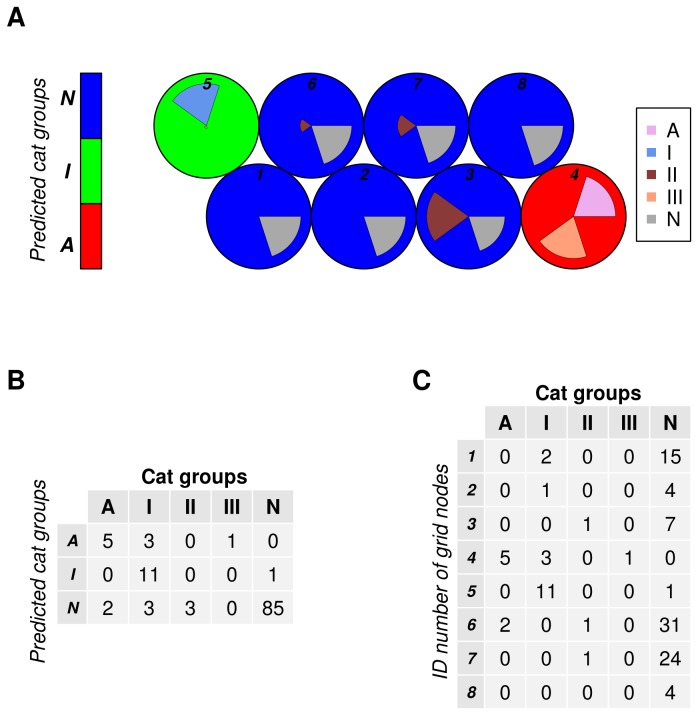
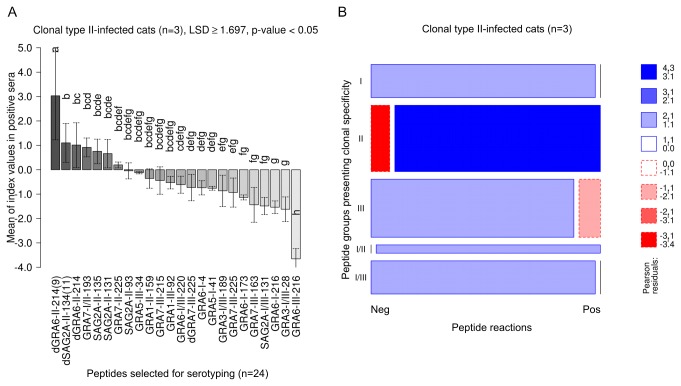
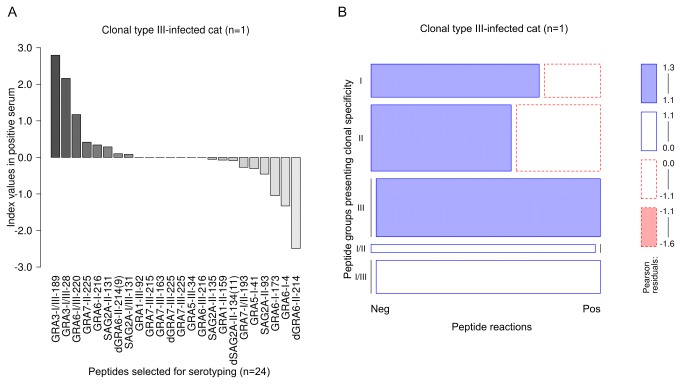
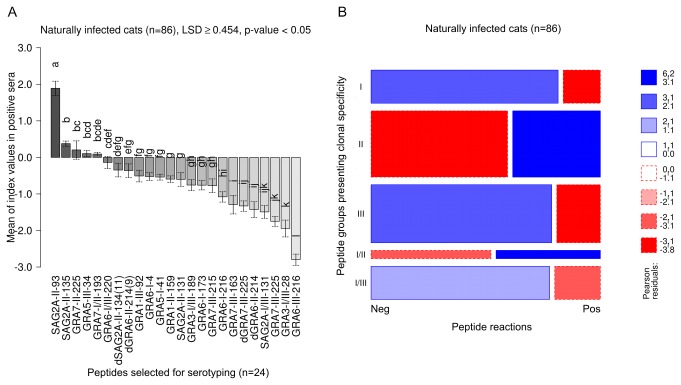
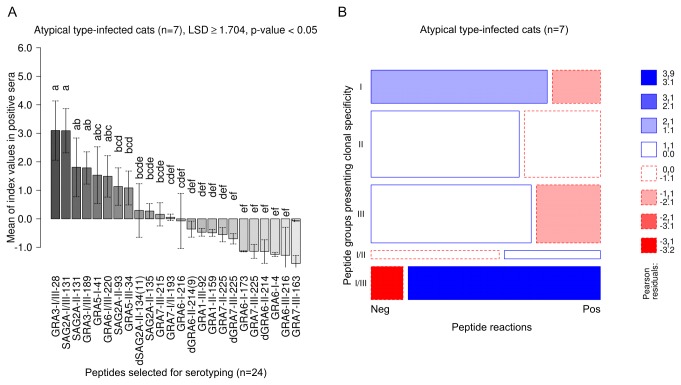
Positive cat reference sera reacted predominantly with peptides harbouring amino acid sequences specific for the clonal T. gondii type the cats were infected with. When the array was applied to field sera from Germany, 98.8% (85/86) of naturally-infected cats recognized similar peptide patterns as T. gondii type II reference sera and showed the strongest reaction intensities with clonal type II-specific peptides. In addition, naturally infected cats recognized type II-specific peptides significantly more frequently than peptides of other type-specificities. Cats infected with non-canonical types showed the strongest reactivity with peptides presenting amino-acid sequences specific for both, type I and type III.
Cats are able to mount a clonal type-specific antibody response against T. gondii. Serotyping revealed for most seropositive field sera patterns resembling those observed after clonal type II-T. gondii infection. This finding is in accord with our previous results on the occurrence of T. gondii clonal types in oocysts shed by cats in Germany.
猫是刚地弓形虫的终末宿主,在该寄生虫的流行病学中起着至关重要的作用。本研究旨在阐明猫是否能够针对不同克隆型的刚地弓形虫产生特异性抗体,并通过血清分型来确定在德国作为中间宿主的猫中流行的刚地弓形虫克隆型。
为了建立肽微阵列血清分型检测方法,我们使用血清学阳性(n=21)和阴性(n=52)的猫血清鉴定了 24 个合适的肽。为了确定德国猫的克隆型特异性抗体反应,我们检测了 86 份来自自然感染的刚地弓形虫血清阳性猫的血清。此外,我们还分析了实验感染非典型刚地弓形虫型的猫的抗体反应(n=7)。
阳性猫参考血清主要与含有其感染的刚地弓形虫克隆型特异性氨基酸序列的肽反应。当将该阵列应用于来自德国的现场血清时,98.8%(85/86)的自然感染猫识别出与刚地弓形虫 II 型参考血清相似的肽模式,并对 II 型特异性肽显示出最强的反应强度。此外,自然感染的猫识别 II 型特异性肽的频率明显高于其他特异性肽。感染非典型型的猫对呈现 I 型和 III 型特异性氨基酸序列的肽显示出最强的反应性。
猫能够针对刚地弓形虫产生克隆型特异性抗体反应。血清分型显示,大多数阳性现场血清的模式类似于 II 型刚地弓形虫感染后的观察结果。这一发现与我们之前关于德国猫卵囊排放的刚地弓形虫克隆型的发生情况的结果一致。