Agência Paulista de Tecnologia dos Agronegócios, Pólo Centro-Sul, Piracicaba, SP, Brazil.
Genet Mol Biol. 2012 Jan;35(1):119-21. doi: 10.1590/s1415-47572012005000002. Epub 2012 Jan 6.
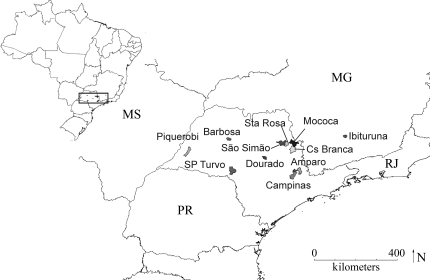
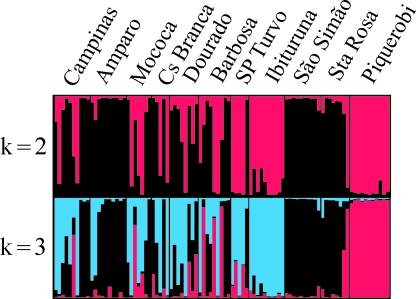
Acrocomia aculeata is a perennial, fruit-producing palm tree, native to tropical forests. Its fruits have spurred interest because of their significant potential for use in the cosmetic industry and as feedstock for biofuel. In the present study, the genetic structure and mating system in Acrocomia aculeata were analyzed, using eight nuclear micro-satellite loci and samples from São Paulo and Minas Gerais states, Brazil. By means of Bayesian analysis, these populations were clustered into two or three groups. A high multilocus outcrossing rate suggests that outcrosses were predominant, although a certain degree of biparental inbreeding also occurred. Thus, although monoecious and self-compatible, there is every indication that A. aculeata bears a mixed reproductive system, with a predominance of outcrossing. Given the genetic structure revealed hereby, future conservation strategies and germplasm collecting should be focussed on sampling and preserving individuals from different clusters.
Acrocomia aculeata 是一种多年生、产果棕榈树,原产于热带雨林。其果实因其在化妆品行业和生物燃料原料方面的巨大潜力而引起了关注。本研究利用来自巴西圣保罗州和米纳斯吉拉斯州的 8 个核微卫星位点,对 Acrocomia aculeata 的遗传结构和交配系统进行了分析。通过贝叶斯分析,这些种群被聚类为两个或三个组。高的多座位异交率表明,异交是主要的,但也存在一定程度的双亲同系交配。因此,尽管 Acrocomia aculeata 是雌雄同体且自交亲和的,但有充分的迹象表明,它具有混合的繁殖系统,以异交为主。鉴于本研究揭示的遗传结构,未来的保护策略和种质收集应集中在对来自不同聚类的个体进行采样和保存。