Laboratory of Vascular Pathology and Regeneration, Regenerative Medicine Section, School of Clinical Sciences, Bristol Heart Institute, University of Bristol, Bristol, BS2 8HW, UK.
Cardiol Res Pract. 2012;2012:486702. doi: 10.1155/2012/486702. Epub 2012 Mar 15.
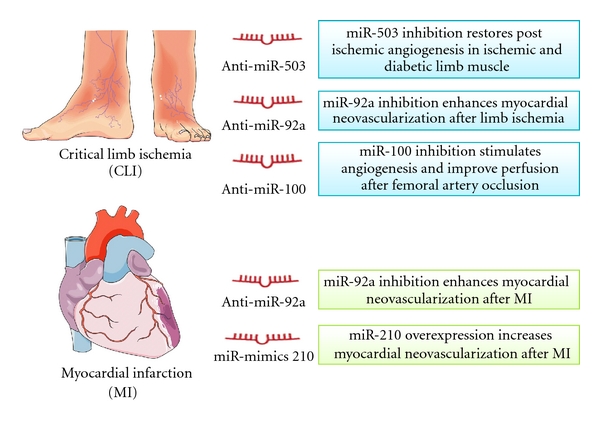
The term angiogenesis describes the growth of endothelial sprouts from preexisting postcapillary venules. More recently, this term has been used to generally indicate the growth and remodeling process of the primitive vascular network into a complex network during development. In adulthood, angiogenesis is activated as a reparative process during wound healing and following ischemia, and it plays a key role in tumor growth and metastasis as well as in inflammatory diseases and diabetic retinopathy. MicroRNAs (miRNAs) are endogenous, small, noncoding RNAs that negatively control gene expression of target mRNAs. In this paper, we aim at describing the role of miRNAs in postischemic angiogenesis. First, we will describe the regulation and the expression of miRNAs in endothelial cells. Then, we will analyze the role of miRNAs in postischemic vascular repair. Finally, we will discuss the role of circulating miRNAs as potential biomarkers in ischemic diseases.
术语血管生成描述了从先前存在的毛细血管后静脉中长出的内皮芽。最近,这个术语已被用于通常表示原始血管网络在发育过程中向复杂网络的生长和重塑过程。在成年期,血管生成作为创伤愈合和缺血后的修复过程被激活,并且在肿瘤生长和转移以及炎症性疾病和糖尿病性视网膜病变中发挥关键作用。microRNAs (miRNAs) 是内源性的、小的、非编码的 RNA,它们负调控靶 mRNAs 的基因表达。在本文中,我们旨在描述 miRNAs 在缺血后血管生成中的作用。首先,我们将描述内皮细胞中 miRNAs 的调节和表达。然后,我们将分析 miRNAs 在缺血后血管修复中的作用。最后,我们将讨论循环 miRNAs 作为缺血性疾病潜在生物标志物的作用。