Department of Pathology, School of Medicine, and Institute of Biomedical Science and Technology, Konkuk University Glocal Campus, Seoul, South Korea.
PLoS One. 2012;7(4):e33361. doi: 10.1371/journal.pone.0033361. Epub 2012 Apr 2.
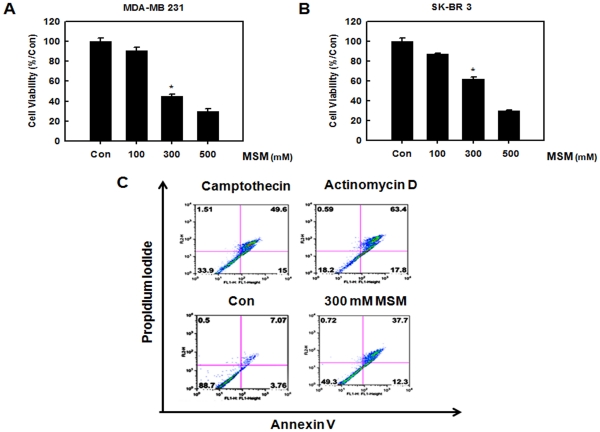
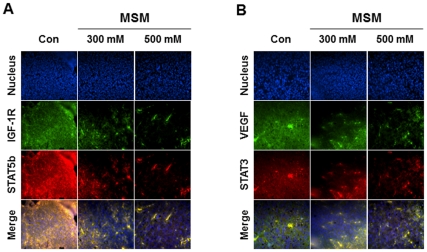
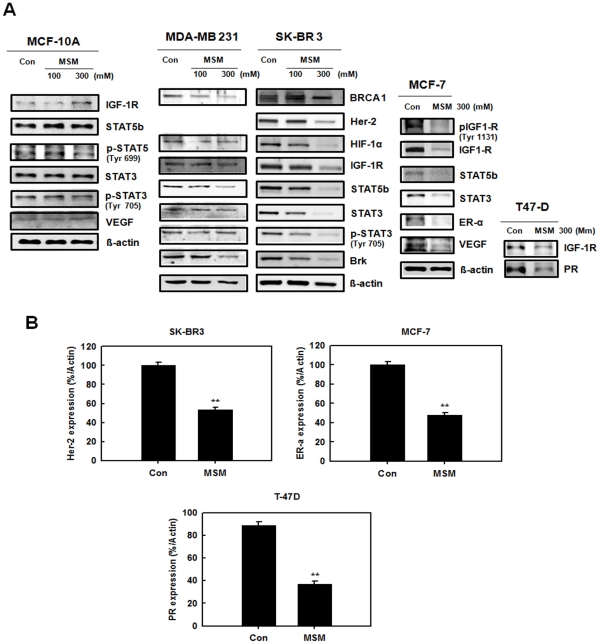
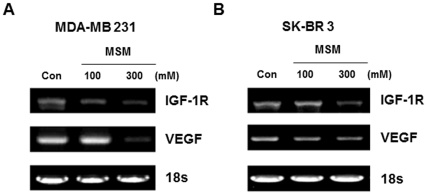
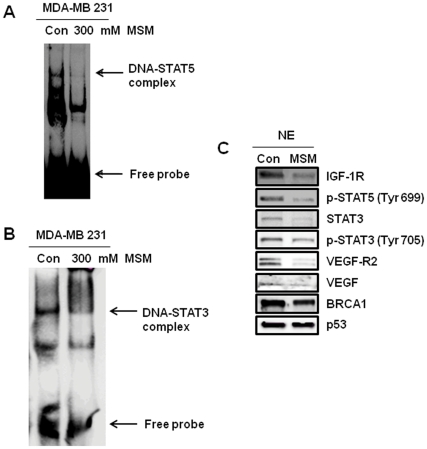
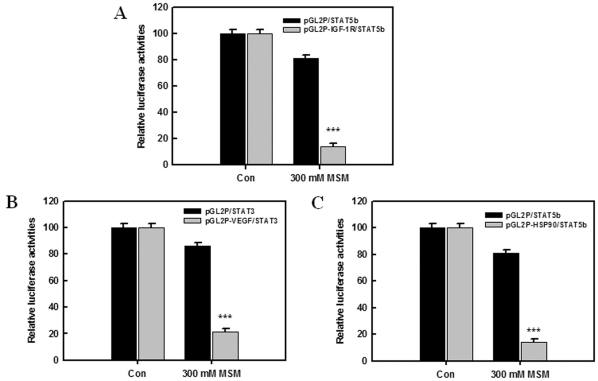
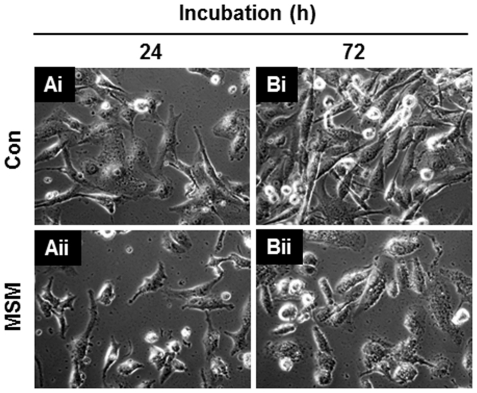
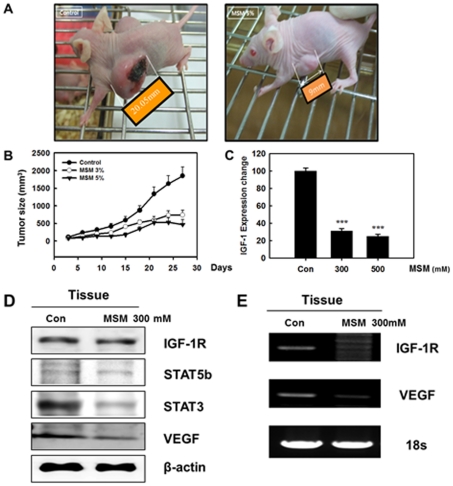
Breast cancer is the most aggressive form of all cancers, with high incidence and mortality rates. The purpose of the present study was to investigate the molecular mechanism by which methylsulfonylmethane (MSM) inhibits breast cancer growth in mice xenografts. MSM is an organic sulfur-containing natural compound without any toxicity. In this study, we demonstrated that MSM substantially decreased the viability of human breast cancer cells in a dose-dependent manner. MSM also suppressed the phosphorylation of STAT3, STAT5b, expression of IGF-1R, HIF-1α, VEGF, BrK, and p-IGF-1R and inhibited triple-negative receptor expression in receptor-positive cell lines. Moreover, MSM decreased the DNA-binding activities of STAT5b and STAT3, to the target gene promoters in MDA-MB 231 or co-transfected COS-7 cells. We confirmed that MSM significantly decreased the relative luciferase activities indicating crosstalk between STAT5b/IGF-1R, STAT5b/HSP90α, and STAT3/VEGF. To confirm these findings in vivo, xenografts were established in Balb/c athymic nude mice with MDA-MB 231 cells and MSM was administered for 30 days. Concurring to our in vitro analysis, these xenografts showed decreased expression of STAT3, STAT5b, IGF-1R and VEGF. Through in vitro and in vivo analysis, we confirmed that MSM can effectively regulate multiple targets including STAT3/VEGF and STAT5b/IGF-1R. These are the major molecules involved in tumor development, progression, and metastasis. Thus, we strongly recommend the use of MSM as a trial drug for treating all types of breast cancers including triple-negative cancers.
乳腺癌是所有癌症中最具侵袭性的一种,其发病率和死亡率都很高。本研究旨在探讨甲磺酰甲烷(MSM)抑制小鼠异种移植乳腺癌生长的分子机制。MSM 是一种有机含硫天然化合物,无任何毒性。在这项研究中,我们证明 MSM 以剂量依赖的方式显著降低了人乳腺癌细胞的活力。MSM 还抑制了 STAT3、STAT5b 的磷酸化、IGF-1R、HIF-1α、VEGF、BrK 和 p-IGF-1R 的表达,并抑制了受体阳性细胞系中三阴性受体的表达。此外,MSM 降低了 MDA-MB 231 或共转染的 COS-7 细胞中 STAT5b 和 STAT3 对靶基因启动子的 DNA 结合活性。我们证实 MSM 显著降低了相对荧光素酶活性,表明 STAT5b/IGF-1R、STAT5b/HSP90α 和 STAT3/VEGF 之间存在串扰。为了在体内证实这些发现,我们用 MDA-MB 231 细胞在 Balb/c 裸鼠中建立了异种移植瘤,并给予 MSM 治疗 30 天。与我们的体外分析一致,这些异种移植瘤显示 STAT3、STAT5b、IGF-1R 和 VEGF 的表达降低。通过体外和体内分析,我们证实 MSM 可以有效地调节多个靶点,包括 STAT3/VEGF 和 STAT5b/IGF-1R。这些是参与肿瘤发生、发展和转移的主要分子。因此,我们强烈建议将 MSM 用作治疗所有类型乳腺癌(包括三阴性乳腺癌)的试验药物。