Yersinia Research Unit, Institut Pasteur, Paris, France.
PLoS One. 2012;7(4):e34714. doi: 10.1371/journal.pone.0034714. Epub 2012 Apr 5.
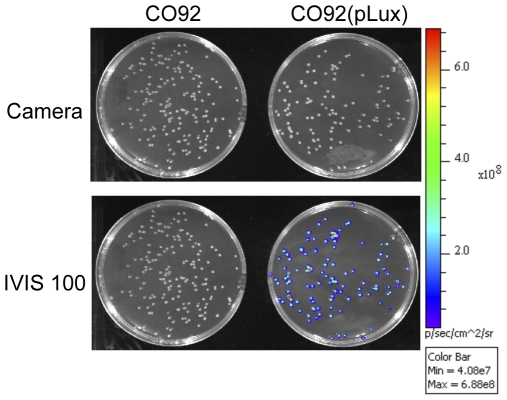
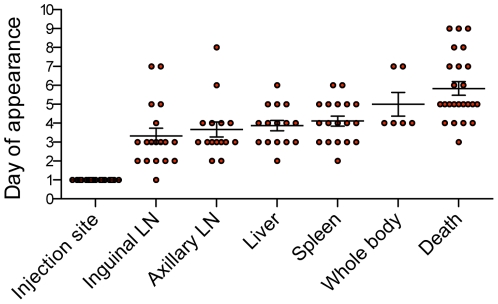
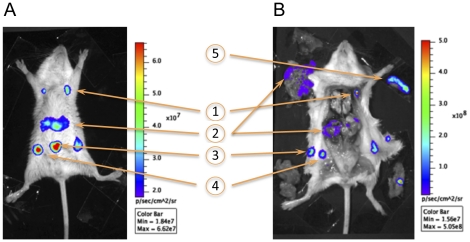
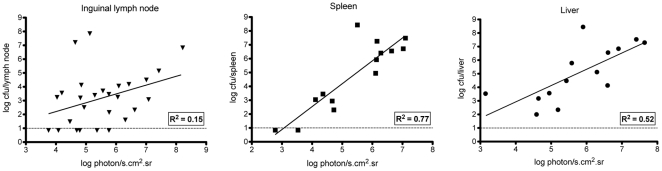
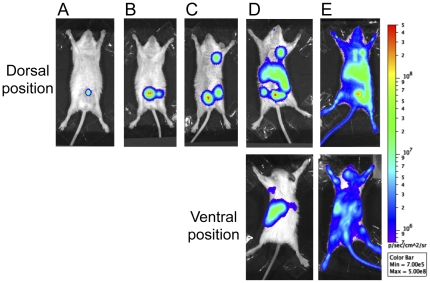
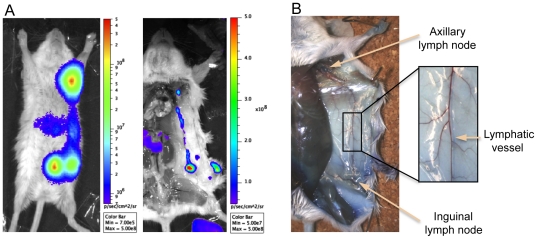
Yersinia pestis dissemination in a host is usually studied by enumerating bacteria in the tissues of animals sacrificed at different times. This laborious methodology gives only snapshots of the infection, as the infectious process is not synchronized. In this work we used in vivo bioluminescence imaging (BLI) to follow Y. pestis dissemination during bubonic plague. We first demonstrated that Y. pestis CO92 transformed with pGEN-luxCDABE stably emitted bioluminescence in vitro and in vivo, while retaining full virulence. The light produced from live animals allowed to delineate the infected organs and correlated with bacterial loads, thus validating the BLI tool. We then showed that the first step of the infectious process is a bacterial multiplication at the injection site (linea alba), followed by a colonization of the draining inguinal lymph node(s), and subsequently of the ipsilateral axillary lymph node through a direct connection between the two nodes. A mild bacteremia and an effective filtering of the blood stream by the liver and spleen probably accounted for the early bacterial blood clearance and the simultaneous development of bacterial foci within these organs. The saturation of the filtering capacity of the spleen and liver subsequently led to terminal septicemia. Our results also indicate that secondary lymphoid tissues are the main targets of Y. pestis multiplication and that colonization of other organs occurs essentially at the terminal phase of the disease. Finally, our analysis reveals that the high variability in the kinetics of infection is attributable to the time the bacteria remain confined at the injection site. However, once Y. pestis has reached the draining lymph nodes, the disease progresses extremely rapidly, leading to the invasion of the entire body within two days and to death of the animals. This highlights the extraordinary capacity of Y. pestis to annihilate the host innate immune response.
鼠疫耶尔森氏菌在宿主中的传播通常通过对不同时间处死的动物组织中的细菌进行计数来研究。这种费力的方法只能给出感染的快照,因为感染过程不同步。在这项工作中,我们使用体内生物发光成像(BLI)来跟踪鼠疫耶尔森氏菌在腺鼠疫中的传播。我们首先证明,用 pGEN-luxCDABE 转化的鼠疫耶尔森氏菌 CO92 在体外和体内稳定地发出生物发光,同时保持完全的毒力。来自活体动物的光允许描绘感染的器官,并与细菌负荷相关联,从而验证了 BLI 工具。然后我们表明,感染过程的第一步是在注射部位(白线)细菌繁殖,随后是引流腹股沟淋巴结的定植,然后是同侧腋窝淋巴结的定植,通过两个淋巴结之间的直接连接。轻度菌血症和肝脏和脾脏对血流的有效过滤可能导致早期细菌清除和这些器官内细菌灶的同时发展。脾脏和肝脏过滤能力的饱和随后导致终末期败血症。我们的结果还表明,次级淋巴组织是鼠疫耶尔森氏菌繁殖的主要靶标,而其他器官的定植主要发生在疾病的终末期。最后,我们的分析表明,感染动力学的高度可变性归因于细菌在注射部位被限制的时间。然而,一旦鼠疫耶尔森氏菌到达引流淋巴结,疾病就会迅速进展,导致两天内全身感染并导致动物死亡。这突出了鼠疫耶尔森氏菌消灭宿主先天免疫反应的非凡能力。