Fels Institute for Cancer Research and Molecular Biology, Temple University School of Medicine, Philadelphia, PA 19140, USA.
BMC Med Genomics. 2012 Apr 12;5:10. doi: 10.1186/1755-8794-5-10.
Infant birth weight is a complex quantitative trait associated with both neonatal and long-term health outcomes. Numerous studies have been published in which candidate genes (IGF1, IGF2, IGF2R, IGF binding proteins, PHLDA2 and PLAGL1) have been associated with birth weight, but these studies are difficult to reproduce in man and large cohort studies are needed due to the large inter individual variance in transcription levels. Also, very little of the trait variance is explained. We decided to identify additional candidates without regard for what is known about the genes. We hypothesize that DNA methylation differences between individuals can serve as markers of gene "expression potential" at growth related genes throughout development and that these differences may correlate with birth weight better than single time point measures of gene expression.
We performed DNA methylation and transcript profiling on cord blood and placenta from newborns. We then used novel computational approaches to identify genes correlated with birth weight.
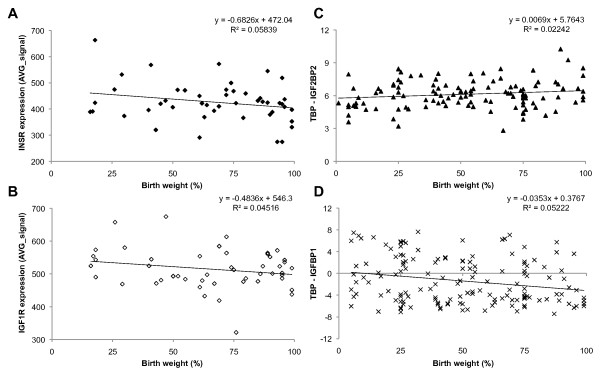
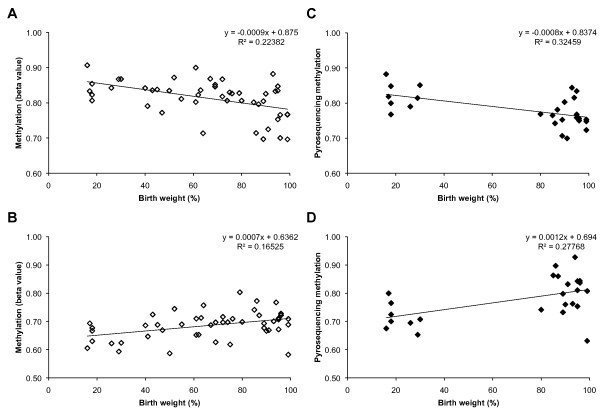
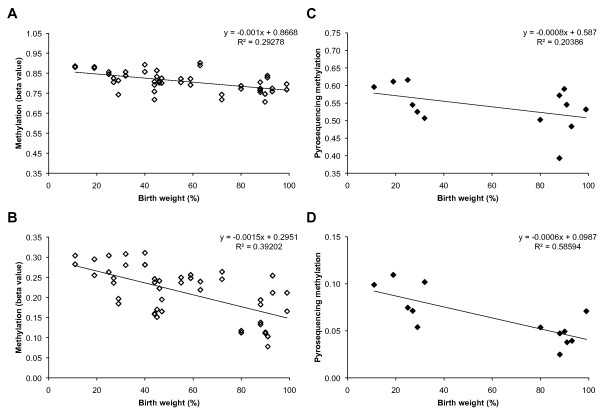
We identified 23 genes whose methylation levels explain 70-87% of the variance in birth weight. Six of these (ANGPT4, APOE, CDK2, GRB10, OSBPL5 and REG1B) are associated with growth phenotypes in human or mouse models. Gene expression profiling explained a much smaller fraction of variance in birth weight than did DNA methylation. We further show that two genes, the transcriptional repressor MSX1 and the growth factor receptor adaptor protein GRB10, are correlated with transcriptional control of at least seven genes reported to be involved in fetal or placental growth, suggesting that we have identified important networks in growth control. GRB10 methylation is also correlated with genes involved in reactive oxygen species signaling, stress signaling and oxygen sensing and more recent data implicate GRB10 in insulin signaling.
Single time point measurements of gene expression may reflect many factors unrelated to birth weight, while inter-individual differences in DNA methylation may represent a "molecular fossil record" of differences in birth weight-related gene expression. Finding these "unexpected" pathways may tell us something about the long-term association between low birth weight and adult disease, as well as which genes may be susceptible to environmental effects. These findings increase our understanding of the molecular mechanisms involved in human development and disease progression.
婴儿出生体重是一个与新生儿和长期健康结果都有关的复杂的定量特征。许多研究已经发表,其中候选基因(IGF1、IGF2、IGF2R、IGF 结合蛋白、PHLDA2 和 PLAGL1)与出生体重有关,但这些研究在人类中难以重复,并且由于转录水平的个体间差异很大,需要进行大型队列研究。此外,该特征的大部分差异仍然无法解释。我们决定不考虑已知基因,寻找其他候选基因。我们假设个体间的 DNA 甲基化差异可以作为与生长相关基因在整个发育过程中“表达潜能”的标记,并且这些差异与出生体重的相关性可能优于单个时间点的基因表达测量。
我们对新生儿的脐带血和胎盘进行了 DNA 甲基化和转录谱分析。然后,我们使用新的计算方法来识别与出生体重相关的基因。
我们确定了 23 个基因,其甲基化水平解释了出生体重 70-87%的差异。其中 6 个(ANGPT4、APOE、CDK2、GRB10、OSBPL5 和 REG1B)与人类或小鼠模型中的生长表型有关。基因表达谱分析解释出生体重差异的比例远小于 DNA 甲基化。我们进一步表明,两个基因,转录抑制因子 MSX1 和生长因子受体衔接蛋白 GRB10,与至少七个被报道与胎儿或胎盘生长有关的基因的转录控制相关,这表明我们已经确定了生长控制中的重要网络。GRB10 甲基化也与涉及活性氧信号、应激信号和氧感应的基因相关,最近的数据表明 GRB10 参与胰岛素信号。
单个时间点的基因表达测量可能反映了与出生体重无关的许多因素,而个体间的 DNA 甲基化差异可能代表了与出生体重相关的基因表达差异的“分子化石记录”。发现这些“意外”的途径可能会告诉我们一些关于低出生体重与成年疾病之间的长期关联,以及哪些基因可能容易受到环境影响。这些发现增加了我们对人类发育和疾病进展中涉及的分子机制的理解。