Fitzpatrick Leo R
Department of Pharmacology, Penn State College of Medicine, Hummelstown, PA 17036, USA.
Int J Inflam. 2012;2012:389404. doi: 10.1155/2012/389404. Epub 2012 Mar 15.
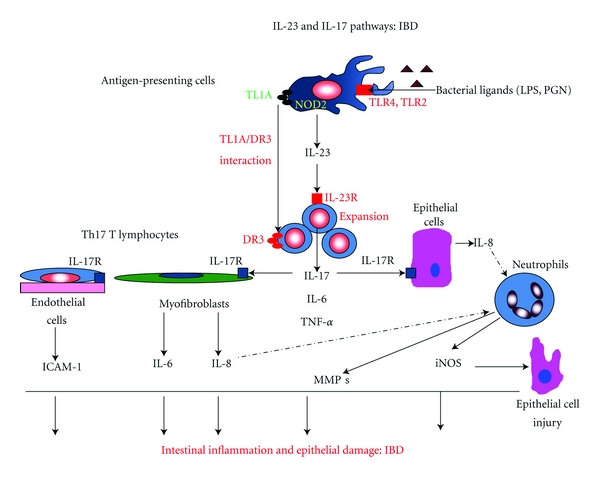
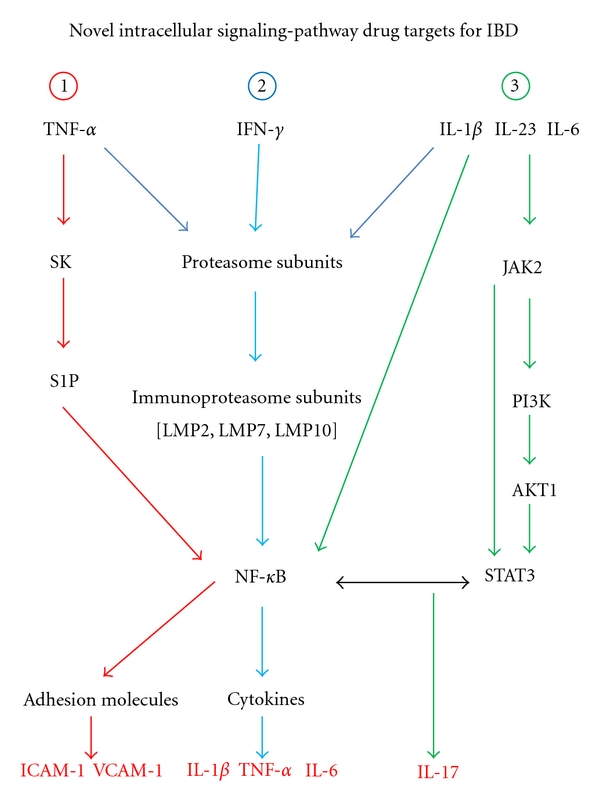
This review identifies possible pharmacological targets for inflammatory bowel disease (IBD) within the IL-23/IL-17 axis. Specifically, there are several targets within the IL-23/IL-17 pathways for potential pharmacological intervention with antibodies or small molecule inhibitors. These targets include TL1A (tumor necrosis factor-like molecule), DR3 (death receptor 3), IL-23, IL-17 and the receptors for IL-23 and IL-17. As related to IBD, there are also other novel pharmacological targets. These targets include inhibiting specific immunoproteasome subunits, blocking a key enzyme in sphingolipid metabolism (sphingosine kinase), and modulating NF-κB/STAT3 interactions. Several good approaches exist for pharmacological inhibition of key components in the IL-23 and IL-17 pathways. These approaches include specific monoclonal antibodies to TL1A, IL-17 receptor, Fc fusion proteins, specific antibodies to IL-17F, and small molecule inhibitors of IL-17 like Vidofludimus. Also, other potential approaches for targeted drug development in IBD include specific chemical inhibitors of SK, specific small molecule inhibitors directed against catalytic subunits of the immunoproteasome, and dual inhibitors of the STAT3 and NF-κB signal transduction systems. In the future, well-designed preclinical studies are still needed to determine which of these pharmacological approaches will provide drugs with the best efficacy and safety profiles for entrance into clinical trials.
本综述确定了白细胞介素-23/白细胞介素-17轴内炎症性肠病(IBD)可能的药理学靶点。具体而言,白细胞介素-23/白细胞介素-17通路中有几个靶点可通过抗体或小分子抑制剂进行潜在的药理学干预。这些靶点包括TL1A(肿瘤坏死因子样分子)、DR3(死亡受体3)、白细胞介素-23、白细胞介素-17以及白细胞介素-23和白细胞介素-17的受体。与IBD相关的还有其他新的药理学靶点。这些靶点包括抑制特定的免疫蛋白酶体亚基、阻断鞘脂代谢中的一种关键酶(鞘氨醇激酶)以及调节核因子κB/信号转导和转录激活因子3(STAT3)的相互作用。存在几种对白细胞介素-23和白细胞介素-17通路关键成分进行药理学抑制的良好方法。这些方法包括针对TL1A、白细胞介素-17受体的特异性单克隆抗体、Fc融合蛋白、针对白细胞介素-17F的特异性抗体以及像维多氟啶这样的白细胞介素-17小分子抑制剂。此外,IBD靶向药物开发的其他潜在方法包括鞘氨醇激酶的特异性化学抑制剂、针对免疫蛋白酶体催化亚基的特异性小分子抑制剂以及STAT3和核因子κB信号转导系统的双重抑制剂。未来,仍需要精心设计的临床前研究来确定这些药理学方法中哪些将为进入临床试验提供疗效和安全性最佳的药物。