Department of Psychiatry, University of California, La Jolla, and Child and Adolescent Services Research Center, Rady's Children's Hospital, San Diego, CA, USA.
Implement Sci. 2012 Apr 18;7:32. doi: 10.1186/1748-5908-7-32.
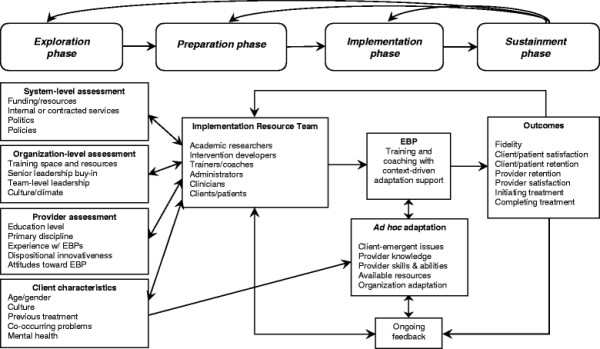
Adaptations are often made to evidence-based practices (EBPs) by systems, organizations, and/or service providers in the implementation process. The degree to which core elements of an EBP can be maintained while allowing for local adaptation is unclear. In addition, adaptations may also be needed at the system, policy, or organizational levels to facilitate EBP implementation and sustainment. This paper describes a study of the feasibility and acceptability of an implementation approach, the Dynamic Adaptation Process (DAP), designed to allow for EBP adaptation and system and organizational adaptations in a planned and considered, rather than ad hoc, way. The DAP involves identifying core elements and adaptable characteristics of an EBP, then supporting implementation with specific training on allowable adaptations to the model, fidelity monitoring and support, and identifying the need for and solutions to system and organizational adaptations. In addition, this study addresses a secondary concern, that of improving EBP model fidelity assessment and feedback in real-world settings.
This project examines the feasibility, acceptability, and utility of the DAP; tests the degree to which fidelity can be maintained using the DAP compared to implementation as usual (IAU); and examines the feasibility of using automated phone or internet-enabled, computer-based technology to assess intervention fidelity and client satisfaction. The study design incorporates mixed methods in order to describe processes and factors associated with variations in both how the DAP itself is implemented and how the DAP impacts fidelity, drift, and adaptation. The DAP model is to be examined by assigning six regions in California (USA) to either the DAP (n=3) or IAU (n=3) to implement an EBP to prevent child neglect.
The DAP represents a data-informed, collaborative, multiple stakeholder approach to maintain intervention fidelity during the implementation of EBPs in the field by providing support for intervention, system, and organizational adaptation and intervention fidelity to meet local needs. This study is designed to address the real-world implications of EBP implementation in public sector service systems and is relevant for national, state, and local service systems and organizations.
在实施过程中,系统、组织和/或服务提供者常常对基于证据的实践(EBP)进行调整。在允许进行地方调整的同时,保持 EBP 的核心要素的程度尚不清楚。此外,可能还需要在系统、政策或组织层面进行调整,以促进 EBP 的实施和维持。本文描述了一项关于实施方法的可行性和可接受性的研究,该方法称为动态适应过程(DAP),旨在以计划和考虑的方式而不是临时的方式允许 EBP 适应以及系统和组织适应。DAP 包括确定 EBP 的核心要素和可适应的特征,然后通过提供有关模型可允许的适应性的具体培训、保真度监测和支持,并确定系统和组织适应性的需求和解决方案,来支持实施。此外,本研究还解决了一个次要问题,即在实际环境中提高 EBP 模型保真度评估和反馈的问题。
本项目检验了 DAP 的可行性、可接受性和实用性;测试了与常规实施(IAU)相比,使用 DAP 可以在多大程度上保持保真度;并检验了使用自动电话或互联网启用的计算机基技术评估干预保真度和客户满意度的可行性。该研究设计采用混合方法,以便描述与 DAP 本身的实施方式以及 DAP 对保真度、漂移和适应的影响相关的过程和因素。DAP 模型将通过将加利福尼亚州(美国)的六个地区分配给 DAP(n=3)或 IAU(n=3)来实施,以实施预防儿童忽视的 EBP。
DAP 代表了一种数据驱动、协作的、多利益相关者的方法,通过为干预、系统和组织适应以及干预保真度提供支持,在实地实施 EBP 期间保持干预的保真度,以满足当地需求。本研究旨在解决公共部门服务系统中 EBP 实施的实际影响,与国家、州和地方服务系统和组织相关。