The Centre for Applied Aquatic Genomics, Chinese Academy of Fishery Sciences, Beijing, China.
PLoS One. 2012;7(4):e35152. doi: 10.1371/journal.pone.0035152. Epub 2012 Apr 13.
Common carp (Cyprinus carpio) is one of the most important aquaculture species of Cyprinidae with an annual global production of 3.4 million tons, accounting for nearly 14% of the freshwater aquaculture production in the world. Due to the economical and ecological importance of common carp, genomic data are eagerly needed for genetic improvement purpose. However, there is still no sufficient transcriptome data available. The objective of the project is to sequence transcriptome deeply and provide well-assembled transcriptome sequences to common carp research community.
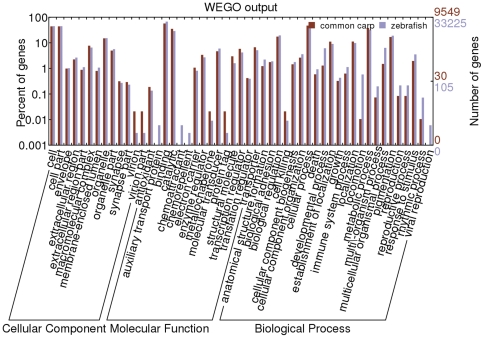
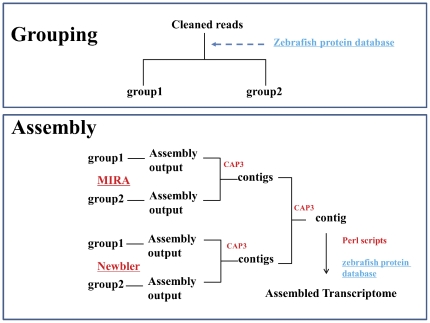
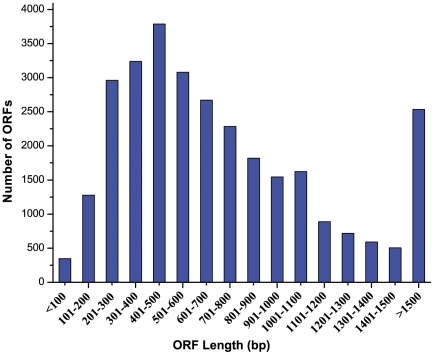
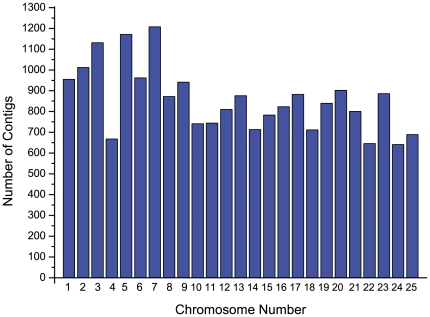
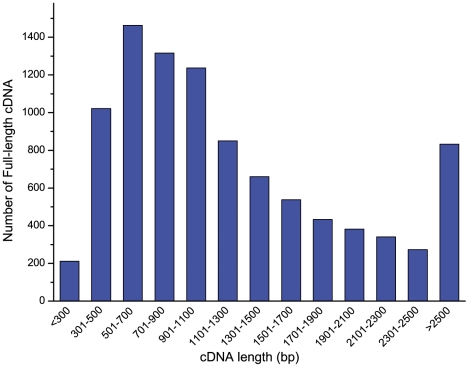
Transcriptome sequencing of common carp was performed using Roche 454 platform. A total of 1,418,591 clean ESTs were collected and assembled into 36,811 cDNA contigs, with average length of 888 bp and N50 length of 1,002 bp. Annotation was performed and a total of 19,165 unique proteins were identified from assembled contigs. Gene ontology and KEGG analysis were performed and classified all contigs into functional categories for understanding gene functions and regulation pathways. Open Reading Frames (ORFs) were detected from 29,869 (81.1%) contigs with an average ORF length of 763 bp. From these contigs, 9,625 full-length cDNAs were identified with sequence length from 201 bp to 9,956 bp. Comparative analysis revealed that 27,693(75.2%) contigs have significant similarity to zebrafish Refseq proteins, and 24,371(66.2%), 24,501(66.5%) and 25,025(70.0%) to teraodon, medaka and three-spined stickleback refseq proteins. A total of 2,064 microsatellites were initially identified from 1,730 contigs, and 1,639 unique sequences had sufficient flanking sequences on both sides for primer design.
The transcriptome of common carp had been deep sequenced, de novo assembled and characterized, providing the valuable resource for better understanding of common carp genome. The transcriptome data will facilitate future functional studies on common carp genome, and gradually apply in breeding programs of common carp, as well as closely related other Cyprinids.
鲤鱼(Cyprinus carpio)是鲤科中最重要的水产养殖物种之一,全球年总产量为 340 万吨,占世界淡水水产养殖产量的近 14%。由于鲤鱼具有经济和生态重要性,因此迫切需要基因组数据用于遗传改良。然而,目前仍然没有足够的转录组数据。本项目的目的是深度测序转录组,为鲤鱼研究界提供高质量组装的转录组序列。
使用 Roche 454 平台对鲤鱼进行转录组测序。共收集到 1,418,591 条清洁 EST 并组装成 36,811 条 cDNA 连续序列,平均长度为 888bp,N50 长度为 1,002bp。对这些序列进行注释,共从组装的连续序列中鉴定出 19,165 个独特的蛋白质。对基因本体论和 KEGG 进行分析,并将所有连续序列分类到功能类别中,以了解基因功能和调控途径。从 29,869(81.1%)个连续序列中检测到开放阅读框(ORFs),其平均长度为 763bp。从这些连续序列中,鉴定出 9,625 个全长 cDNA,序列长度从 201bp 到 9,956bp。比较分析表明,27,693(75.2%)个连续序列与斑马鱼 Refseq 蛋白具有显著相似性,与金枪鱼、青鳉和三刺鱼 Refseq 蛋白具有显著相似性的分别为 24,371(66.2%)、24,501(66.5%)和 25,025(70.0%)。从 1,730 个连续序列中初步鉴定出 2,064 个微卫星,1,639 个独特序列在两侧有足够的侧翼序列可用于引物设计。
鲤鱼的转录组已被深度测序、从头组装和分析,为更好地了解鲤鱼基因组提供了有价值的资源。转录组数据将有助于未来对鲤鱼基因组的功能研究,并逐步应用于鲤鱼及相关鲤科鱼类的选育计划。